

louise bourgeois
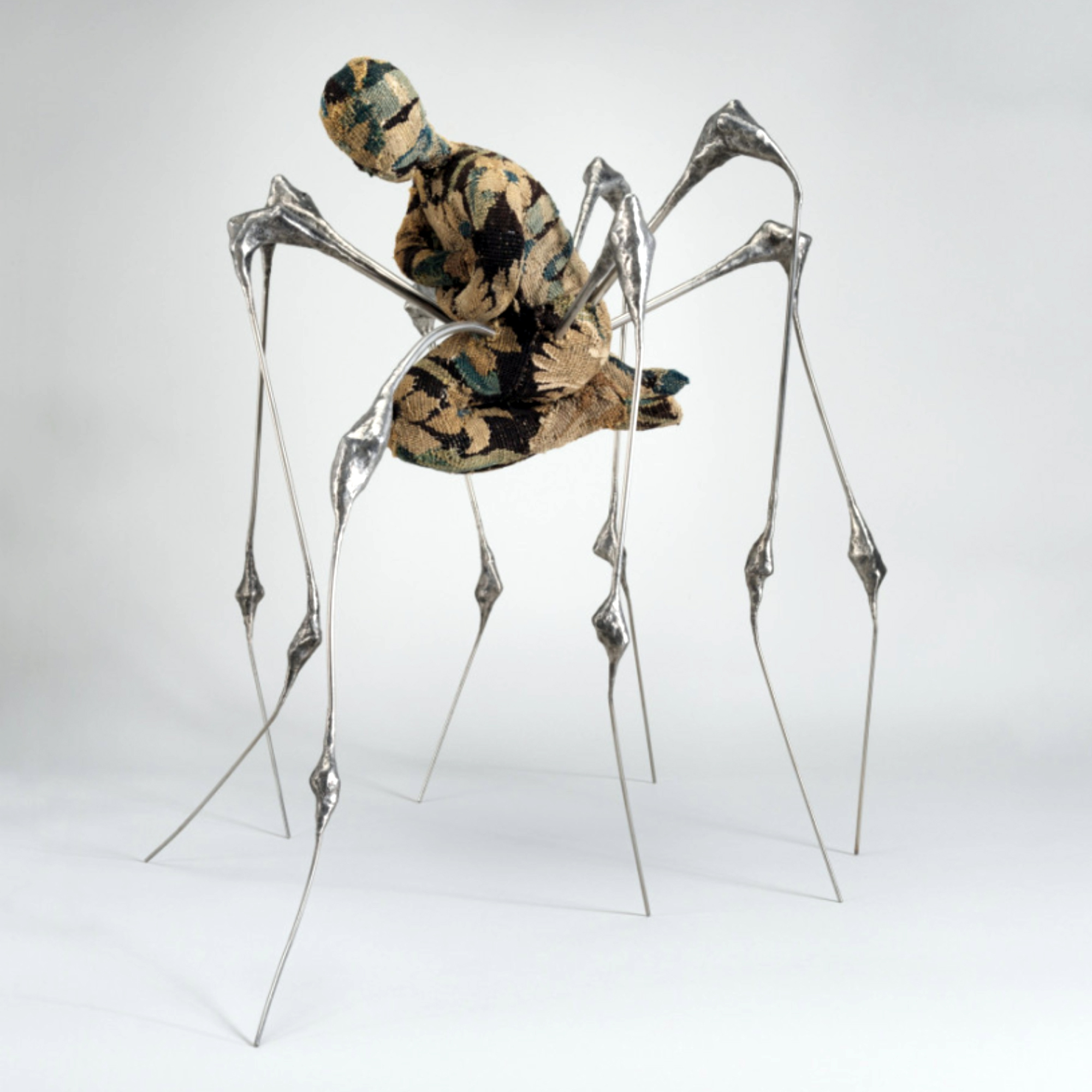
spider, 2003
stainless steel and tapestry, 59,7 × 71,1 × 63,5 cm
while the others are dancing,
martin eugen raabenstein’s
sensor spotlight focuses on:
© san francisco museum of modern art, photo christopher burke
in 2006, robert de niro directs the acclaimed cia film the good shepherd and develops within it a successful and ironically double-edged metaphor for the founding years of the organization. he takes the title from the gospel of john in the bible (john 10:11), where jesus says that he is the good shepherd who lays down his life for the sheep. the film embodies this idea on three levels. in the cia’s self-image, the protagonist edward wilson, played by matt damon, and the agency’s other founders see themselves as elite “shepherds” of american society. the ordinary citizen is an unsuspecting sheep that must be protected from the wolves — namely the soviet kgb, communism in general, and other global threats. entirely in keeping with the devotion of the good shepherd to his flock, wilson sacrifices his entire personal life, his marriage, his relationship with his son, his own soul, and his morality in order to protect the country. a biblical shepherd is a holy and pure figure, the work of the cia, however, consists of blackmail, betrayal, torture, murder, and manufactured paranoia. de niro uses the noble film title to expose the brutal and dirty reality of espionage. in order to protect the sheep, the shepherds themselves must become monsters. the concept of the good shepherd is then contrasted in the bible with its opposite. following the words of jesus, the text introduces the “hireling,” a paid servant who, as a bad shepherd, does not truly care for the animals. when the wolf comes to attack, he abandons the sheep and flees in order to save his own skin. warnings against prophets and kings who exploit the flock — and thus the people — rather than nourish them, can also be found throughout scripture.
the good shepherd reveals the blurred boundary between a good shepherd who protects the flock and a bad one who imprisons it or sacrifices it for his own military ambitions. in louise bourgeois’ world, the spider is the ultimate symbol of goodness and protection. de niro and bourgeois work according to exactly opposite principles. while de niro deconstructs the traditionally positive symbol of the shepherd and thereby exposes its darker side, bourgeois takes precisely the opposite path and removes the terror from the culturally feared and sinister symbol of the spider in order to reveal its loving core. for the artist, the eight-legged creature is a direct ode to her own mother, a weaver. the family runs a workshop for the restoration of historical tapestries, and her mother spends day after day at the loom, repairing tears and weaving in new threads. just like a spider, she is a weaver, and bourgeois sees in the spider’s web a healing and restorative force. instead of focusing on the deadly trap used to capture prey, the spider in bourgeois’ work builds, structures, and continually repairs its web as an ordering force against chaos. in stark contrast to bourgeois’ nurturing interpretation, her monumental giant spiders made of metal can nevertheless appear unsettling, intimidating, and monumental to the viewer. from time to time, true protection requires a frightening form. standing beneath bourgeois’ gigantic sculpture maman, one discovers a metal cage filled with marble eggs. here, the spider is the mother protecting her offspring, and the immense scale of the work represents not threat but invincible strength and larger-than-life maternal love.
to protect the eggs — or the flock — the spider, or the shepherd, must appear large and at times deadly. in bourgeois’ symbolism, however, unlike in de niro’s film, there is no evil spider. it remains consistently a positive and salvific principle. everything negative in bourgeois’ art — the treacherous, destructive, and chaotic — is associated with her father, who constantly endangers the family, while the mother serves as a counterweight, holding it together through iron patience and reason. edward wilson, burdened by the obligation to protect, gradually becomes emotionally hollow and paranoid, ultimately destroying his own family. bourgeois’ spider, by contrast, is unwavering and hard as metal, yet it uses this hardness solely to guard the eggs within its web. the spider as shepherd, retaining its moral integrity even when the world perceives it as a monster, simultaneously becomes a guarantee of the artist’s psychological well-being. she is fully aware of the simple fact that most people feel disgust or fear toward spiders. yet she has no desire to convert society or rehabilitate the spider’s image, and the analytical dimension of public perception is ultimately of little concern to her. according to the motto “art is a guarantee of sanity,” her art is strictly autobiographical and serves as a means of coping with deep-seated childhood trauma, this is about self-healing, not public education. although the spider in bourgeois’ work represents the good mother, she understands perfectly well that maternal love is not merely soft and comforting, and that motherhood can also embody something devouring, overwhelming, and dominant. within this profound psychological ambivalence, the spider is allowed to remain uncanny, and the maternal protective instinct it conveys resembles an unforgiving force of nature … and the cia? well, yes …
iir, june 2026
2006 inszeniert Robert De Niro den mehrfach ausgezeichneten CIA-Film The Good Shepherd und entwickelt darin eine gelungene und ironisch doppeldeutige Metapher über die Gründungsjahre dieser Organisation. Den Titel entnimmt er dem Johannes-Evangelium der Bibel (Johannes 10,11), in dem Jesus sagt, er sei der gute Hirte, der sein Leben für die Schafe lässt. Der Film versinnbildlicht dies auf drei Ebenen: In der Selbstsicht der CIA sehen sich die Hauptfigur Edward Wilson, gespielt von Matt Damon, und die anderen Gründer als elitäre „Hirten“ der amerikanischen Gesellschaft. Der Normalbürger ist ahnungsloses Schaf, das vor den Wölfen, sprich dem sowjetischen KGB, dem Kommunismus im Allgemeinen und anderen globalen Bedrohungen beschützt werden muss. Ganz im Sinne der Hingabe des guten Hirten für seine Herde opfert Wilson sein gesamtes persönliches Leben, seine Ehe, die Beziehung zu seinem Sohn, seine eigene Seele und seine Moral, um das Land zu schützen. Ein biblischer Hirte ist eine heilige und reine Figur – Die Arbeit der CIA allerdings setzt sich aus Erpressung, Verrat, Folter, Mord und inszenierter Paranoia zusammen, De Niro nutzt den hehren Filmtitel, um die brutale und schmutzige Spionagerealität aufzuzeigen. Um die Schafe zu schützen, müssen die Hirten selbst zu Monstern werden. Dem Begriff des guten Hirten wird in der Bibel sodann dessen Gegenteil gegenübergestellt. Nach dem Jesus-Zitat geht es dort um den „Mietling“, einen bezahlten Knecht, der sich als schlechter Hirte nicht wirklich um die Tiere kümmert. Kommt der Wolf, um zu reißen, lässt er die Schafe im Stich und flieht, um seine eigene Haut zu retten. Warnungen vor Propheten und Königen, die die Herde und damit das Volk ausbeuten, statt sie zu nähren, finden sich dort zudem allenortes.
The Good Shepherd zeigt die unscharfe Grenze zwischen einem guten, die Herde beschützenden Hirten und einem schlechten, der sie einsperrt oder für seine eigenen kriegerischen Interessen opfert. In Louise Bourgeois’ Welt ist die Spinne ultimatives Symbol für das Gute und Beschützende. De Niro und Bourgeois arbeiten mit exakt gegensätzlichen Prinzipien: Während De Niro das klassisch als gut konnotierte Symbol des Hirten dekonstruiert und so dessen dunkle Seite offenlegt, geht Bourgeois exakt den umgekehrten Weg und nimmt dem kulturell angstbesetzten und bösen Symbol der Spinne den Schrecken, um so deren liebevollen Kern zu enthüllen. Für die Künstlerin ist die Achtbeinerin eine direkte Ode an ihre eigene Mutter, eine Weberin. Die Familie betreibt eine Werkstatt für die Restaurierung historischer Wandteppiche, und die Mutter sitzt Tag für Tag am Webstuhl, um Risse zu flicken oder neue Fäden einzunähen. Genau wie eine Spinne ist sie eine Weberin, und Bourgeois sieht in einem Spinnennetz das Heilende, den reparierenden Moment. Anstatt die tödliche Beutefalle in den Fokus zu stellen, baut die Spinne im Werk der Künstlerin auf, strukturiert und repariert ihr Netz immer wieder als ordnende Kraft gegen das Chaos. Im krassen Kontrast zu Bourgeois‘ treusorgender Interpretation wirken deren monumentale Riesenspinnen aus Metall für den Betrachter durchaus erschütternd, furchteinflößend und monumental. Von Zeit zu Zeit erfordert guter Schutz eine furchteinflößende Gestalt. und steht man unter Bourgeois‘ gigantischer Skulptur Maman, erkennt man dort einen metallenen Käfig, gefüllt mit marmornen Eiern. Die Spinne ist hier die Mutter, die sich schützend über ihre Brut stellt, und die gigantische Größe der Arbeit repräsentiert nicht Bedrohung, sondern unbezwingbare Stärke und überlebensgroße mütterliche Liebe.
Um die Eier, oder die Herde, zu beschützen, muss die Spinne, oder der Hirte, groß und zuweilen tödlich wirken. In Bourgeois‘ Symbolik existiert im Gegensatz zu De Niros Film allerdings keine schlechte Spinne; diese verbleibt konstant als positives und rettendes Prinzip. Alles Schlechte in Bourgeois’ Kunst – das Verräterische, Zerstörerische und Chaotische – ordnet sie ihrem Vater zu, der die Familie konstant gefährdet, während die Mutter als Gegengewicht die Familie mit eiserner Geduld und Vernunft zusammenhält. Edward Wilson wird durch den Druck, beschützen zu müssen, über die Zeit innerlich hohl, paranoid und zerstört letztendlich seine eigene Familie. Die Spinne bei Louise Bourgeois hingegen ist unerschütterlich und metallhart, nutzt diese Härte jedoch ausschließlich, um die Eier in ihrem Netz zu behüten. Die Spinne als Hirte, die ihre moralische Integrität behält, selbst wenn die Welt sie für ein Monster hält, ist gleichzeitig Garant für die geistige Gesundheit der Künstlerin. Der simple Fakt, dass die meisten Menschen sich vor Spinnen ekeln oder fürchten, ist ihr durchaus bewusst. Sie will die Gesellschaft jedoch nicht bekehren oder das Image der Spinne rehabilitieren, und der analytische Aspekt ihrer Wahrnehmung ist ihr im Grunde egal. Nach dem Motto „Art is a Guarantee of Sanity“ ist ihre Kunst streng autobiografisch und dient der Bewältigung ihres tief sitzenden Kindheitstraumas – Hier geht es um Selbstheilung, nicht um Volksbildung. Und obwohl die Spinne bei Bourgeois die gute Mutter repräsentiert, weiß sie sehr wohl, dass Mutterliebe nicht nur weiches, kuscheliges darstellt und Mutterschaft ebenso etwas Verschlingendes, Übermächtiges und Dominantes repräsentiert. In dieser tiefen psychologischen Ambivalenz darf die Spinne ruhig unheimlich bleiben, und der so vermittelte mütterliche Beschützerinstinkt entspricht einer gnadenlosen Naturgewalt … Und die CIA? Ehm, ja …
iir, june 2026