
cady noland
towards a meta language of evil, 1987
essay
#23
the 23rd episode of your chair, your choice… is presented by the artist jonathan joosten. he recommends the essay towards a meta language of evil by the american artist cady noland, for … (argument is on it’s way)
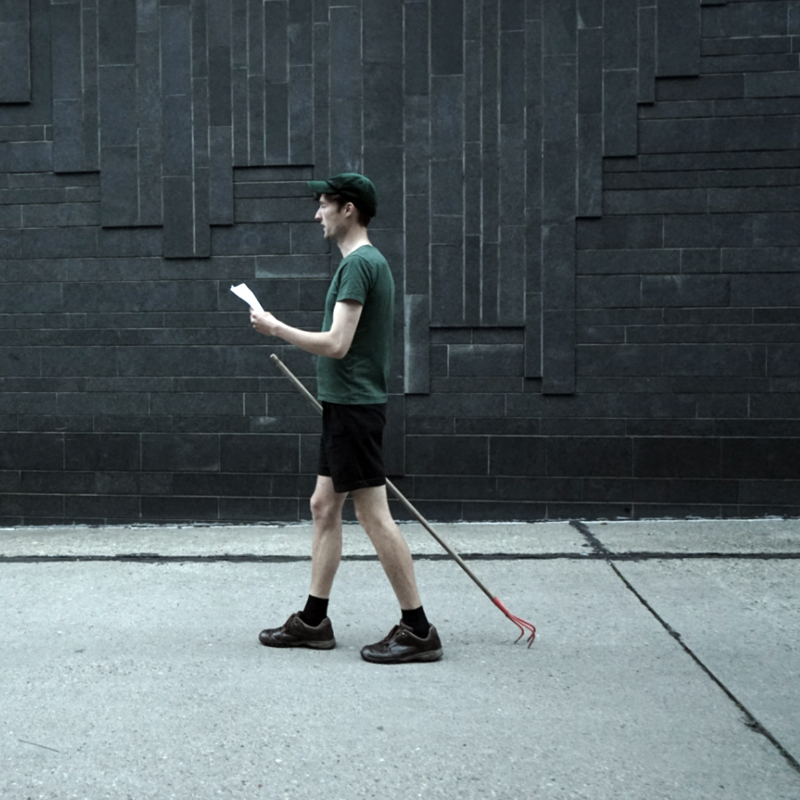
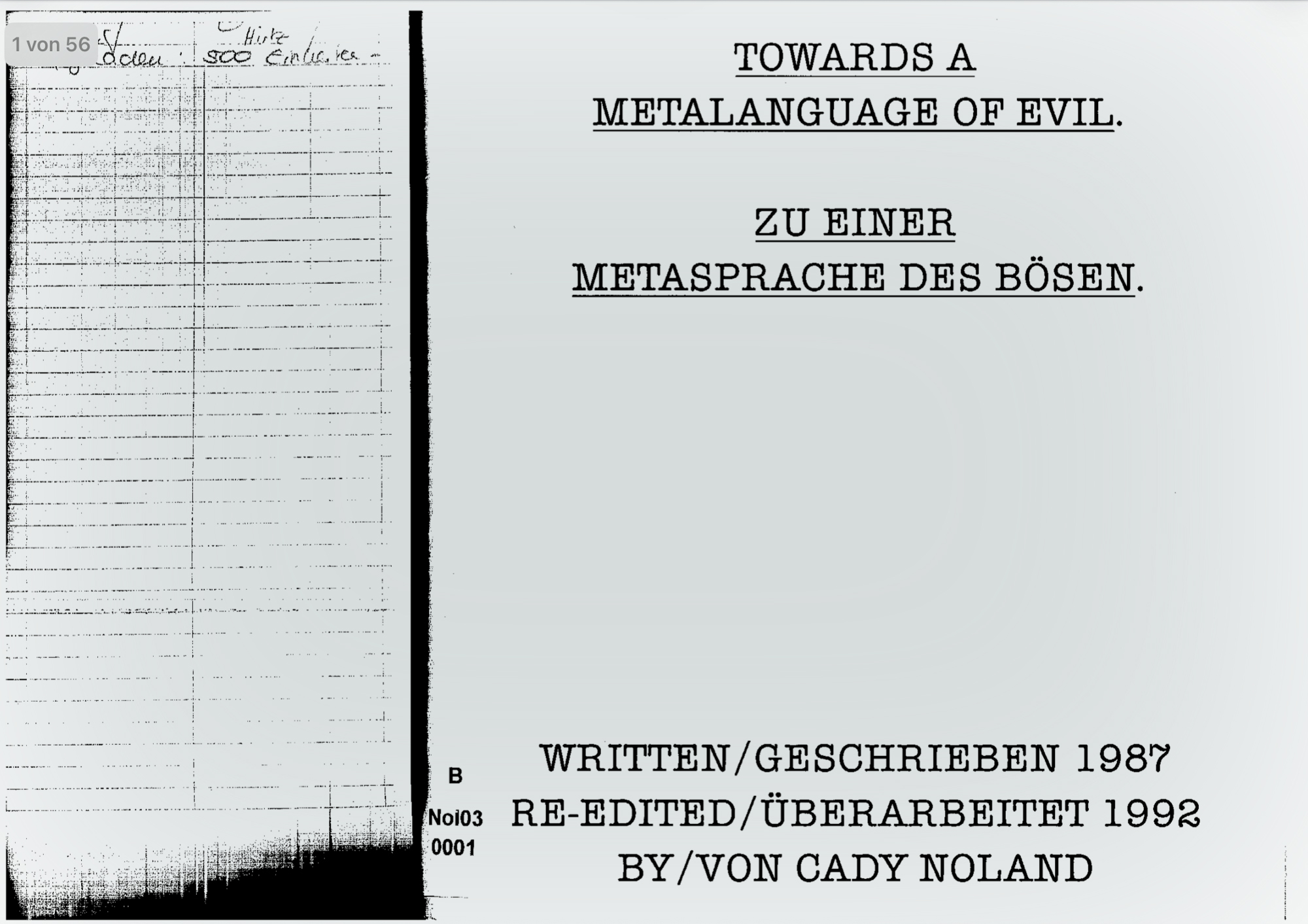
© cady noland
“in the mornings she writes cease-and-desist letters, in the afternoons she turns down the advances of the world’s major museums. conspiracy theories are cady noland’s lifeblood, refusal her modus operandi. difficult, withdrawn, idle and industrious, abandoned by her profession (for how long now?), yet still relentlessly committed. noland—we romanticize the mad widows of art—would probably be mad if she were not simply right. the world today—if one is foolish enough to lay down one’s survival armor, turn one’s gaze away from one’s navel, and look beyond one’s own bubble—can drive a person insane. unless, like the madman in the oval office … one is insane!” writes jack bankowsky in artforum about noland’s exhibition at the museum für moderne kunst frankfurt in 2018. for an artist who presents texts on her website such as “noland believes that the male psychopath is the ultimate example of americans’ tendency to manipulate and objectify one another,” exactly the right person occupies the chair of the american president in 2018, and once again today. although…? somehow none of this really fits together. if one asks who the fool is—the fool himself or the fool who follows the fool—we are already on the right track, because fundamentally we should not take noland seriously in any way whatsoever, let alone reflect upon her.
the artist who deploys the very social psychopathy strategies she investigates and criticizes against galleries, collectors, and the art system itself, and who tactically instrumentalizes withdrawal, license revocation, and refusal of control, embodies on the grand mat of the art market precisely those deficiencies she identifies as archetypically american patterns and denounces so tirelessly and vehemently. generally speaking, it is often one’s own faults that stand out most clearly in others, and thus the question can be asked quite directly whether noland’s apparently inflamed brain gives rise to her analyses, or whether the psychopathic society inspires her to imitate it. let us leave behind this classic chicken-and-egg discussion and refocus on our format. jonathan joosten proposes cady noland’s text towards a meta language of evil for his your chair, your choice edition, and we set out to explore the terrain. the three-part essay is originally presented as a lecture at an academic conference in atlanta in 1987, then published in balcony no. 4 in 1989, and finally revised and republished for documenta ix in 1992. in this text, noland examines a quasi-sociological anatomy of evil and identifies it as a fundamental and structural social characteristic. psychopathy is rooted in something profoundly american, according to the artist, and success is achieved through violence and manipulation.
she supports her thesis with a number of key concepts. by “the game” she means a covertly operating system of social tactics whose rules—and even the fact that the game exists at all—remain invisible to parts of the population. those who do not know the game are classified as naïve, provincial, or easy prey. the clinical psychopath is not the deviation here but merely the extreme case of a socially sanctioned pattern. the psychopath and the socially accepted entrepreneurial male differ mainly in terms of volume; the psychopath’s actions are simply “louder.” evil is therefore structured differently in degree, not in kind. with the “mirror device,” she develops a phenomenology of common manipulation techniques, drawing not from the relevant textbooks but from films by alfred hitchcock and michelangelo antonioni, using cinema as an ethnography of the game. in the documenta version she adds another aspect, and with the “bonsai effect” she describes how minorities are kept occupied through insoluble tasks: women through the obligation to be beautiful, black people through pressure to conform to white norms—trimmed and shaped according to external standards like a bonsai tree. for noland, “evil” is not monstrous but mechanical and banal. she writes not as a moralist but as an analyst. the text is simultaneously a key to her visual work and an independent political diagnosis. the text and noland’s artistic practice do not form a unity of theory and practice but rather exist in a relationship of tension. what is prepared as a game in the essay continues to meander through her sculptures, while noland’s personal behavior and relationship to the art world frame the dark scenery.
noland’s banal mechanics of evil are closely linked to hannah arendt’s theories on the subject, which the artist not only studies but also explicitly uses to ground her own thoughts. in 1963, hannah arendt coins the term “the banality of evil” in order to describe ss obersturmbannführer adolf eichmann during his trial in jerusalem not as a demon or a mentally ill monster, but as an alarmingly ordinary, career-oriented bureaucrat. evil is reduced in him to an organizational, mechanical, and thoughtless administrative act. noland also adopts directly from arendt’s descriptions of the mass murderer eichmann the concept of the mirror trick—the psychopath’s method of gaining deeper trust from victims by projecting a reassuring and entirely normal façade. noland transfers this mechanism by no longer seeing evil as a historical exception but rather as a foundation of the american dream itself, in which a ruthlessly conducted competition rewards pathological and manipulative traits. manipulation, appropriation, objectification, refusal—it takes a thief to catch a thief, as the saying goes, and somewhere a chicken is clucking once again …
iir, june 2026
„Vormittags schreibt sie Unterlassungserklärungen, nachmittags weist sie die Avancen der großen Museen der Welt zurück. Verschwörungstheorien sind Cady Nolands Lebenselixier, Verweigerung ihr Modus Operandi. Schwierig, zurückgezogen, müßig und fleißig, von ihrem Beruf im Stich gelassen (wie lange schon?), aber immer noch unerbittlich engagiert. Noland – wir verklären die verrückten Witwen der Kunst – wäre wohl verrückt, wenn sie nicht einfach recht hätte. Die Welt von heute – wenn man töricht genug ist, seine Überlebensrüstung abzulegen, den Blick vom Bauchnabel abzuwenden und aus seiner Blase herauszuschauen – kann einen in den Wahnsinn treiben. Es sei denn, man ist, wie der Verrückte im Oval Office … verrückt!“, schreibt Jack Bankowsky im Artforum über Nolands Ausstellung im Museum für Moderne Kunst Frankfurt, 2018. Für die Künstlerin, die Texte wie „Noland ist der Ansicht, dass der männliche Psychopath das ultimative Beispiel für die Tendenz der Amerikaner ist, einander zu manipulieren und zu objektivieren“ auf ihrer Webseite präsentiert, sitzt schon 2018 und so auch heute wieder genau der Richtige auf dem Stuhl des amerikanischen Präsidenten. Wobei…? Irgendwie passt das alles doch nicht so richtig zusammen. Wenn man sich fragt, wer der Narr sei, der Narr selbst oder der Narr, der dem Narren folgt, sind wir schon mal auf der richtigen Spur, denn im Grunde genommen dürfen wir Noland in keinster Weise ernst nehmen, geschweige denn reflektieren.
Die Künstlerin, die die von ihr untersuchten und entsprechend kritisierten gesellschaftlichen Psychopathiestrategien selbst gegen Galerien, Sammler und das Kunstsystem einsetzt und Rückzug, Lizenzentzug oder Kontrollverweigerung taktisch funktionalisiert, verkörpert hier auf der großen Matte des Kunstmarktes exakt jene von ihr als urtypisch amerikanische Muster benannten Mängel, die sie so unentwegt und vehement anprangert. Ganz allgemein gesprochen sind es gerade die eigenen Fehler, die einem bei anderen auffallen, und so lässt sich die Frage unumwunden stellen, ob Nolands offensichtlich entflammtes Hirn die Ursache für ihre Analysen bildet oder aber die psychopathische Gesellschaft dazu inspiriert, es ihr gleichzutun. Verlassen wir nun diese klassische Henne-Ei-Diskussion und refokussieren auf unser Format. Jonathan Joosten schlägt Cady Nolands Text „Towards a Meta Language of Evil“ für seine „Your Chair, Your Choice“-Ausgabe vor, und wir begeben uns zur Erkundung des Terrains. Der dreiteilige Essay ist ursprünglich ein Vortrag für eine akademische Konferenz in Atlanta im Jahr 1987, wird dann 1989 im Magazin Balcony No. 4 abgedruckt und schließlich 1992 für die Documenta IX neu überarbeitet herausgegeben. In diesem Text untersucht Noland eine quasi-soziologische Anatomie des Bösen und benennt diese als grundsätzliche und strukturelle gesellschaftliche Eigenschaft. Der Psychopathie liegt etwas zutiefst Amerikanisches zugrunde, so die Künstlerin, und Erfolg wird durch Gewalt und Manipulation errungen.
Sie untermauert ihre These mit verschiedenen Schlagwörtern. Mit „The Game“ meint sie ein verdeckt operierendes System sozialer Taktiken, dessen Regeln – und die Tatsache selbst, dass es dieses Spiel überhaupt gibt – für Teile der Bevölkerung unsichtbar bleiben. Wer es nicht kennt, wird als naiv, provinziell oder als leichte Beute eingestuft. Der klinische Psychopath ist hierbei nicht die Abweichung, sondern simpler Extremfall eines gesellschaftlich sanktionierten Musters. Psychopath und gesellschaftlich akzeptierter, unternehmerischer Mann unterscheiden sich hauptsächlich im Dezibelwert, die Handlungen des Psychopathen sind einfach „lauter“. Das Böse ist demnach graduell und nicht kategorial anders strukturiert. Mit dem „Mirror Device“ entwickelt sie sodann eine Phänomenologie gängiger Manipulationstechniken, die sie nicht entsprechenden Lehrbüchern entnimmt, sondern Filme von Alfred Hitchcock oder Michelangelo Antonioni heranzieht, um das Kino als Ethnographie des Spiels zu entlarven. In der Documenta-Ausgabe fügt sie einen weiteren Aspekt hinzu, und mit dem „Bonsai Effect“ beschreibt sie, wie Minderheiten durch unlösbare Aufgaben beschäftigt gehalten werden, Frauen durch die Pflicht zur Schönheit, Schwarze durch Anpassungsdruck an weiße Normen – einem Bonsai-Baum gleich, gestutzt und geformt nach fremden Maßstäben. Das „Böse“ ist bei Noland nicht monströse, sondern banale Mechanik. Noland schreibt nicht als Moralistin, sondern als Analytikerin, der Essay ist gleichzeitig Schlüssel zu ihrem bildnerischen Werk und eigenständige politische Diagnose. Text und Nolands künstlerisches Werk bilden keine Einheit aus Theorie und Praxis, sondern stehen eher in einem Spannungsverhältnis. Was im Essay als Spiel vorbereitet wird, mäandert in ihren Skulpturen fort, und Nolands persönliches Verhalten und Verhältnis zum Kunstbetrieb umrahmen die düstere Szenerie.
Nolands banale Mechanik des Bösen ist eng mit Hannah Arendts Theorien zum Thema verknüpft, die die Künstlerin nicht nur studiert, sondern auch konkret nutzt, um ihre eigene Theorie zu fundieren. Hannah Arendt prägt den Begriff der Banalität des Bösen 1963, um den SS-Obersturmbannführer Adolf Eichmann während dessen Prozesses in Jerusalem nicht als Dämon oder geisteskrankes Monster zu beschreiben, sondern diesen als erschreckend normalen, schlichtweg karriereorientierten Bürokraten darzustellen. Das Böse reduziert sich in ihm zu einem organisatorisch-mechanischen und gedankenlosen Verwaltungsakt. Auch das Konzept des Spiegel-Tricks, die Psychopathen-Methode, um das tiefere Vertrauen ihrer Opfer zu gewinnen, indem eine beruhigende, völlig normal erscheinende Fassade vorgespiegelt wird, übernimmt Noland direkt von Hannah Arendts Beschreibungen des Massenmörders Eichmann. Noland transferiert diese Mechanik, indem sie im Bösen keine historische Ausnahmeerscheinung mehr sieht, sondern das Fundament des American Dream selbst, in dem ein rücksichtslos geführter Wettbewerb pathologische und manipulative Züge belohnt. Manipulation, Aneignung, Objektifizierung, Verweigerung – es braucht einen Dieb, um einen Dieb zu fangen, so sagt man, und schon wieder gackert da irgendwo ein Huhn …
iir, june 2026
© cady noland