

charles simonds
dwelling, 1981
installation
while the others are dancing,
martin eugen raabenstein’s
sensor spotlight focuses on:
© charles simonds
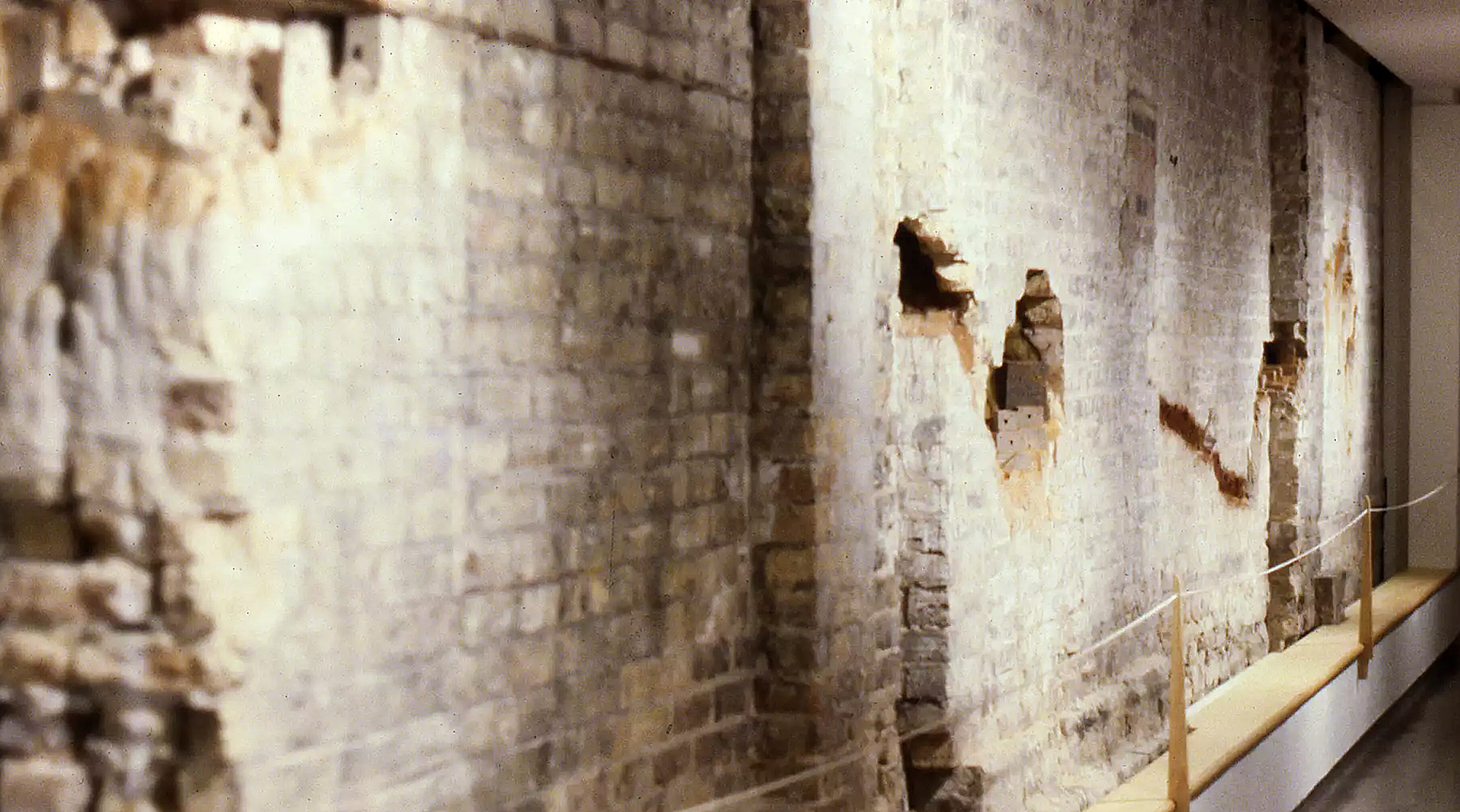
while some wrest a personal artistic handwriting from the signs and forms of the world, others choose the exact opposite path and assemble these ingredients in such a way that they seemingly point to a third thing that actually exists. this is what happens in the rooms of the chicago museum of contemporary art, behind whose historic masonry charles simonds not only makes the hearts of hardcore model railway aficionados beat faster. the artist’s first comprehensive exhibition in america presents an approximately thirteen-meter-long installation by the sculptor that winds through the bricks of the museum wall—including an old baking oven from the building’s early history—and shows the seemingly archaeologically uncovered dwellings of a fictitious little people. simonds’ central concept is reflected in the decaying and transient character of his miniature clay dwellings, whether he installs them in streets, in the entrances of houses in a city, or in the walls of a museum. the central theme is the transience of peoples, cultures, and urban development.
simonds’ fiction draws connections between a multitude of fantastic civilizations, whether contemporary or traditional, real or simply literary. formed from tiny clay bricks, simonds leaves his vision of a wandering people of miniature builders in all kinds of corners of new york’s lower east side, and it is the intriguing question of what causes the reduction in scale that leads us toward a possible interpretive clue. miniatures enforce a fundamentally different mode of reception: whoever looks at them has to come closer, bend down, focus their gaze. an asymmetrical constellation emerges; the human being towers over the work, a god in this world and its archaeologist at the same time, yet projection also enforces caution. in on longing (1984), susan stewart describes how the miniature format activates nostalgia and fantasies of control as a reduced, manageable, comprehensible, and imaginatively inhabitable world. the unfired clay further intensifies the situation: transience is not a metaphor here but an inbuilt program; the fragile street installations are trampled by passersby, weather away, or simply disappear as possible souvenirs quickly taken away.
by using the concepts of fiction and people, rather than individual or abstract civilization, simonds is able to represent history as an anonymous process. the people as a collective has no heroes and requires no architectural authorship within the depicted world—dwellings are the sediment of a community and not its individual achievements. simonds implicitly criticizes heroic architectural history, and by choosing fiction he keeps a direct comparison with real ethnic groups at a distance, although he cannot really prevent it. the textual reference in the catalogue to the philippine aeta or isolated brazilian groups demonstrates the actual dilemma—simonds operates with a primitivist reservoir of imagination and an archaic aura, yet at the same time seeks to protect himself from the accusation of direct instrumentalization through fictionalization. the question of whether his little-people concept ultimately corresponds to a neocolonial gaze in aesthetic disguise remains open—the civilized viewer, looking down from above onto tiny stone-age cultures, leaves behind a conceptual and irresolvable predetermined breaking point. in 1996 the chicago museum finds new premises; simonds’ multi-part installation is not moved along with it and is ultimately, unfortunately, destroyed with the demolition of the building in 2017.
iir, june 2026
Während die einen sich aus Zeichen und Formen der Welt eine eigene künstlerische Handschrift erstreiten, entscheiden sich andere für den exakt gegensätzlichen Weg und setzen diese Ingredienzen so zusammen, dass sie vermeintlich auf etwas real Existierendes, Drittes verweisen. So geschehen in den Räumen des Chicagoer Museums für Zeitgenössische Kunst, hinter dessen historischem Mauerwerk Charles Simonds nicht nur die Herzen von Hardcore-Modelleisenbahn-Aficionados höher schlagen lässt. Des Künstlers erste umfassende Ausstellung in Amerika präsentiert eine cirka dreizehn Meter lange Installation des Bildhauers, die sich durch die Ziegelsteine der Museumswand schlängelt – inklusive eines alten Backofens aus der Frühgeschichte des Gebäudes – und die scheinbar archäologisch freigelegten Behausungen eines fiktiven kleinen Volkes zeigt. Simonds’ Kernkonzept spiegelt sich im zerfallend vergänglichen Charakter seiner Miniatur-Lehmbehausungen, ob er diese auf den Straßen, den Hauseingängen einer Stadt oder in die Wände eines Museums einbaut. Zentrales Thema ist die Vergänglichkeit von Völkern, Kulturen und städtischer Entwicklung.
Simonds Fiktion zieht Verbindungen zwischen einer Vielzahl fantastischer Zivilisationen, ob nun zeitgenössisch oder traditionell, real oder einfach nur literarisch. Gebildet aus winzigen Lehmziegeln hinterlässt Simonds seine Vorstellung eines wandernden Volkes winziger Baumeister an allen möglichen Ecken New Yorks Lower East Side, und es ist die spannende Frage nach der Verkleinerungsursache seines Maßstabs, die uns auf eine mögliche interpretatorische Spur geleitet. Miniaturen erzwingen eine grundsätzlich andere Rezeptionshaltung: wer sie betrachtet, muss sich nähern, bücken, den Blick fokussieren. Eine asymmetrische Konstellation entsteht, der Mensch überragt das Werk, ein Gott in dieser Welt und ihr Archäologe zugleich, die Projektion erzwingt zugleich aber auch Vorsicht. Susan Stewart beschreibt 1984 in On Longing, wie das Miniaturformat Nostalgie und Kontrollphantasien aktiviert als verkleinerte, beherrschbare, überschaubare und imaginär bewohnbare Welt. Der ungebrannt eingesetzte Lehm verstärkt die Situation noch: Vergänglichkeit ist hier keine Metapher, sondern eingebautes Programm, die fragilen Straßeninstallationen werden von Passanten zertreten, verwittern oder verschwinden einfach als mögliches, rasch entwendetes Souvenir.
Indem Simonds die Begriffe Fiktion und Volk, und nicht Individuum oder abstrakte Zivilisation verwendet, kann er Geschichte als anonymen Prozess darstellen. Das Volk als Kollektiv hat keine Helden, benötigt keine Architektenautorschaft innerhalb der dargestellten Welt – Behausungen sind das Sediment einer Gemeinschaft und nicht deren Einzelleistungen. Simonds übt implizite Kritik an heroischer Architekturgeschichte, und indem er die Fiktion wählt, hält er einen direkten Vergleich mit realen ethnischen Gruppen auf Distanz, ohne ihn allerdings wirklich verhindern zu können. Der im Katalog enthaltene Textverweis auf die philippinischen Aeta oder isolierte brasilianische Gruppen führt das eigentliche Dilemma vor – Simonds operiert mit primitivistischem Imaginationsreservoir und archaischer Aura, will sich aber durch die Fiktionalisierung zugleich vor dem Vorwurf direkter Instrumentalisierung schützen. Die Frage, ob sein Little-People-Konzept nicht letztlich einem neokolonialen Blick in ästhetischer Verkleidung entspricht, bleibt offen – Der zivilisierte Betrachter, von oben auf winzige, steinzeitliche Kulturen herabschauend, hinterlässt eine gedankliche und unauflösliche Sollbruchstelle. 1996 findet das Chicagoer Museum neue Räumlichkeiten, die mehrteilige Installation Simonds’ wird hierbei nicht mit umgezogen und mit dem Gebäudeabriss 2017 schliesslich leider vernichtet.
iir, june 2026