

claes oldenburg
the store, 1961
a store
while the others are dancing,
martin eugen raabenstein’s
sensor spotlight focuses on:
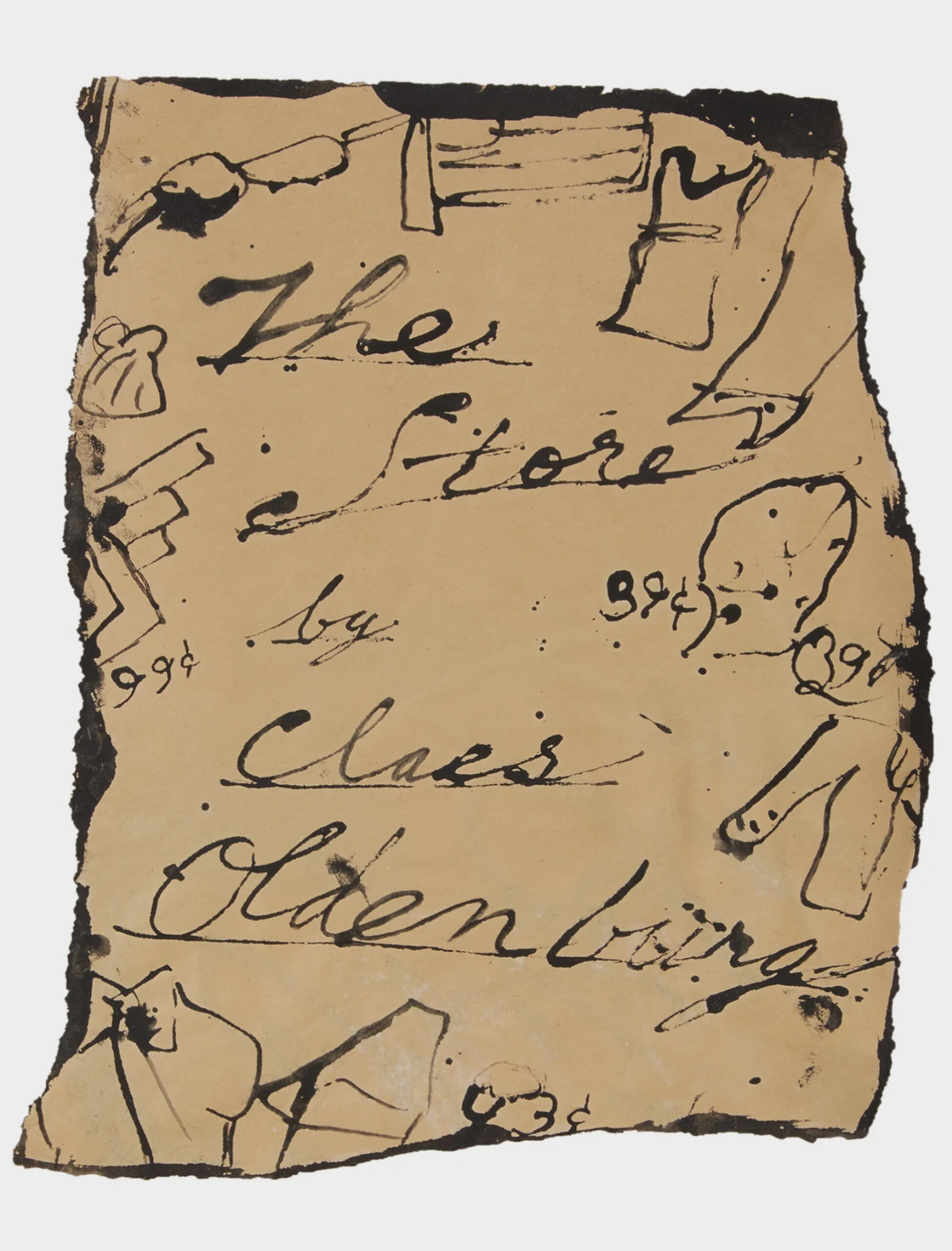
© claes oldenburg
„the goods in the stores: clothing, objects of all kinds, the boxes and packagings, signs and billboards – for all these radiant commercial goods in my immediate surroundings i have developed a great affection that has brought me to imitate them,“ says claes oldenburg in 1961, known for his large-scale sculptures. ice cream cones, saws, shuttlecocks, oldenburg pulls nearly every imaginable everyday object in a pop version into the gigantic, but it is the dealing with everyday objects in his early phase that forms the key to his entire following work. as a finely conceived and direct attack on the bourgeois conception of sublime art, he rents a shop in new york’s lower east side in the winter of 1961 and calls it simply the store, in order to dissect the consumer culture of his time. the room at 107 east 2nd street is circa 24 meters long, three meters wide, and the artist invents lovingly caressing variations of the naming. the store, my store or the ray gun mfg. co. is divided into two parts, the front half houses the sales area, while he uses the back part as a studio to continuously reproduce objects. oldenburg molds muslin cloth panels soaked in plaster over wire frames and paints the rough surfaces with colorful enamel paints. whether coarse, common or simply expressionistic, the artist imitates no flawless realism, shows himself sensuous and processes, splatters or splatters the uneven surfaces with tempera paint or commercial enamel. oldenburg’s interest in the exploration of temporary commodity aesthetics seems immeasurable, pieces of clothing hang on the walls, cakes, tarts wait in showcases here, burgers, pieces of meat next to deformed coffee cups and crushed beverage cans there. the immediate center is formed by a cash register in a still recognizable form, but likewise artistically treated.
the sculptor is business-minded, the relief of a crumpled belt he offers for 249.95 dollars, that corresponds to circa 2800 dollars today. a big sandwich exists for 149.98 dollars; a price tag 9.99 hanging in the shop window costs a bold 399.95 dollars. the pricing as an object itself, oldenburg plays his commodity aesthetics briskly through with this article too. the store is the second part of a project and successor of the immersive installation the street carried out in 1960, on the occasion of which oldenburg depicts his immediately surrounding neighborhood, the lower east side, with collected materials such as cardboard, newspaper and black poster paint. everything flows into the scenery, a program of the common is supposed to emerge, filled with neighbors, beggars, street signs and manhole covers. oldenburg begins to rhapsodize and emphasizes: „it is entirely right to emphasize the vulgar when it has been neglected, when art has become too lyrical — by vulgar i mean proletarian, commonplace, tasteless, but also instinctive, life-affirming.“ the street is presented in a preliminary version for the first time in november 1959 in the judson gallery, hand-typed notes pinned to a bulletin board announce the artist’s preferences in the real world – the city, the poor and the wretched – and then presented completely as one half of the ray gun show with jim dine. opened in january 1960 in the judson gallery, this serves at the same time as a stage for oldenburg’s first performance, snapshots from the city. coarsely and graffiti-like applied on cardboard or burlap, torn and shredded, hanging from the ceiling or leaned against gallery walls. everything testifies to poverty, decay and a skull is there too – oldenburg states regarding this: „the street is death“.
the street draws its impulses from the street and the people acting on it, the store shifts the view and directs itself to what else is to be seen. „it is as if one looks at the pavement and then raises the eyes and sees the stores.“ the street is gray, black and dirt, the store on the other hand indulges in colorful sweetness. a preliminary version of the installation is shown by the martha jackson gallery in 1961, oldenburg operates simultaneously inside and outside of the institutional framework and moreover eagerly documents in his diaries everything that he consumes, as a conceptual parallel gesture to the object production. sandwich, coffee and beer, the artist’s body itself is observed as a further unit in the commodity circulation. oldenburg continues to produce plaster store objects until 1963, then he switches to precision and industrial surface. paper, canvas, plaster and chicken wire are replaced by vinyl, formica and plexiglas. the giant blt is his first vinyl sculpture, cleanly sewn by patty mucha, richard artschwager delivers the wooden bacon slices as well as the giant toothpick and this multi-part construction differs fundamentally from its sculptural predecessors. the following mental step after this soft sandwich with bacon, lettuce and tomato occurs likewise in 1963, and with the bedroom ensemble in the sidney janis gallery a completely furnished motel bedroom is presented, likewise a total installation, but with completely different means than the store. in 1965 oldenburg begins a series of drawings that designs everyday objects as giant public sculptures in cities, the proposed colossal monuments. in the sequence street, store, performance prop, soft sculpture, urban monument he explores the scaling of the relationship between subject, object and context. and yes, a giant blt, we would also like to have now.
iir, june 2026
„Die Waren in den Läden: Kleidung, Gegenstände aller Art, die Schachteln und Verpackungen, Schilder und Werbetafeln – für all diese strahlenden Handelswaren in meiner unmittelbaren Umgebung habe ich eine große Zuneigung entwickelt, die mich dazu gebracht hat, sie nachzuahmen“, sagt Claes Oldenburg 1961, bekannt für seine Large-Scale-Skulpturen. Eiskremtüten, Sägen, Federbälle, Oldenburg zieht nahezu jeden erdenklichen Alltagsgegenstand in einer Pop-Version ins Gigantische, aber es ist der Umgang mit Alltagsgegenständen in seiner Frühphase, der den Schlüssel zu seinem gesamten folgenden Werk bildet. Als fein ausgedachte und direkte Attacke auf die bürgerliche Vorstellung erhabener Kunst mietet er im Winter 1961 ein Ladengeschäft in der New Yorker Lower East Side und nennt es schlicht The Store, um so die Konsumkultur seiner Zeit zu sezieren. Der Raum in der 107 East 2nd Street ist circa 24 Meter lang, drei Meter breit, und der Künstler erdsinnt liebevoll kosende Variationen der Benennung. The Store, My Store oder The Ray Gun Mfg. Co. ist zweigeteilt, die vordere Hälfte beherbergt den Verkaufsbereich, während er den hinteren Teil als Atelier nutzt, um laufend Objekte nachzuproduzieren. Oldenburg formt in Gips getränkte Musselin-Stoffbahnen über Drahtgestelle und bemalt die rauen Oberflächen mit bunten Lackfarben. Ob grob, gewöhnlich oder einfach nur expressionistisch, der Künstler imitiert keinen makellosen Realismus, gibt sich sinnlich und bearbeitet, bespritzt oder bekleckert die unebenen Oberflächen mit Temperafarbe oder handelsüblichem Email. Oldenburgs Interesse an der Erforschung temporärer Warenästhetik scheint unermesslich, Kleidungsstücke hängen an den Wänden, Kuchen, Torten warten in Vitrinen hier, Burger, Fleischstücke neben deformierten Kaffeetassen und zerquetschten Getränkedosen dort. Das unmittelbare Zentrum bildet eine Registrierkasse in noch erkennbarer Form, aber ebenfalls künstlerisch behandelt.
Der Bildhauer ist geschäftstüchtig, das Relief eines zerknautschten Gürtels bietet er für 249,95 Dollar an, das entspricht circa 2800 Dollar heute. Ein Big Sandwich gibt es für 149,98 Dollar; ein im Schaufenster hängendes Preisschild 9.99 kostet mutige 399,95 Dollar. Die Auspreisung als Objekt selbst, Oldenburg spielt auch mit diesem Artikel seine Warenästhetik munter durch. The Store ist der zweite Teil eines Projektes und Nachfolger der 1960 durchgeführten, immersiven Installation The Street, anlässlich derer Oldenburg sein ihn unmittelbar umgebendes Viertel, die Lower East Side, mit gesammelten Materialien wie Karton, Zeitungspapier und schwarzer Plakatfarbe abbildet. Alles fließt in die Szenerie ein, ein Programm des Einfachen soll entstehen, angefüllt mit Nachbarn, Bettlern, Straßenschildern und Kanaldeckeln. Oldenburg kommt ins Schwärmen und betont: „Es ist durchaus richtig, das Gewöhnliche zu betonen, wenn es vernachlässigt wurde, wenn Kunst zu lyrisch geworden ist — mit gewöhnlich meine ich proletarisch, gewöhnlich, geschmacklos, aber auch instinktiv, lebensbejahend.“ The Street wird in einer Vorversion erstmals im November 1959 in der Judson Gallery präsentiert, handgetippte, an eine Pinnwand geheftete Notizen verkünden des Künstlers Vorlieben in der realen Welt – die Stadt, die Armen und die Elenden – und dann vollständig als eine Hälfte der Ray Gun Show mit Jim Dine präsentiert. Eröffnet im Januar 1960 in der Judson Gallery, dient diese zugleich als Bühne für Oldenburgs erste Performance, Snapshots from the City. Grob und graffitiartig auf Karton oder Jute angebracht, angerissen und zerfetzt, von der Decke hängend oder gegen Galeriewände gelehnt. Alles zeugt von Armut, Verfall und ein Totenschädel ist auch dabei – Oldenburg konstatiert hierzu: „the street is death“.
The Street bezieht seine Impulse aus der Straße und den darauf agierenden Menschen, The Storeverschiebt den Blick und richtet sich auf das, was sonst noch zu sehen ist. „Es ist, als würde man auf den Bürgersteig schauen und dann die Augen heben und die Läden sehen.“ The Street ist grau, schwarz und Dreck, The Store hingegen ergeht sich in farbenfroher Süßigkeit. Eine Vorversion der Installation zeigt die Martha Jackson Gallery 1961, Oldenburg operiert gleichzeitig im und außerhalb des institutionellen Rahmens und dokumentiert in seinen Tagebüchern zudem eifrig alles, was er konsumiert, als konzeptuelle Parallelgeste zur Objektproduktion. Sandwich, Kaffee und Bier, der Künstlerkörper selbst wird als weitere Einheit im Warenkreislauf observiert. Oldenburg stellt bis 1963 weiterhin Gips-Store-Objekte her, dann wechselt er zu Präzision und industrieller Oberfläche. Papier, Leinwand, Gips und Hühnerdraht werden durch Vinyl, Formica und Plexiglas ersetzt. Das Giant BLT ist seine erste Vinyl-Skulptur, von Patty Mucha sauber venäht, Richard Artschwager liefert die hölzernen Speckscheiben sowie den riesigen Zahnstocher und diese mehrteilige Konstruktion unterscheidet sich grundlegend von ihren skulpturalen Vorgängern. Der folgende gedankliche Schritt nach diesem weichen Sandwich mit Speck, Salat und Tomaten, erfolgt ebenfalls 1963, und mit dem Bedroom Ensemblein der Sidney Janis Gallery wird ein vollständig eingerichtetes Motelschlafzimmer vorgestellt, gleichfalls eine Gesamtinstallation, aber mit vollständig anderen Mitteln als The Store. 1965 beginnt Oldenburg eine Zeichnungsserie, die alltägliche Objekte als riesige öffentliche Skulpturen in Städten entwirft, die Proposed Colossal Monuments. In der Abfolge Straße, Laden, Performance-Requisit, Soft Sculpture, urbanes Monument erkundet er die Skalierung der Beziehung zwischen Subjekt, Objekt und Kontext. Und ja, einen Giant BLT, hätten wir jetzt auch gerne.
iir, june 2026
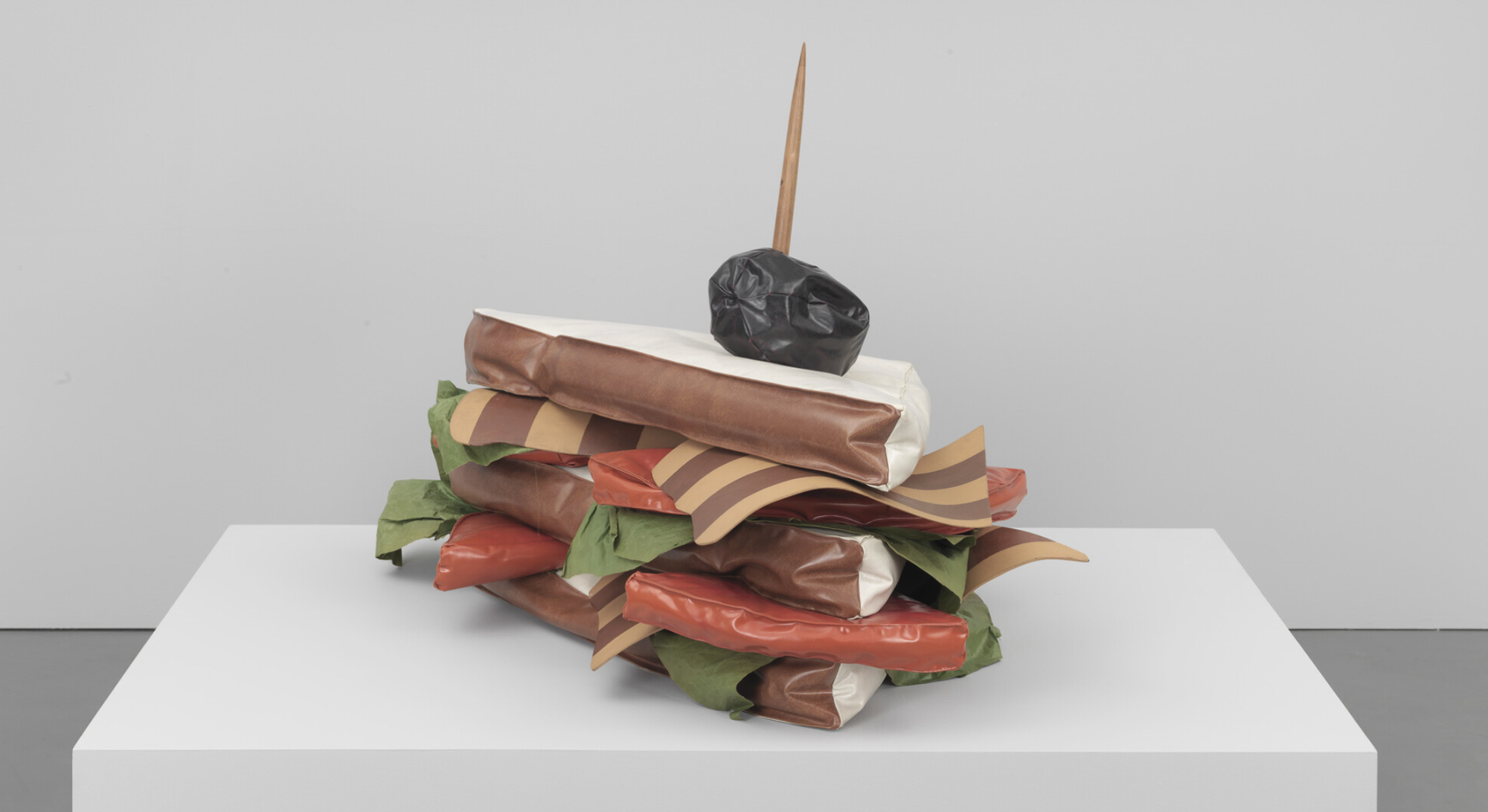
© claes oldenburg, giant blt, vinyl, kapok, painted and untreated wood, 81,3 x 99,1 x 73,7 cm, 1963
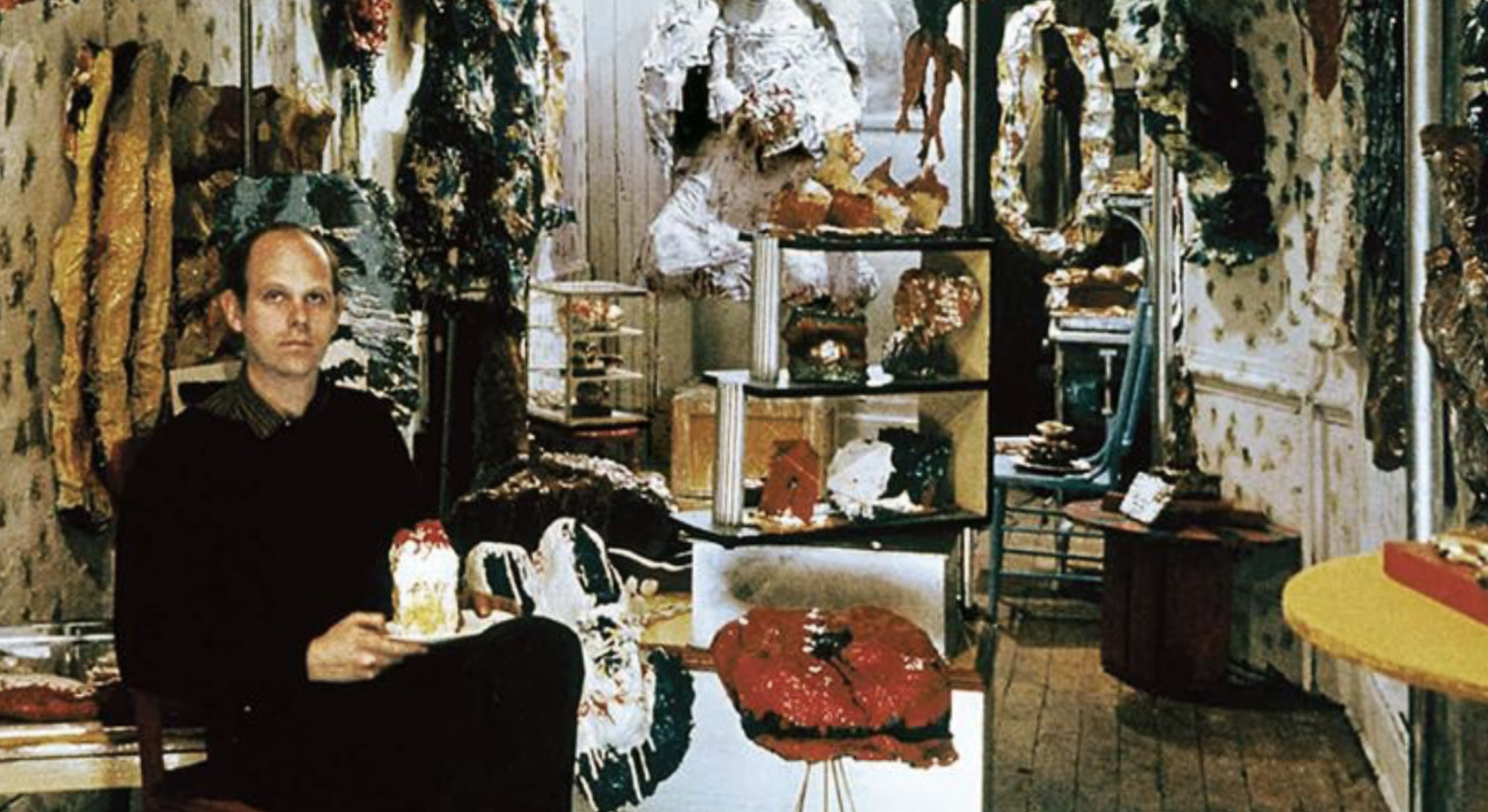
© claes oldenburg, the store, 1961