

john stezaker
mask cxlvi, 2009
collage, 25,4 x 20,32 cm
while the others are dancing,
martin eugen raabenstein’s
sensor spotlight focuses on:
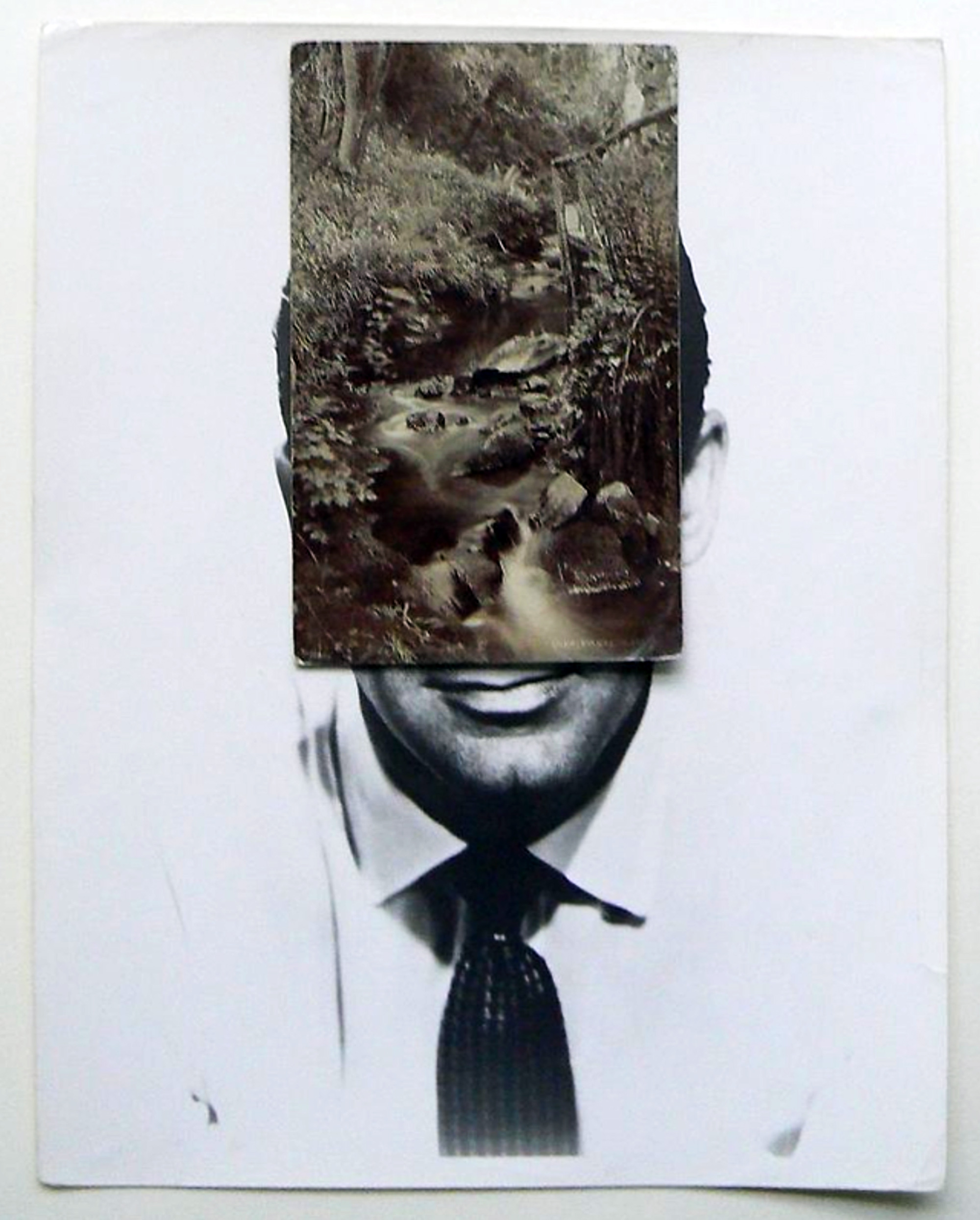
© john stezaker
the situationists, above all guy debord, not only anticipate poststructuralism in many respects, but form the intellectual foundation on which thinkers like jean baudrillard, gilles deleuze or michel foucault will later build. in 1967 he writes in the society of the spectacle: “everything that was directly lived has escaped into a representation.” and argues that capitalism has developed so far that not only commodities are consumed, but likewise the image of the commodity. jean baudrillard will later radicalize this in his theory of hyperreality and simulacra. while debord still laments the alienation of real life through images, baudrillard takes the next step and postulates that there is no longer any “real” at all, behind the image lies only emptiness. corresponding to the situationist analysis of everyday life, modern man is no longer an autonomous being, but a prisoner of the spectacle, which speaks through us and at the same time sees our desires, longings and identities as already medially preformulated. the situationists take existing images from standardized mass media such as comics, advertising posters or hollywood stills and add new, often subversive elements or texts to them, in order to turn their inherent image ideology against itself. poststructuralist textual analysis proceeds similarly, by exposing the internal contradictions of an existing text or image as well as its ruptures and hidden power structures.
the radical difference however lies in the temperament of the situationists who, marxists of the late revolutionary persuasion at their core, still firmly believe that the spectacle can be broken through and alienation overcome in order to return to an “authentic, unalienated life”, for example through the establishment of self-managed “situations” in urban space. the failed unrest of may 1968 relativizes these utopian hopes, the poststructuralists see no “outside” of power and no innocent place beyond the sign system they had already sketched out earlier. here the circle closes with john stezaker, who in the 1970s takes his leave of contemporarily situationistically treated media images in order to turn to walter benjamin and maurice blanchot. in his writings on the arcades project benjamin describes that an ageing image, detached from its context, loses its original purpose, but at the same time gains a new, almost ghostly depth – and becomes a dialectical image in which past and present face each other. for maurice blanchot the image is not a depiction of a thing, but its absence, a trace of something that no longer exists in that way.
stezaker finds precisely here the literary inspiration to let himself fall into the pure fascination and transience of the image. a single and precise cut is sufficient to arrange the landscape motif of a postcard perfectly over the face of an actor, sometimes even this act is not required and a pure rearrangement suffices to free the images from their respective temporal reference. this is neither nostalgia nor kitsch, but a tool, since we no longer know the corresponding actors and their films have fallen into oblivion. their likenesses become universal archetypes, as a psychological-visual examination of pictorial material that can seduce, age and at the same time conceal. in an art cosmos that strictly demands being contemporary, the deliberate retreat into the past counts as a transgression. joseph cornell confirms the seeker with his surreal glass boxes, the box assemblages, in which nostalgic found objects, old photographs and astronomical charts are accumulated. these prove to stezaker that the present can very well be escaped in order to explore one’s own, rather nostalgic universe, without simultaneously losing artistic relevance.
iir, june 2026
Die Situationisten, allen voran Guy Debord, nehmen den Poststrukturalismus in vielerlei Hinsicht nicht nur vorweg, sondern formen das intellektuelle Fundament, auf dem Denker wie Jean Baudrillard, Gilles Deleuze oder Michel Foucault später aufbauen werden. 1967 schreibt er in Die Gesellschaft des Spektakels: „Alles, was direkt gelebt wurde, ist in eine Vorstellung entwichen.” und argumentiert, dass der Kapitalismus sich so weit entwickelt hat, dass nicht mehr nur Waren konsumiert, sondern gleichfalls das Bild der Ware. Jean Baudrillard wird das später in seiner Theorie der Hyperrealität und der Simulakren radikalisieren. Während Debord noch die Entfremdung des echten Lebens durch Bilder beklagt, vollzieht Baudrillard den nächsten Schritt und postuliert, dass es überhaupt kein „Echtes” mehr gäbe, hinter dem Bild läge nur die Leere. Entsprechend der situationistischen Analyse des Alltagslebens ist der moderne Mensch kein autonomes Wesen mehr, sondern Gefangener des Spektakels, das durch uns spreche und zugleich unsere Wünsche, Sehnsüchte und Identitäten medial bereits vorformuliert seien. Die Situationisten entnehmen bestehende Bilder aus standardisierten Massenmedien wie Comics, Werbeplakaten oder Hollywood-Stills und fügen ihnen neue, oft subversive Elemente oder Texte hinzu, um deren inhärente Bildideologie gegen sie selbst zu wenden. Die poststrukturalistische Textanalyse verfährt ähnlich, indem sie die inneren Widersprüche eines bestehenden Textes oder Bildes sowie dessen Brüche und verborgenen Machtstrukturen freilegt.
Der radikale Unterschied allerdings besteht im Temperament der Situationisten, die, im Kern revolutionäre Spätmarxisten, noch fest daran glauben, dass das Spektakel durchbrochen und die Entfremdung aufgehoben werden kann, um solcherart zu einem „authentischen, unentfremdeten Leben” zurückzukehren, zum Beispiel durch die Errichtung selbstverwalteter „Situationen” im urbanen Raum. Die gescheiterten Unruhen im Mai 1968 relativieren diese utopischen Hoffnungen, die Poststrukturalisten sehen kein „Außerhalb” der Macht und keinen unschuldigen Ort jenseits des von ihnen aber auch schon früher anskizzierten Zeichensystems. Hier schließt sich der Kreis zu John Stezaker, der sich in den 1970er-Jahren von zeitgenössisch situationistisch behandelten Medienbildern verabschiedet, um sich Walter Benjamin und Maurice Blanchot zuzuwenden. In seinen Schriften zum Passagen-Werk beschreibt Benjamin, dass ein alterndes, aus seinem Kontext herausgelöstes Bild zwar seinen ursprünglichen Zweck verliere, aber zugleich eine neue, fast geisterhafte Tiefe gewinne – und es zu einem dialektischen Bild mache, in dem Vergangenheit und Gegenwart gegenüberstehen. Für Maurice Blanchot ist das Bild kein Abbild einer Sache, sondern deren Abwesenheit, eine Spur von etwas, das so nicht mehr existiert.
Stezaker findet genau hier die literarische Inspiration, sich in die pure Faszination und Vergänglichkeit des Bildes hineinfallen zu lassen. Ein einziger und präziser Schnitt ist ausreichend, um das Landschaftsmotiv einer Postkarte perfekt über dem Gesicht eines Schauspielers zu arrangieren, manchmal benötigt es selbst dieses Aktes nicht und eine reine Neuarrangierung genügt, um die Bilder von ihrem jeweiligen Zeitbezug zu befreien. Das ist weder Nostalgie noch Kitsch, sondern ein Werkzeug, da wir die entsprechenden Akteure nicht mehr kennen und die Filme in Vergessenheit geraten sind. Deren Abbilder geraten zu universellen Archetypen, als psychologisch-visuelle Untersuchung von Bildmaterial, das verführen, altern und zugleich verbergen kann. In einem strikt zeitgenössisch zu sein fordernden Kunstkosmos gilt der bewusste Rückzug in die Vergangenheit als Tabubruch. Joseph Cornells bestätigt den Suchenden mit seinen surrealen Glaskästen, den Box-Assemblagen, in denen nostalgische Fundstücke, alte Fotos und astronomische Karten angesammelt sind. Diese beweisen Stezaker, dass der Gegenwart sehr wohl entflohen werden kann, um so ein eigenes, eher nostalgisches Universum zu ergründen, ohne gleichzeitig an künstlerischer Relevanz zu verlieren.
iir, june 2026