

jannis kounellis
untitled (12 cavalli), 1969
12 horses
while the others are dancing,
martin eugen raabenstein’s
sensor spotlight focuses on:
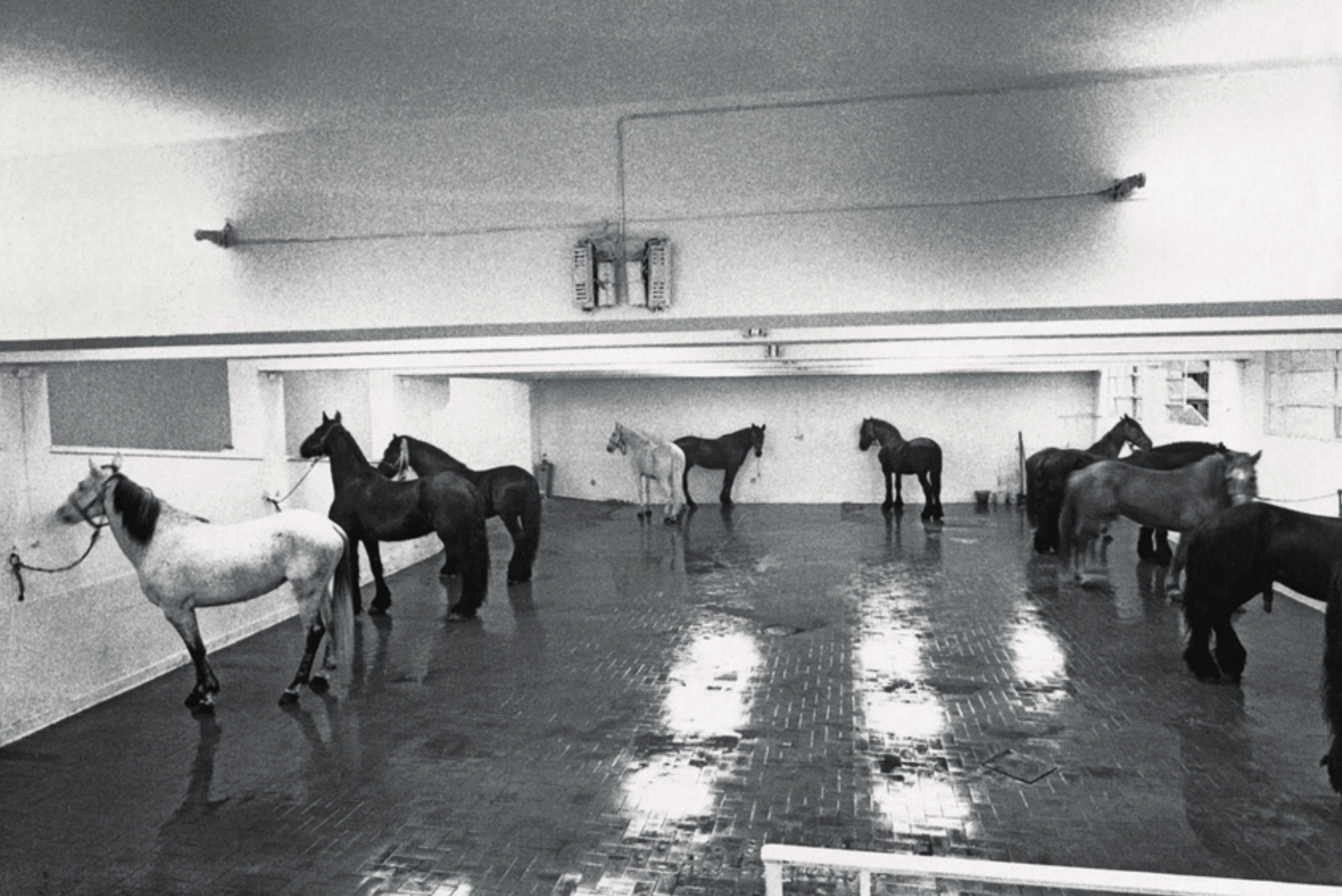
© claudio abate & jannis kounellis
jannis kounellis wants to replace painting with real life, without losing the respect for structure and the pathos of classical art history, and so he ties twelve horses to the new walls of the galleria l’attico in rome, a former garage space and car dealership. founded by fabio sargentini, its premises form a central pivot point for the arte povera artists, and kounellis uses the raw character of the repurposed architecture to stage the radical approach of his work as the breaking-in of living nature into the everyday of an art space. his own statements use terms like reality, the tradition of painting, or theater, and he sees the horses not as provocation or even happening, but as a deeply formal, classical statement. the artist emphasizes that the horse is one of the oldest and most heavily charged motifs in art history: “the horse is a historical element. it is no coincidence that it appears in the gallery. for me it has a deeper meaning, connected to the idea of history.”
no equestrian statue, no monumental painting, or the usual modern abstractions on canvas form a metaphor against illusion, but rather the direct three-dimensional reality of living four-legged animals. arte povera forms for kounellis a way to smash the bourgeois picture-frame illusion, and so he shows not its image but the unpredictable horse itself – its smell, its warmth, and its breath. he very much likes to use the gallery space as a stage, he often calls exhibitions teatro, in which objects or indeed animals act like actors, activating the space. twelve horses on the walls of a former car dealership transform the fundamentally sterile gallery architecture into a living, sacred scene, as a construction of space through presence. this uncompromising shift of parameters ensures that the exhibition is still regarded today as one of the absolute key moments of 20th-century art and burns itself deeply into collective memory as an iconic gesture. the contemporary press reacts with a mixture of shock and fascination, above all to the smell.
disbelieving astonishment gives way to sensory overload, and in the midst of this intellectual tension roman critics and the international art press stand before a situation that escapes the classical categories of art criticism entirely, simply through physical intensity. one does not enter a gallery but a stable, the biting smell of horse manure, urine, and hay, the snorting of the animals, and the dull clopping of hooves on the garage floor allow for no distance and the critics grasp the difference between viewing a mere picture and participating in a living, breathing mass. the subversive character and the art-market critique it contains are also quickly recognized. the press comments, partly amused, partly alarmed, that a work has been created here that one can neither buy, nor collect, nor take home, and that exists only in the here and now, in this garage. the photographic documentation by photographer claudio abate, with its masterfully captured black-and-white image symmetry, the cool light of the neon tubes, and the archaic presence of the animals, becomes an autonomous artwork in itself and embodies, as rarely any other photo does, the spirit of the avant-garde of these extremely vivid years.
iir, june 2026
Jannis Kounellis will die Malerei durch das reale Leben ersetzen, ohne dabei den Respekt vor der Struktur und dem Pathos der klassischen Kunstgeschichte zu verlieren, und so bindet er in der Galleria L’Attico in Rom zwölf Pferde an die neuen Wände der Galleria L’Attico in Rom, einem ehemaligen Garagenraum und Autohaus. Gegründet von Fabio Sargentini, bilden deren Räumlichkeiten einen zentralen Dreh- und Angelpunkt der Arte-Povera-Künstler, und Kounellis nutzt den rauen Charakter der umgenutzten Architektur, um so den radikalen Ansatz seiner Arbeit als das Hereinbrechen lebendiger Natur in den Alltag eines Kunstraums perfekt zu inszenieren. Seine eigenen Aussagen nutzen Begriffe wie Realität, Tradition der Malerei oder Theater, und er sieht die Pferde nicht als Provokation oder gar Happening, sondern als zutiefst formales, klassisches Statement. Der Künstler betont, dass das Pferd eines der ältesten und am stärksten aufgeladenen Motive der Kunstgeschichte sei: „Das Pferd ist ein historisches Element. Es ist kein Zufall, dass es in der Galerie auftaucht. Für mich hat es eine tiefere Bedeutung, die mit der Idee der Geschichte verbunden ist.“
Kein Reiterstandbild, kein monumentales Gemälde oder die üblichen modernen Abstraktionen auf Leinwand bilden eine Metapher gegen die Illusion, sondern die direkte dreidimensionale Realität lebendiger Vierbeiner. Arte Povera bildet für Kounellis einen Weg, die bürgerliche Bilderrahmen-Illusion zu zertrümmern, und so zeigt er nicht dessen Abbild, sondern das unberechenbare Pferd selbst – seinen Geruch, seine Wärme und seinen Atem. Den Galerie-Raum nutzt er sehr gerne als Bühne, Ausstellungen nennt er oft Teatro, in dem Objekte oder eben Tiere wie Schauspieler den Raum aktivierend agieren. Zwölf Pferde an den Wänden eines ehemaligen Autohauses transformieren die grundsätzlich sterile Galerie-Architektur in ein lebendig sakrales Szenenbild, als Konstruktion von Raum durch Präsenz. Diese kompromisslose Verschiebung der Parameter sorgt dafür, dass die Ausstellung bis heute als einer der absoluten Schlüsselmomente der Kunst des 20. Jahrhunderts gilt und sich tief als ikonische Geste ins kollektive Gedächtnis einbrennt. Die zeitgenössische Presse reagiert in einer Mischung aus Schock und Faszination vor allem auf den Geruch.
Ungläubiges Staunen weicht sensorischer Überforderung, und inmitten dieser intellektuellen Anspannung stehen römische Kritiker und die internationale Kunstpresse vor einer Situation, die sich den klassischen Kategorien der Kunstkritik allein durch die physische Intensität komplett entzieht. Man betritt keine Galerie, sondern einen Stall, der beißende Geruch von Pferdemist, Urin und Heu, das Schnauben der Tiere und das dumpfe Hufenklopfen auf dem Garagenboden lässt keine Distanz zu, und die Kritiker begreifen den Unterschied zwischen der Betrachtung eines schnöden Bildes und der Teilhabe an einer lebendigen, atmenden Masse. Rasch wird ebenfalls der subversive Charakter und die darin liegende Kunstmarktkritik erkannt. Die Presse kommentiert, teils amüsiert, teils alarmiert, dass hier ein Werk geschaffen wurde, das man weder kaufen, noch sammeln, noch mit nach Hause nehmen könne, und das nur im Hier und Jetzt in dieser Garage existiere. Die fotografische Dokumentation des Fotografen Claudio Abate, mit der meisterhaft in Schwarz-Weiß eingefangenen Bildsymmetrie, dem kühlen Licht der Neonröhren und der archaischen Präsenz der Tiere, wird selbst zum autonomen Kunstwerk und verkörpert wie selten ein anderes Foto den Geist der Avantgarde dieser äußerst lebendigen Jahre.
iir, june 2026