

billy wilder
some like it hot, 1959
comedy
while the others are dancing,
martin eugen raabenstein’s
sensor spotlight focuses on:
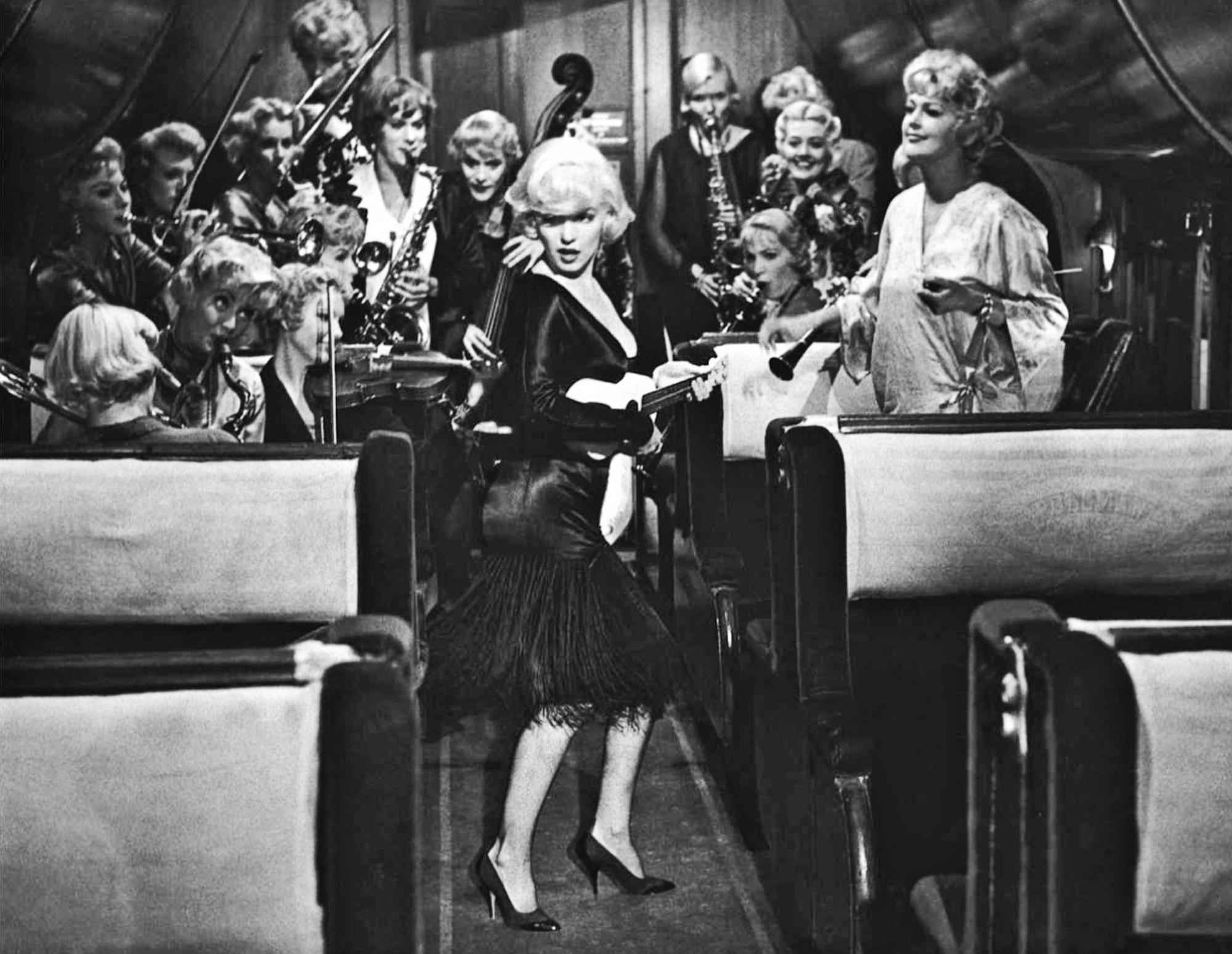
© mgm / united artists
in a fit of appropriate intellectual greatness, god invents the famous first line of a novel and the final scene of a feature film. raymond chandler’s hard-boiled crime novel the big sleep begins with: „it was about eleven o’clock in the morning, mid-october. the sun was not shining, and the air looked as if it had been freshly washed in the clear, clean light of autumn.“ billy wilder, on the other hand, ends his comedy of the century with jerry’s confession (jack lemmon) of being a man instead of a woman, and osgood fielding iii’s (joe e. brown) retort: „well, nobody’s perfect!“ originally only set as a provisional punchline, it does not answer the question asked, but simply unhinges it. osgood’s affectionate respond answers a question of identity with flippant marriage-counseling tactics, quite as if „man“ is just another inadequacy alongside snoring or unpunctuality, and bourgeois norms like marriage, gender, or identity are just a charade. wilder’s comedy treats costume and masquerade as a game anyway, and this final sentence reveals that there never was a deeper truth hidden that had to be disclosed in the end – no depth, just a platitude, and the platitude is enough to grant the masterpiece its loudest laugh right at the end. the blondest of all blondes plays her way to another high point of her career, tony curtis draws a hitler comparison when asked what it is like to kiss marilyn, but stupid inquiries just deserve a stupid answer, voilà.
joe gets sugar, the drag costume is a means to an end and not an expression of identity. the film discusses no trans-identity in today’s reading, rather it is one of the few hollywood productions that leave an escape door open without naming it. some like it hot is still completed under the hays code, a strict censorship system that prohibits explicit nudity, crime without punishment, same-sex love, blasphemy, and lustful kisses. films require a seal of approval to run in cinemas, and alfred hitchcock’s thriller psycho, completed in 1960, counts as one of the important catalysts for its termination. the film undermines the moral foundations of the censorship authority so masterfully that the system is abolished later after being irreparably weakened. the thesis that strict rules can produce brilliant results through their circumvention is sheer cynicism in view of the mass of kitsch, platitudes, and self-censored mediocrity that has emerged over decades, and a specification is required: not the rule itself generates quality, but a specific constellation between rule and desire, which is utilized productively by only a few.
otto preminger attacks the code directly; in his films the moon is blue and the man with the golden arm, unwanted themes are concretely named and then shown in cinemas without a seal. wilder, on the other hand, does not violate the code directly; cross-dressing is the camouflage under which everything can then be treated that would otherwise be highly prohibited. homoeroticism, gender ambivalence, and sexual openness take place beneath the comedic surface that wilder adopts from his master ernst lubitsch. highest brilliance arises through the use of gaps in the system; osgood’s final sentence functions according to the same principle as the director’s fundamental approach to the code. the censorship question of whether we are seeing a forbidden homosexual couple here is shifted into the realm of the trivial. restriction does not force the punchline, but it forces the form in which the punchline becomes possible in the first place. in the pragmatics of laughter itself lies the productive tension of the juxtaposition – chandler opens up an entire cosmos with his first sentence, that is controlled, atmospheric authorship in its purest form. wilder’s last sentence, on the other hand, corresponds to a grinning irony that evades the literary gesture as a matter of casualness. the frenetic hunt involving men in women’s clothing, hidden in a ladies’ band, will never receive the relevant certification, as no application is even been made for it.
iir, july 2026
In einem Anfall angemessener geistiger Größe erfindet Gott den berühmten ersten Satz in einem Roman und die Schlussszene eines Spielfilmes. Raymond Chandlers Hard-Boiled-Krimi Der große Schlaf beginnt mit: „Es war ungefähr elf Uhr vormittags, Mitte Oktober. Die Sonne schien nicht, und im klaren, sauberen Licht des Herbstes sah die Luft aus, als sei sie frisch gewaschen.“ Billy Wilder hingegen endet seine Jahrhundertkomödie mit Jerrys Geständnis (Jack Lemmon), keine Frau, sondern ein Mann zu sein, und Osgood Fielding IIIs (Joe E. Brown) Replik: „Na und? Niemand ist perfekt!“ Ursprünglich nur als provisorische Pointe gesetzt, beantwortet sie nicht die gestellte Frage, sondern hebelt sie einfach aus. Osgoods liebevolle Erwiderung beantwortet eine Identitätsfrage mit flapsiger Eheberatungstaktik, ganz so als sei „Mann“ nur eine weitere Unzulänglichkeit neben Schnarchen oder Unpünktlichkeit und bürgerliche Normen wie Ehe, Geschlecht oder Identität nur Scharade. Wilders Komödie behandelt Kostüm und Maskerade ohnehin als Spiel, und dieser finale Satz gibt preis, dass nie eine tiefere Wahrheit verdeckt wird, die es am Ende preiszugeben gilt – keine Tiefe, nur eine Floskel, und die Floskel genügt, um dem Meisterstück den lautesten Lacher zum Ende hin zu bescheren. Die blondeste aller Blonden erspielt sich einen weiteren Höhepunkt ihrer Karriere, Tony Curtis zieht auf die Frage hin, wie es denn sei, Marilyn zu küssen, einen Hitler-Vergleich, aber dumme Erkundigungen verdienen nun mal eine dumme Antwort, voilà.
Joe bekommt Sugar, das Frauenkostüm ist Mittel zum Zweck und nicht Ausdruck einer Identität. Der Film bespricht keine Trans-Identität in der heutigen Lesart, vielmehr ist er eine der wenigen Hollywood-Produktionen, die eine Ausstiegstür offenlassen, ohne sie zu benennen. Some Like It Hot wird noch unter dem Hays Code fertiggestellt, ein strenges Zensursystem, das explizite Nacktheit, Kriminalität ohne Bestrafung, gleichgeschlechtliche Liebe, Gotteslästerung und lüsterne Küsse verbietet. Filme benötigen ein Freigabesiegel, um in den Kinos laufen zu dürfen, und Alfred Hitchcocks 1960 fertiggestellter Thriller Psycho gilt als einer der wichtigen Katalysatoren für dessen Beendigung. Der Film untergräbt die moralischen Grundmauern der Zensurbehörde so meisterlich, dass das System als irreparabel geschwächt später abgeschafft wird. Die These, nachdem strenge Regeln durch deren Umgehung auch brillante Ergebnisse erzeugen können, ist blanker Zynismus angesichts der über Jahrzehnte hinweg entstandenen Masse an Kitsch, Plattitüden und selbstzensierter Mittelmäßigkeit, und eine Präzisierung ist erforderlich: Nicht die Regel selbst erzeugt Qualität, sondern eine bestimmte Konstellation zwischen Regel und Begehren, die nur bei wenigen produktiv genutzt wird.
Otto Preminger greift den Code direkt an, in seinen Filmen The Moon Is Blue und The Man with the Golden Arm werden unerwünschte Thematisierungen konkret benannt und dann ohne Siegel in den Kinos gezeigt. Wilder hingegen verletzt den Code nicht direkt, das Cross-Dressing ist die Tarnung, unter der dann alles behandelt werden kann, was sonst hochgradig verboten wäre. Homoerotik, Geschlechterambivalenz und sexuelle Offenheit finden unter der komödiantischen Oberfläche statt, die Wilder von seinem Lehrmeister Ernst Lubitsch übernimmt. Höchste Brillanz entsteht durch die Nutzung von Lücken im System, Osgoods Schlusssatz funktioniert nach demselben Prinzip wie des Regisseurs grundsätzlicher Umgang mit dem Code – Die Zensurfrage, ob wir hier ein verbotenes homosexuelles Paar sehen, wird in den Bereich des Trivialen verschoben. Restriktion erzwingt nicht die Pointe, aber sie erzwingt die Form, in der die Pointe überhaupt möglich wird. In der Pragmatik des Lachens selbst liegt die produktive Spannung der Gegenüberstellung – Chandler eröffnet mit seinem ersten Satz einen ganzen Kosmos, das ist kontrollierte, atmosphärische Autorschaft in Reinform. Wilders letzter Satz hingegen entspricht einer grinsenden Ironie, die sich der literarischen Geste als Beiläufigkeit entzieht. Die turbulent inszenierte Jagd auf Männer in Frauenkleidern, versteckt in einer Damenkapelle, wird das entsprechende Siegel nie erhalten., da man sich darum gar nicht erst bewirbt.
iir, july 2026