

robert mapplethorpe
louise bourgeois, 1982
photography
while the others are dancing,
martin eugen raabenstein’s
sensor spotlight focuses on:
© mapplethorpe foundation
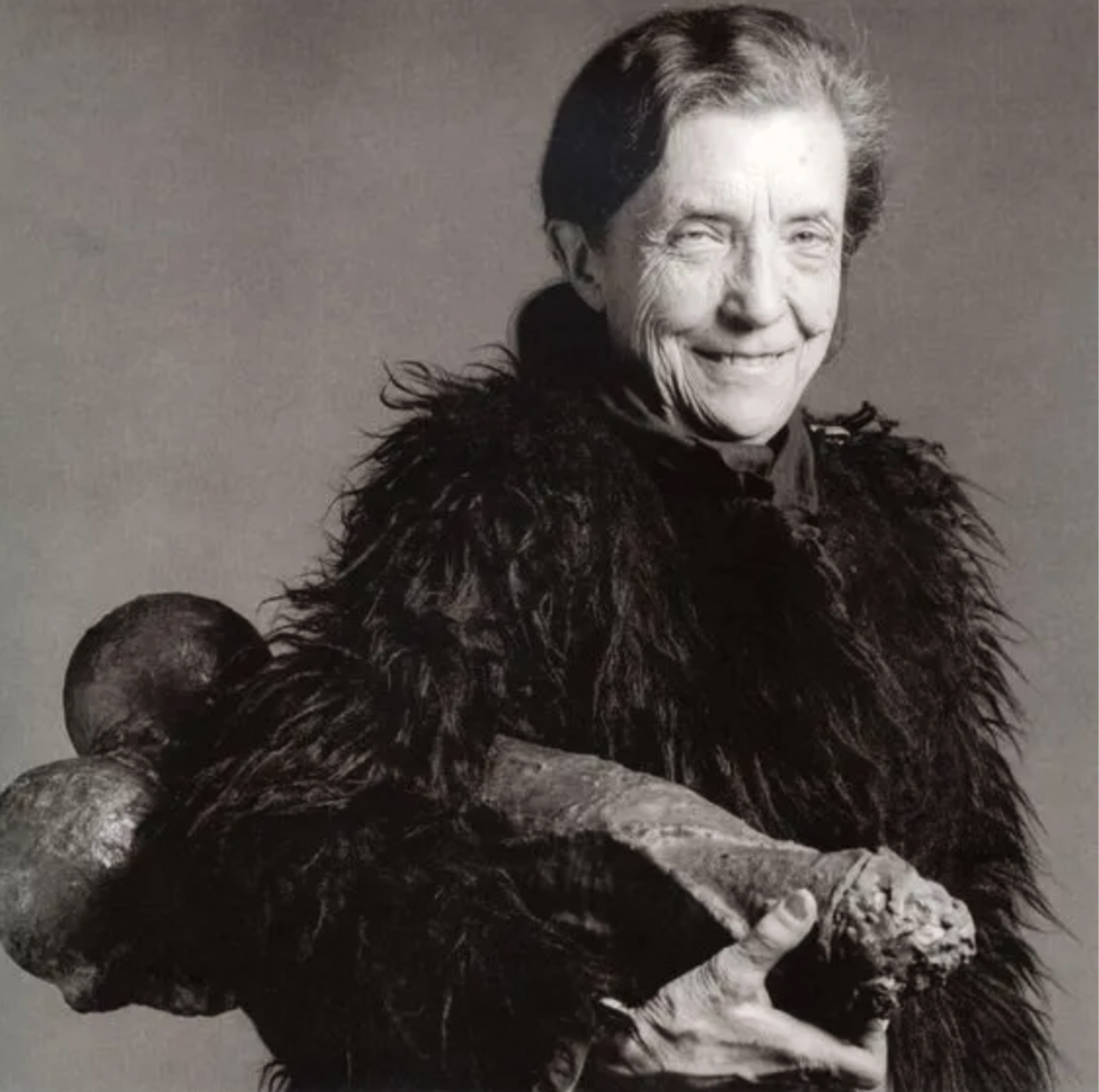
louise bourgeois’ sculpture fillette (little girl) is usually presented in exhibitions hanging from a meat hook. the sculpture in the shape of a penis, created in 1968, is made of plaster and covered with a veined latex skin. robert mapplethorpe invites the sculptor to his new york studio at the request of gallerist robert miller to shoot a portrait for her upcoming retrospective at the moma. bourgeois, however, is nervous and uses the work for reassurance by holding it under her arm. the museum of modern art has no sense for this subtle kind of ambiguity and without further ado cuts off the suggestive work in order to depict only the artist’s head on the corresponding catalog. she is annoyed; the entire erotic humor is lost that way, she notes later, and her mischievous, roguish smile truly makes little sense without the connection to the phallus object tucked under her arm. the depiction of the male reproductive organ regardless of condition, reproduction scale or medial carrier is highly context-dependent and requires the correspondingly art-historically authorized producer, as already the hbo series rome knows how to demonstrate with a smirk.
there, the grimy wall-smearer is desperately hunted down, while the nobleman stretched out on couches can calmly let hang uncovered what and where he is just carefully used to it. precisely this habit of the zeitgeist makes dealing with the muscular hardening so treacherous: dangling from a butcher utensil it feels cozy, on a book cover it causes disturbance. robert mapplethorpe himself is praised for his penis photographs, klaus biesenbach also in 2024 praises the corresponding photographs and silkscreens of andy warhol presented in the berlin neue nationalgalerie beyond all measure. but it always requires the certain circumstances that separate holy glorification from nasty low blame. penis is thus not penis; it depends on who treats it. bourgeois, too, does not see her own work as clearly aggressive, describes the penis as a fragile, vulnerable organ that needs protection, and jokingly refers to the sculpture as “little louise”.
at the same time she draws parallels to the men in her life: “it was the shape of my husband, the shape of my children… i wanted to represent something i love.” whether tender or hard desirability, also through the beautiful curating the question shifts away from the actual organ itself toward the sovereignty of interpretation over it. from the attribution of the respective narrative instance – artist, curator, censor – grows vulnerability, aestheticized desire or obscenity as in the case of the cropped moma catalog cover. on the street and outside of art-savvy discursivities, the male sexual organ is traded as what it is. the symbol bearer of a patriarchate that does not want to yield is correspondingly humiliated and as a rule fully laughed at, and so the bearer of a corresponding bodily protuberance must probably decide whether he wants to come to rest in front of or behind the window pane.
iir, july 2026
Louise Bourgeois’ Skulptur Fillette (Kleines Mädchen) wird in Ausstellungen üblicherweise an einem Fleischerhaken präsentiert. Die 1968 erstellte Skulptur in Penisform ist aus Gips und mit einer geäderten Latexhaut überzogen. Robert Mapplethorpe bittet die Bildhauerin auf Ersuchen des Galeristen Robert Miller in sein New Yorker Studio, um ein Porträt für ihre kommende Retrospektive im MoMA zu schießen. Bourgeois ist jedoch nervös und nutzt die Arbeit zur Beruhigung, indem sie sie unter dem Arm hält. Das Museum of Modern Art hat keinen Sinn für diese unterschwellige Art von Doppeldeutigkeit und schneidet kurzerhand die anzügliche Arbeit ab, um nur den Kopf der Künstlerin auf dem entsprechenden Katalog abzubilden. Diese ist verärgert; der ganze erotische Humor gehe so verloren, befindet sie später, und ihr verschmitztes, spitzbübisches Lächeln macht ohne die Verbindung mit dem unter den Arm geklemmten Phallusobjekt auch wahrlich wenig Sinn. Die Abbildung des männlichen Fortpflanzungsorgans unabhängig von Zustand, Abbildungsmaßstab oder medialem Träger ist hochgradig kontextabhängig und bedarf des entsprechend kunsthistorisch berechtigten Produzenten, wie uns schon die HBO-Serie Rome schmunzelnd vorzuführen weiß.
Dort wird der schmuddelige Wändebeschmierer händeringend gejagt, während der auf Liegen ausgestreckte Adelige seelenruhig unbedeckt hängen lassen kann, was und wo er es nun mal tunlichst gewohnt ist. Gerade diese Gewohnheit des Zeitgeists macht den Umgang mit der muskulären Verhärtung so tückisch: An einem Metzgerutensil baumelnd fühlt es sich betulich an, auf einem Buchdeckel sorgt es für Verstörung. Robert Mapplethorpe selbst wird für seine Penisfotografien gerühmt, Klaus Biesenbach lobt auch 2024 die entsprechenden in der Berliner Neuen Nationalgalerie präsentierten Fotografien und Siebdrucke Andy Warhols über alle Maßen. Aber es bedarf immer der gewissen Umstände, die heilige Verherrlichung von garstig niederem Tadel trennen. Penis ist also nicht Penis; es kommt darauf an, wer ihn behandelt. Auch Bourgeois sieht ihre eigene Arbeit nicht als eindeutig aggressiv, beschreibt den Penis als fragiles, verletzliches Organ, das Schutz benötigt, und bezeichnet die Skulptur scherzhaft als „kleine Louise“.
Zugleich zieht sie Parallelen zu den Männern in ihrem Leben: „Es war die Form meines Ehemanns, die Form meiner Kinder… Ich wollte etwas darstellen, das ich liebe.“ Ob nun zärtliche oder harte Begehrlichkeit, auch durch die schöne Kuratierung verschiebt sich die Frage weg vom tatsächlichen Organ selbst hin zur Deutungshoheit darüber. Aus der Zuschreibung der jeweiligen Erzählinstanz – Künstlerin, Kurator, Zensor – erwächst Verletzlichkeit, ästhetisiertes Verlangen oder Obszönität wie im Falle des beschnittenen MoMA-Katalog-Covers. Auf der Straße und außerhalb der kunstbeflissenen Diskursivitäten wird das männliche Geschlechtsorgan als das gehandelt, was es ist. Der Symbolträger eines nicht weichen wollenden Patriarchats wird entsprechend gedemütigt und in aller Regel vollmundig verlacht, und so muss sich der Träger einer entsprechenden Körperausstülpung wohl entscheiden, ob er vor oder hinter der Scheibe zur Ruhe kommen mag.
iir, july 2026