

the klf
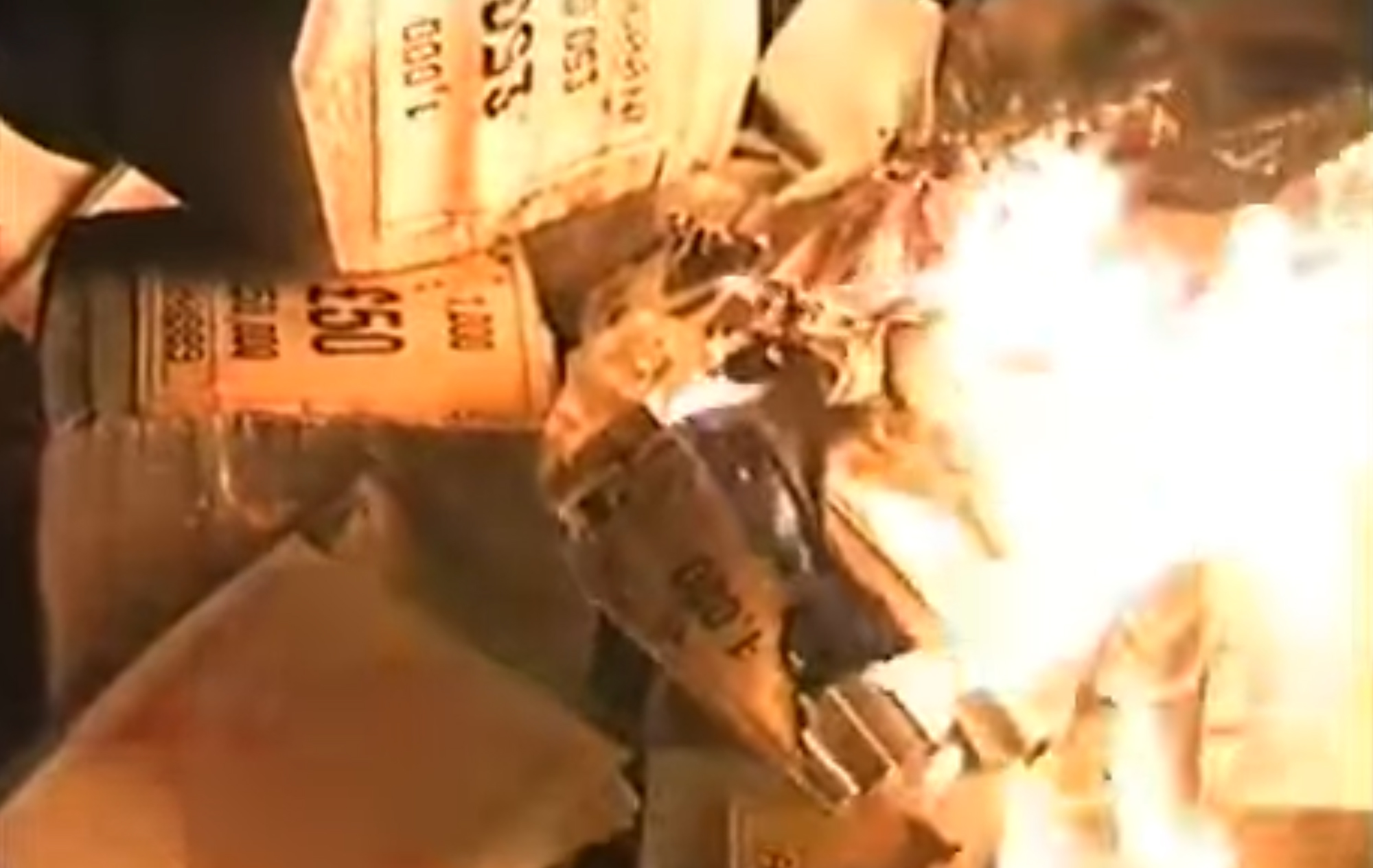
watch the k foundation burn a million quid, 1994
performance video
while the others are dancing,
martin eugen raabenstein’s
sensor spotlight focuses on:
bill drummond and jimmy cauty come from the trade; they know how to stage a cow on a roof in a media-effective way, dada is the program, thus they cannot do anything wrong, and that is exactly their problem. the technically skilled late adolescents can burp, fart, or speak crudely; they are forgiven thanks to their talent and their financial success. the provocative child, however, wants to see angry faces, so it stomps harder and harder time after time until it finally has to leave the stage. on the occasion of their appearance at the brit awards in 1992, the two, aka the klf, justified ancients of mu mu, k foundation, the timelords, or 2k, announce their withdrawal from the music business. drummond and cauty are defiant people and like to burn things: the remaining copies of their debut album “what the fuck is going on,” which contains samples of abba’s “dancing queen” and has to be withdrawn from the market, end up on a swedish field and are burned after the two fail to meet the stockholm sing-along quartet in person in the studio. all remaining merchandise items also go up in flames after their musical exit, and their musical back catalogue is radically deleted; all matrices for pressing records are destroyed. the resulting loss of foregone royalties amounts to millions. one can call this stupid or simply consistent, but it shows how strongly they believe they are bringing their disgust at the commercialization of a pop cosmos closer to the world, a world that simply smiles it away.
with the publication of their well-meaning handbook “the manual (how to have a number one the easy way),” their unconditional will to transparency becomes clear in the explanation of how their number-one hit “doctorin’ the tardis” can be easily recreated. the klf now call themselves the k foundation and deal with the even more confused art market. the annually awarded british turner prize in particular is a powerful thorn in their side, and they want to oppose it with their own counterpart: the prize for the worst artist. by doubling the turner prize money to 40,000 pounds alone, the journalistic rabble in 1994 becomes more than sharp-eared, and so the foundation organizes its own event on the same evening and in parallel with the official celebration under the motto “the change of art history.” 25 journalists are picked up in london in a convoy of seven stretch limousines, each receive an envelope with 1,600 pounds in cash, and after an hour’s drive reach a wooded area near woking. in the parking lot there, they are presented with the foundation’s first artwork, consisting of one million pounds in unused 50-pound notes nailed to a piece of board. the invited guests are now instructed to nail the money they previously received onto another board, whereupon most of them kneel on the frosty ground and hammer 15-centimeter nails through money into wood. eagerly documented in multimedia form, “money: a major body of cash” darkly suggests what may still follow.
conspiratorial writings in sharp combination with consciousness-expanding intoxicants cannot really prevent subversive distortions of reality, and so the new art messiahs and illuminati disciples have to learn in amazement that, with all due respect, it takes more effort and finesse to shake centuries-old traditions. rachel whitehead, the first nominated recipient of the prize for bad art, is not amused but allows herself to be persuaded when she hears that the money would otherwise be burned. but the clever move of playing with guilt and shame of others also fails. we are still in the year 1994, and the k foundation burns one million british pounds on the scottish island of jura from the proceeds of their record sales, once again carefully documented by an employee. the well-intentioned attack on the hypocritical cultural establishment ends as self-direction. a contract is signed not to speak about the events and their details for 23 years, but only four more years later do parts of their musical catalogue cautiously appear on streaming platforms under the title “samplecity thru trancentral.” that is what one probably calls all-in in poker, and drummond and cauty still give cause for a discreet frown or at least for the question: can one be that naive? if you light the candle on both sides, however, this is not a question but a prerequisite.
iir, february 2026
Bill Drummond und Jimmy Cauty kommen vom Fach, sie wissen, wie man die Kuh auf dem Dach medienwirksam inszeniert. Dada ist Programm, also können sie nichts falsch machen, und genau das ist ihr Problem. Die technisch versierten Spätpubertären können rülpsen, furzen oder unflätig reden, es wird ihnen verziehen, dank ihres Talentes und des finanziellen Erfolges. Das provozierende Kind allerdings will wütende Gesichter sehen, also stampft es Mal ums Mal heftiger auf, bis es die Bühne schließlich verlassen muss. Anlässlich ihres Auftritts während der Brit Awards 1992 verkünden die beiden, aka The KLF, Justified Ancients of Mu Mu, K Foundation, The Timelords oder 2K, ihren Ausstieg aus dem Musikbusiness. Drummond und Cauty sind trotzige Menschen und verbrennen gerne Dinge: Die Restexemplare ihres Albumerstlings „What the Fuck Is Going On“, das Samples von ABBAs „Dancing Queen“ enthält und vom Markt genommen werden muss, landen auf einem schwedischen Acker und werden verbrannt, nachdem die beiden das Stockholmer Schunkelquartett nicht persönlich im Studio antreffen. Auch sämtliche noch verbliebenen Merchandise-Artikel gehen nach ihrem musikalischen Austritt in Flammen auf, und ihr musikalischer Backkatalog wird radikal gelöscht, alle Matrizen zur Pressung von Schallplatten vernichtet. Ihr dadurch entstandener Verlust an entgangenen Tantiemen beläuft sich in Millionenhöhe. Das kann man dumm nennen oder schlichtweg konsequent, aber es zeigt, wie sehr sie glauben, der Welt ihren Abscheu vor der Kommerzialisierung eines Popkosmos‘ nahezubringen, die dies einfach weglächelt.
Mit der Veröffentlichung ihres wohlmeinenden Handbuches „The Manual (How to Have a Number One the Easy Way)“ wird ihr unbedingter Transparenzwille deutlich, in der Erklärung, wie man ihren No.-1-Hit „Doctorin’ the Tardis“ unaufwendig nachbasteln kann. The KLF nennen sich nun K Foundation und beschäftigen sich mit dem noch verworreneren Kunstmarkt. Speziell der jährlich vergebene britische Turner-Preis ist ihnen ein mächtiger Dorn im Auge, dem sie ein eigenes Pendant entgegensetzen wollen: den Preis für den schlechtesten Künstler. Durch die Verdopplung des Turner-Preisgeldes auf 40.000 Pfund allein ist die journalistische Mischpoke 1994 mehr als spitzohrig, und so veranstaltet die Foundation am selben Abend und parallel zur offiziellen Festlichkeit einen eigenen Event unter dem Motto „Die Änderung der Kunstgeschichte“. 25 Journalisten werden in einem Konvoi aus sieben Stretchlimousinen in London abgeholt, erhalten jeweils einen Umschlag mit 1.600 Pfund in bar und erreichen nach einer Stunde Fahrt ein Waldstück nahe Woking. Auf dem dortigen Parkplatz wird ihnen das erste Kunstwerk der Stiftung präsentiert, bestehend aus einer Million Pfund in ungebrauchten 50er-Noten, genagelt auf ein Stück Brett. Die geladenen Gäste werden nun aufgefordert, ihr zuvor erhaltenes Geld an ein weiteres Brett zu nageln, woraufhin die meisten sich auf den frostigen Boden knien und 15-Zentimeter-Nägel in Geld auf Holz einhämmern. Multimedial eifrig dokumentiert lässt „Money: A Major Body of Cash“ dunkel erahnen, was nun noch alles folgen kann.
Konspirative Schriften in scharfer Kombination mit bewusstseinserweiternden Rauschmitteln können subversive Realitätsverzerrungen nicht wirklich verhindern, und so müssen die neuen Kunstmessiasse und Illuminati-Jünger staunend erfahren, dass es bei allem Respekt schon mehr Anstrengung und Finesse bedarf, jahrhundertealte Traditionen zu erschüttern. Rachel Whitehead, die erste nominierte Preisträgerin für schlechte Kunst, ist wenig amüsiert, lässt aber mit sich reden, als sie hört, dass das Geld ansonsten verbrannt werden soll. Aber auch der kluge Schachzug, mit Schuld und Scham der anderen zu spielen, verläuft ohne Erfolg. Wir sind noch immer im Jahr 1994, und die K Foundation verbrennt auf der schottischen Insel Jura eine Million britische Pfund aus Einnahmen ihrer Plattenverkäufe, wiederum fein von einem Mitarbeiter dokumentiert. Die wohlgemeinte Attacke gegen den heuchlerischen Kulturbetrieb endet als Selbstrichtung. Ein Vertrag wird unterschrieben, 23 Jahre nicht mehr über die Geschehnisse und ihre Details zu sprechen, aber erst weitere vier Jahre später erscheinen zaghaft Teile ihres musikalischen Kataloges unter dem Titel „Samplecity Thru Trancentral“ auf Streaming-Plattformen. Das nennt man dann wohl All-in beim Pokern, und noch immer sind Drummond und Cauty Anlass für ein dezentes Stirnrunzeln oder zumindest für die Frage: Kann man so naiv sein? Brennt man die Kerze an beiden Seiten an, ist das allerdings keine Frage sondern die entsprechende Vorraussetzung.
iir, february 2026