

utagawa kuniyoshi
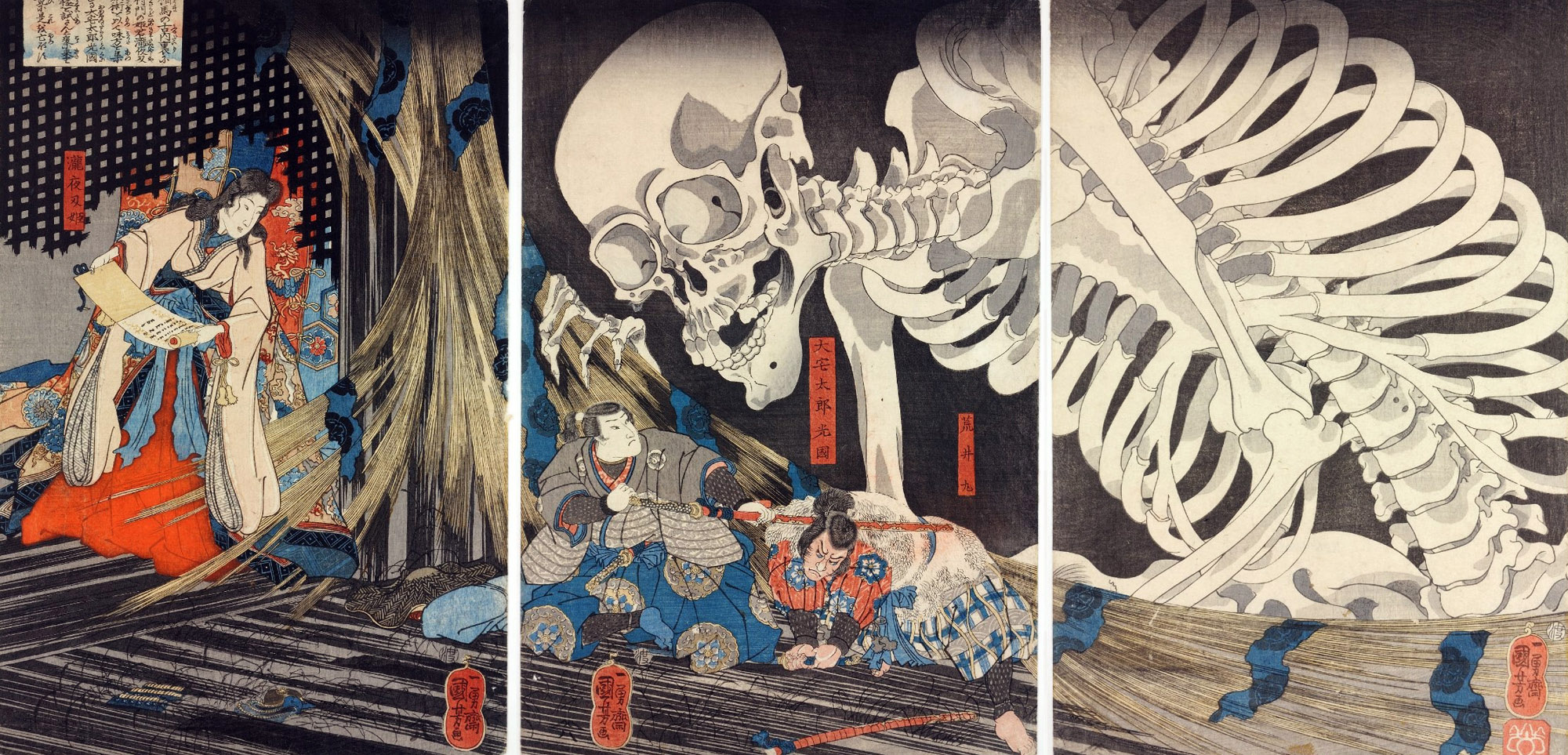
takiyasha the witch and the skeleton specter from the story of utö yasutaka, c. 1843 – 1847
nishiki-e, woodblock print (3 parts), 35.8 × 23.2 cm, 35.8 × 24.2 cm, 35.8 × 23.9 cm
#14
the fourteenth episode of your chair, your choice… is presented by artist heiko sievers. he recommends the japanese wood block master utagawa kuniyoshi, for alongside hiroshige, hokusai and kunisada, he is one of the most important artists of the first half of the 19th century. what fascinates and surprises him about kuniyoshi – apart from his drawing skills – is his quirky humour and his talent for staging fantastic stories and myths in unusual ways. he is the most important precursor of today’s comic art among the artists mentioned and even today, his large battle and warrior triptychs still appear fresh, dynamic and modern in their presentation …
© utagawa kuniyoshi
utagawa kuniyoshi’s masterfully staged print originates from santō kyōden’s popular 1807 novel the story of utō yasutaka and is set in the 10th century. princess takiyasha, daughter of the rebellious provincial lord taira no masakado, receives magical powers from a hermit in the mountains and plots a conspiracy against her father’s murderer. the anatomically precise skeleton depicted here does not correspond to the literary source, in which takiyasha summons hundreds of human-sized skeletons, but kuniyoshi’s stroke of genius employs western dramaturgy to compose an iconic image with a single, gigantic ghostly being bursting beyond the frame. the summoning of spirits, gashadokuro, in order – as here – to drive away the imperial envoy mitsukuni, belongs to the familiar standard repertoire of japanese horror literature. at a time when ghosts in japan appear as misty, formless apparitions or stylized masks, kuniyoshi radically breaks with tradition. his skeleton is not merely a symbol of death, and its astonishingly accurate draftsmanship suggests that kuniyoshi possesses a copy of the kaitai shinsho, the first japanese anatomy book, and uses this foreign knowledge to render the supernatural physically tangible and thus far more terrifying.
kuniyoshi gladly experiments with techniques regarded in traditional japan as foreign or even ugly. while classical ukiyo-e employs isometrically constructed spaces, kuniyoshi also incorporates elements of western linear perspective and draws inspiration from european engravings. he likewise playfully adopts the concept of light and shadow, chiaroscuro, from foreign artistic traditions, and this differently generated spatial depth does not correspond to the preference for clearly defined lines and flat planes of color. moreover, he uses shadow to enhance corporeality, and his general anatomical interest becomes wonderfully evident in the detailed rendering of the ghostly skeleton enlarged to monumental scale here. despite these technical experiments, kuniyoshi remains distinctly an edo artist, stays faithful to classical japanese tales and chinese novels, and it is precisely the warrior prints derived from them, the musha-e, that make him famous. he confronts the strictly drawn censorship boundaries of the shogunate with quirky humor, deftly skirts around them, and binds everything together with a boldly drawn black contour line – the unmistakable hallmark of traditional woodblock prints.
the widely known classical source delights the japanese audience, and with themes of rebellion, honor, and spirit summoning, the message of honor and myth remains traditional, while the representation itself becomes revolutionary. it is precisely this combinatory genius that elevates kuniyoshi to a gifted modernizer of ukiyo-e – just before photography and the subsequent meiji restoration permanently transform everything. already during the sakoku era, the period of the country’s absolute isolation, which officially ends only in 1853 with the arrival of commodore perry’s black ships, kuniyoshi conducts extensive studies of western art history. the dutch are the only europeans permitted to maintain a trading post on the island of dejima, and from there western cultural goods flow into japan. scholars, physicians, and artists study dutch books on medicine, astronomy, and physics, often richly illustrated with engravings and generally referred to as rangaku, or dutch studies. the fascination with opposing artistic attitudes works both ways: while curious figures such as van gogh follow the traces of japanese ukiyo-e in amazement, kuniyoshi draws his dreadful skeleton in a western manner – well then.
iir, march 2026
Utagawa Kuniyoshis meisterlich in Szene gesetztes Blatt entstammt Santō Kyōdens populärem Roman Die Geschichte von Utō Yasutaka aus dem Jahr 1807 und spielt im 10. Jahrhundert. Prinzessin Takiyasha, Tochter des rebellischen Provinzfürsten Taira no Masakado, erhält von einem Einsiedler in den Bergen magische Kräfte und schmiedet eine Verschwörung gegen den Mörder ihres Vaters. Der hier anatomisch exakt dargestellte Knochenmann entspricht nicht der Buchvorlage, in der Takiyasha Hunderte menschengroßer Skelette beschwört, aber Kuniyoshis Geniestreich nutzt westliche Dramaturgie, um mit einem einzigen, gigantischen, den Bildrand sprengenden Geisterwesen ein ikonisches Bild zu komponieren. Die Beschwörung von Geistern, Gashadokuro, um – wie hier – den kaiserlichen Gesandten Mitsukuni zu vertreiben, gehört zum geläufigen Standardrepertoire japanischer Schauerliteratur. In einer Zeit, in der Geister in Japan als nebelhaft formlose Erscheinungen oder stilisierte Masken dargestellt werden, bricht Kuniyoshi hier radikal mit der Tradition. Sein Skelett ist kein bloßes Todessymbol, und dessen erstaunlich korrekte zeichnerische Ausführung lässt vermuten, dass Kuniyoshi eine Kopie des Kaitai Shinsho, des ersten japanischen Anatomiebuchs, besitzt und dieses fremde Wissen einsetzt, um Übernatürliches physisch greifbar und damit noch viel erschreckender zu gestalten.
Kuniyoshi experimentiert gern mit im traditionellen Japan als fremd oder gar hässlich geltenden Techniken. Während sich das klassische Ukiyo-e isometrisch aufgebauter Räume bedient, setzt Kuniyoshi auch Elemente westlicher Zentralperspektive ein und lässt sich von europäischen Kupferstichen inspirieren. Auch seine Idee von Licht und Schatten, dem Chiaroscuro, entnimmt er spielerisch fremdländischer Kunstauffassung, und diese anders erzeugte Raumtiefe entspricht so ebenfalls nicht der Vorliebe für klar gesetzte Linien und flache Farbflächen. Darüber hinaus setzt er Schatten zur Steigerung der Körperlichkeit ein, und sein generelles anatomisches Interesse lässt sich anhand der Detailtreue des hier ins Riesige gezogenen Geisterskeletts wunderbar erklären. Trotz dieser technischen Spielereien ist Kuniyoshi ein eindeutiger Edo-Künstler, bleibt den klassisch japanischen Geschichten und chinesischen Romanen treu, und eben jene daraus entnommenen Kriegsbilder, die Musha-e, machen ihn berühmt. Den streng gezogenen Zensurgrenzen des Shogunats begegnet er mit skurrilem Humor, umtänzelt diese mit Leichtigkeit und bindet alles mit einer kräftig gezogenen schwarzen Konturlinie zusammen – als eindeutiges Markenzeichen traditioneller Holzschnitte.
Die allseits bekannte klassische Vorlage verzückt das japanische Publikum, und mit den Themen Rebellion, Ehre und Geisterbeschwörung verbleibt die Botschaft von Ehre und Mythos im Traditionellen, während sich die Darstellung revolutionär gestaltet. Eben jenes kombinatorische Genie lässt Kuniyoshi zum begnadeten Modernisierer des Ukiyo-e aufsteigen – kurz bevor Fotografie und die folgende Meiji-Restauration ohnehin alles für immer verändern. Schon während der Sakoku-Ära, der absoluten Isolation des Landes, die erst 1853 durch die Ankunft der Schwarzen Schiffe Kommodore Perrys offiziell endet, betreibt Kuniyoshi umfangreiche Studien westlicher Kunstgeschichte. Die Niederländer dürfen als einzige Europäer einen Handelsposten auf der Insel Dejima unterhalten, und von hier aus fließt westliches Kulturgut nach Japan ein. Gelehrte, Ärzte und Künstler studieren niederländische Bücher über Medizin, Astronomie und Physik, die oft reichhaltig mit Kupferstichen illustriert sind und generell als Rangaku, als Holland-Studien, bezeichnet werden. Die Faszination an gegensätzlich gestalteter künstlerischer Haltung ist beiderseitig: Während Neugierige wie van Gogh staunend den Spuren japanischer Ukiyo-e folgen, zeichnet Kuniyoshi sein schreckliches Skelett in westlicher Manier – Na also.
iir, march 2026