

david hockney
gregory, 1978
pencil on paper, 43,2 x 35,6 cm
while the others are dancing,
martin eugen raabenstein’s
sensor spotlight focuses on:
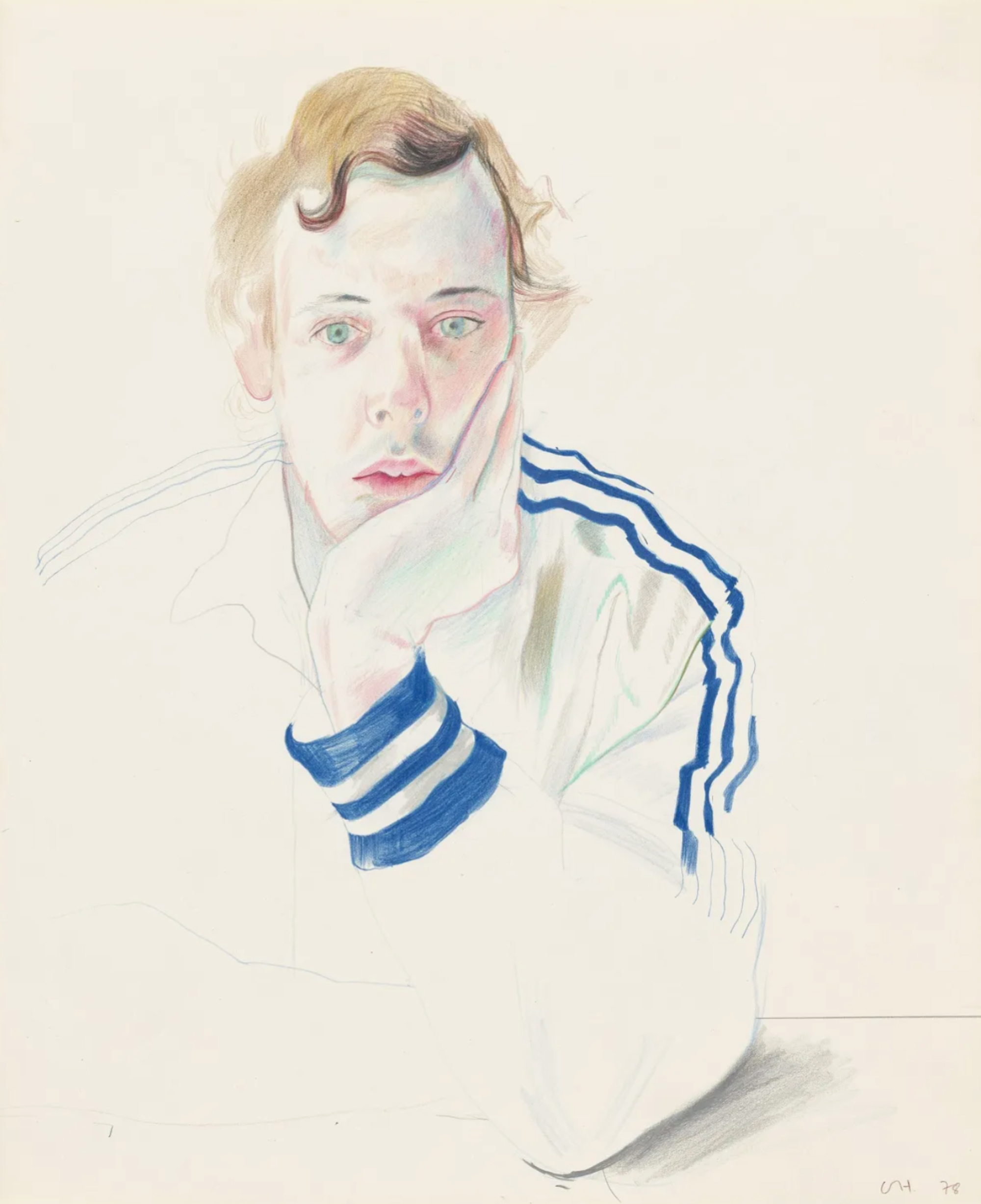
© david hockney
david hockney draws from pop art, abstract expressionism, and color field painting; traces of artists such as pablo picasso and henri matisse can likewise be found in his work. the british artist readily brings these influences onto paper and creates portraits of people close to him, including an estimated hundreds of portraits of his former partner and curator gregory evans. hockney and evans meet in los angeles through the art dealer nicholas wilder. they live in paris and begin a romantic relationship in 1974. over the course of their more than decade-long partnership, evans evolves from lover and studio assistant into curator and steadfast advisor, and, according to the artist himself, is possibly hockney’s great love. after their relationship ends, they remain close friends, and gregory continues to sit for hockney throughout different phases of his artistic practice—whether drawn, photographed, or, ultimately, fragmented in a cubist manner. artist is exuberantly alive, openly gay, and beneath his wheat-blond hair an oversized black pair of glasses signals precisely what this is all about: perception and processing. the question of how seeing fundamentally works, how the eye moves through time and space rather than staring at a single fixed point, is not a secondary motif for hockney but the central question of his oeuvre, to which he subordinates his portraits, landscapes, and even his stage designs.
this movement becomes most evident in the portraits when viewed along a timeline. hockney paints almost exclusively people from his immediate circle—his mother, celia birtwell, and, of course, gregory evans—and, with one exception, accepts no portrait commissions from strangers. he does, however, create an ipad portrait of queen elizabeth ii. intimacy is a prerequisite rather than a coincidence, and because the same faces reappear over decades, every individual sheet becomes a dated fragment of a larger series, part of a portrait that continuously transforms over time. time itself becomes a material to be shaped, eclipsing anecdote through an accumulative process of perception and interpretation—in direct contrast to the fleeting instant of a photographic snapshot. from this emerges hockney’s lifelong distrust of central perspective and of photography as its mechanical culmination. his “secret knowledge” thesis, which argues that old master painters employ optical aids, effectively constitutes a critique of the camera’s fixed and disembodied eye. as a countermodel, he favors the “reverse perspective” of chinese handscroll painting, within which and through which the viewer can move across the depicted landscape. hockney’s photographic polaroid collages, the “joiners,” embody precisely this attempt to assemble multiple viewpoints and moments into a single image, one that resembles an ongoing spatial experience more than its flattened and focused representation.
picasso and matisse, formal adversaries and spiritual companions, provide him with a valuable formal toolkit through their complementary yet opposing approaches. through their different strategies for dissolving the motif, including simultaneous viewpoints, and through the liberation of color as an autonomous force detached from mere description, hockney poses the phenomenological question, “what does seeing look like while it is happening?” rather than, “what does something look like?” portrait and landscape function for the artist as two experimental configurations of the same problem, merely operating at different scales. as an eternal pioneer, he does not rest on the success of his early iconic california pool paintings. through artistic explorations that are technologically and stylistically unique, he remains part of the avant-garde crème de la crème—whether working with fax machines in the 1980s, creating large-scale ipad friezes in normandy, or producing the equally monumental, multiperspectival yorkshire landscapes and video installations. at the same time, he remains an intimate chronicler. his countless portrait series depicting close friends, family members, and companions reveal how passing time and profound human connection enter his life’s work as artistic material.
is hockney a provocateur of art history? not really. his controversial yet brilliant conceptual model is, in a fundamental sense, rooted in premodern thinking; questioning central perspective is already a concern of the japonistes of the late nineteenth century. but ultimately that hardly matters. hockney’s undiminished sense of play is overwhelming—and for that we are grateful.
iir, june 2026
David Hockney saugt an der Pop-Art, dem Abstrakten Expressionismus und der Farbfeldmalerei, Spuren von Künstlern wie Pablo Picasso und Henri Matisse finden sich ebenso in seinen Nüstern wieder. Der Brite bringt diese Einflüsse gern auf Papier und zeichnet Porträts ihm nahestehender Menschen, darunter schätzungsweise Hunderte Porträts seines zeitweiligen Lebensgefährten und Kurators Gregory Evans. Hockney und Evans treffen sich in Los Angeles über den Kunsthändler Nicholas Wilder, sie leben in Paris und beginnen 1974 eine Liebesbeziehung. In ihrer mehr als zehnjährigen Beziehung entwickelt sich Evans vom Liebhaber und Studioassistenten zum Kurator und standfest beratenden Vertrauten und ist möglicherweise Hockneys große Liebe, so der Künstler selbst. Nach dem Ende ihrer Beziehung verbleiben sie als enge Freunde, und Gregory sitzt für Hockneys unterschiedliche Schaffensphasen gern Modell – ob gezeichnet, fotografiert oder zuletzt kubistisch fragmentiert. Der Künstler ist äußerst lebensfroh, schwul, und unter seinen weizenblonden Haaren zeigt eine übergroße schwarze Brille genau das an, worum es hier geht: Wahrnehmung und Verarbeitung. Die Frage, wie Sehen grundsätzlich funktioniert, wie das Auge sich durch Zeit und Raum bewegt, statt auf einen Punkt zu starren, ist bei Hockney kein beiläufiges Motiv, sondern bildet seine eigentliche Werkfrage, der er seine Porträts, Landschaften und sogar die Bühnenbilder unterordnet.
Bei den Porträts zeigt sich diese Bewegung auf einer Zeitachse am deutlichsten. Hockney malt fast ausschließlich Menschen seines unmittelbaren Umfelds – seine Mutter, Celia Birtwell und eben Gregory Evans – und nimmt mit einer Ausnahme keine Porträtaufträge von Fremden an, für Queen Elisabeth II. allerdings fertigt er eine iPad Arbeit an. Nähe ist Bedingung, nicht Zufall, und da dieselben Gesichter über Jahrzehnte hinweg immer wiederkehren, ist jedes einzelne Blatt ein mit Datum festgehaltener Teil einer Serie, eines sich in der Zeit beständig wandelnden Porträts. Zeit wird selbst zum gestaltbaren Material und überdeckt das Anekdotenhafte als akkumulierender Prozess der Wahrnehmung und Verarbeitung – im direkten Gegensatz zum rasch vergehenden Moment eines fotografischen Schnappschusses. Daraus lässt sich Hockneys lebenslanges Misstrauen gegenüber der Zentralperspektive und der Fotografie als deren mechanischer Vollendung ableiten. Seine „Secret Knowledge“-These, wonach altmeisterliche Malerei optische Hilfsmittel nutzt, ist faktisch eine Kritik am fixierten und körperlosen Auge der Kamera. Als Gegenmodell bevorzugt er die „umgekehrte Perspektive“ der chinesischen Rollbildmalerei, in und mit der sich der Betrachter durch die dargestellte Landschaft bewegen kann. Hockneys fotografische Polaroid-Collagen, die „Joiners“, entsprechen genau diesem Versuch, viele Blicke und Momente zu einem einzigen großen Bild zu montieren, das eher einem fortlaufenden Raumerlebnis entspricht als dessen fokussiert reduzierter und flacher Abbildung.
Picasso und Matisse, die formalen Gegner und geistigen Freunde, liefern ihm mit ihren sich gegensätzlich ergänzenden Ansätzen ein willkommenes formales Rüstzeug. Mit ihren unterschiedlichen Strategien zur Auflösung des Motivs, auch in simultanen Ansichten, und mit der Befreiung der Farbe als eigenständiger, von reiner Beschreibung gelöster Kraft stellt Hockney die phänomenologische Frage: „Wie sieht das Sehen aus, während es passiert?“ anstatt „Wie sieht etwas aus?“. Porträt und Landschaft bilden für den Künstler zwei Versuchsanordnungen ein und desselben Problems, nur lediglich in unterschiedlichen Maßstäben. Als ewiger Pionier ruht er sich nicht auf dem grossen Erfolg seiner frühen ikonischen kalifornischen Pool-Bilder aus und gehört mit seinen technologisch und stilistisch einzigartigen künstlerischen Erkundungen zur avantgardistischen Crème de la Crème – ob mit Faxgeräten in den 1980er-Jahren, seinen grossflächigen iPad-Friesen aus der Normandie oder den ebenfalls gigantischen, multiperspektivischen Yorkshire-Landschaften und Video-Installationen. Parallel dazu bleibt er ein intimer Chronist. In seinen unzähligen Porträtserien von engen Freunden, Familienmitgliedern und Weggefährten wird deutlich, wie vergehende Zeit und tiefe menschliche Verbundenheit als gestalterisches Material in sein Lebenswerk einfließen.
Ist Hockney ein Provokateur der Kunstgeschichte? Eher nicht. Sein kontroverses und zugleich brillantes Gedankenmodell ist im eigentlichen Sinne vormodern verankert; die Hinterfragung der Zentralperspektive ist bereits ein Anliegen der Japonisten des späten 19. Jahrhunderts. Aber das spielt letztlich keine Rolle, Hockneys ungebrochene Spielfreude ist überwältigend – und dafür sind wir ihm dankbar.
iir, june 2026