

heaven 17
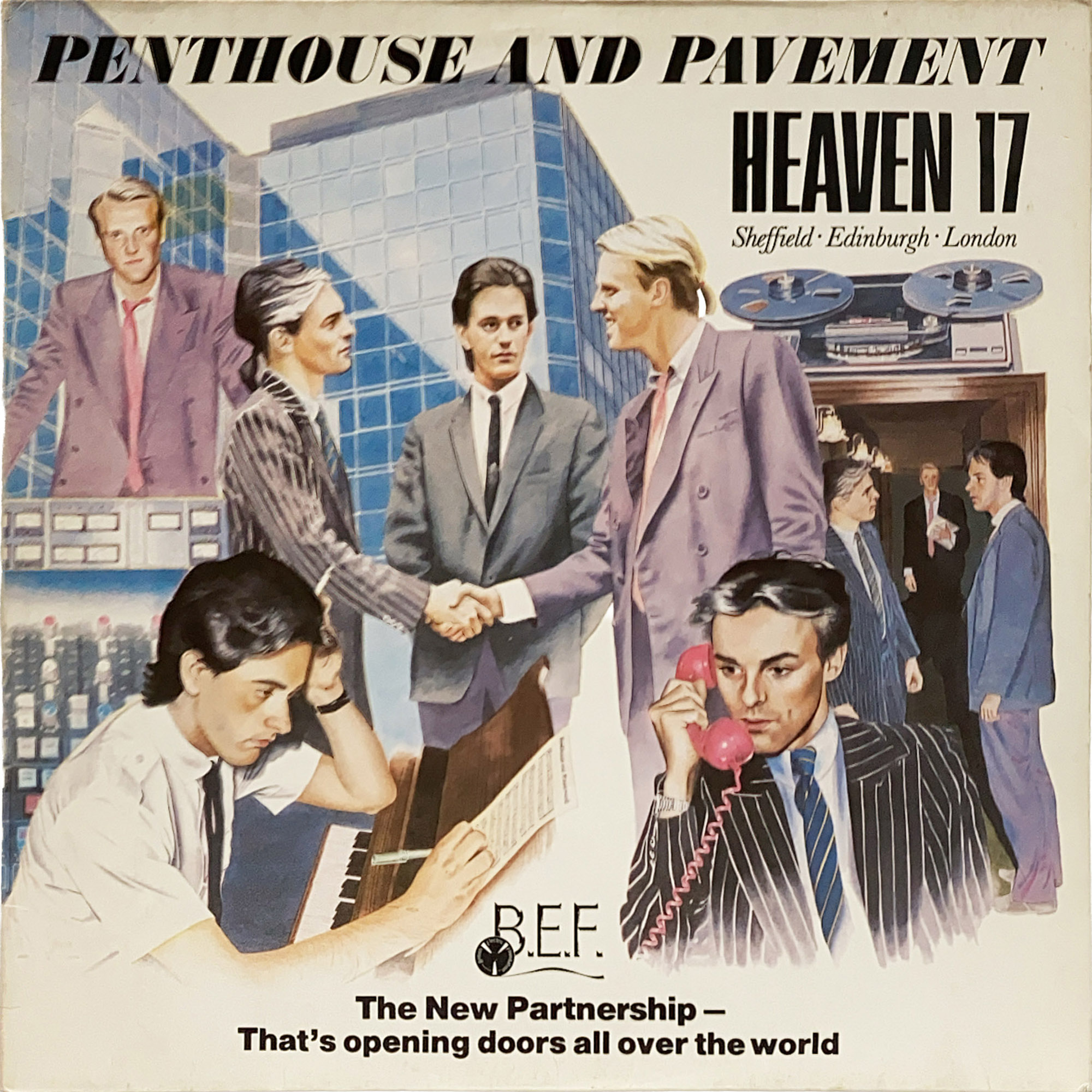
penthouse and pavement, 1981
vinyl album
while the others are dancing,
martin eugen raabenstein’s
sensor spotlight focuses on:
© heaven 17
if you hire dancing dolls who cannot sing, these dancing dolls just hop around without the other dancing dolls noticing. that only roughly explains why philip oakey’s the human league commercially leaves the breakaway faction heaven 17 so far behind after the split, thus we need more details. martyn ware and ian craig marsh leave the band they co-founded in 1980 after two studio albums, respectful recognition, and massive ideological conflicts. oakey’s chart-conquering pop star vision stands in stark contrast to the art-and-technology nobility of ware and marsh, but bob last, the band manager from rough trade, also sees the future in synthpop, and so the paths diverge – though not completely, at first. in martin rushent’s genetic studios in reading, the upcoming albums of the two projects are recorded alternately and under mutual, watchful mistrust. oakey, who is invited in 1978 because of his handsome face and a good voice, simply repeats the principle and, one night in a club, picks two nice looking schoolgirls waving their arms in a brilliant way – and just brings susanne sulley and joanne catherall on board. heaven 17 also have a new singer in glenn gregory, and so the story takes its course. polished, smooth pop and sweet glamour: the human league – dare becomes one of the most successful and style-defining pop albums of all time, including the hit don’t you want me.
but marsh and ware are also overjoyed to have freed themselves from this success-hungry schmaltz boy and now follow their “musicians’ musician” vision of intelligent and technologically innovative music with a clear political statement. ware, the intellectual architect who develops the album penthouse and pavement through highly complex layering, watches as philip oakey simultaneously tinkers with cheap pop melodies together with two inexperienced schoolgirls and martin rushent. what ware cannot see is rushent’s genius of simplification, of conjuring glittering candy cascades from cool synthesizers. in addition, rushent uses one of the first drum machines, the linn lm-1, whose crisp 8-bit aesthetic juices up the tightly precisioned rhythms. ware and marsh are also absolute tech nerds and are among the first to know how to virtuously program the sampler and workstation fairlight cmi. we’re going to live for a very long time is a masterpiece of early digital manipulation, in which voices or noises are granulated in a way that only years later finds use again in techno or glitch. in the fusion of cool kraftwerk-style electronics with real black american funk and soul, heaven 17 achieve a compelling and demanding combination that many synth bands of the time simply lack.
the explicitly socialist, anti-capitalist lyrics, especially on the first single release from the album (we don’t need this) fascist groove thang, criticize social injustices, are strongly influenced by the economically battered situation in sheffield and represent a direct attack on the rising, europe-flooding fascism – from the british national front to the grey wolves in turkey. ronald reagan’s 1980 landslide election victory is the sobering triumph of conservative values. reaganomics aims at deregulation and massive tax cuts, just as margaret thatcher does in the british homeland. this may not shake a true socialist to the core, but in the case of heaven 17 it still does, and so we hear fragments of fascist groove thang lyrics from the mouths of international anti-fascists around the world. for the bbc, these left-wing lads are too explicit: they fall under its relentless ban, and a deserved chart placement is thus destroyed. oakey’s watered-down, radio-friendly version can only smile tiredly at this: don’t you want me is number one in the uk, the usa, as well as canada, new zealand, belgium, ireland, and norway. that is how it is, my young friends – your choice. but always be aware: when the musicians begin to play the slower classics, keep a watchful eye on the emergency exits, you know why …
iir, february 2026
Wenn man Hupfdohlen engagiert, die nicht singen können, hupfdohlen diese Hupfdohlen eben so rum, ohne dass es die anderen Hupfdohlen merken. Das erklärt nur so ungefähr, warum Philip Oakeys The Human League den Aussteigerflügel Heaven 17 nach dem Split kommerziell so massiv abhängt, also benötigen wir mehr Details. Martyn Ware und Ian Craig Marsh verlassen die von ihnen mitgegründete Band 1980 nach zwei Studioalben, würdigender Anerkennung und massiven inhaltlichen Kontroversen. Oakeys die Charts erobernde Popstar-Vision steht im krassen Gegensatz zur Art-&-Technology-Noblesse von Ware und Marsh, aber auch Bob Last, der Bandmanager von Rough Trade, sieht die Zukunft im Synthpop, und so trennen sich die Wege – aber nicht vollständig, zunächst. In Martin Rushents Genetic Studios in Reading werden die nun anstehenden Alben der beiden Projekte im Wechsel und unter sich gegenseitig belauerndem Misstrauen aufgenommen. Der 1978 wegen seines hübschen Gesichts und einer guten Stimme eingeladene Oakey wiederholt einfach das Prinzip und schaut sich des Nachts in einem Club zwei Schülermädchen aus, die etwas hermachen, blendend mit den Armen wackeln können – und holt Susanne Sulley und Joanne Catherall einfach mit ins Boot. Heaven 17 haben mit Glenn Gregory auch einen neuen Sänger, und so nimmt die Sache ihren Lauf. Geschliffener, glatter Pop und süßer Glamour: The Human League – Dare wird eines der erfolgreichsten und stilprägendsten Pop-Alben aller Zeiten, inklusive des Hits Don’t You Want Me.
Aber auch Marsh und Ware sind überglücklich, sich von diesem erfolgsgierigen Schmalzheini befreit zu haben, und folgen nun ihrer „Musicians’ Musician“-Vision einer intelligenten und technologisch innovativen Musik mit klarem politischem Statement. Martyn Ware, der intellektuelle Architekt, der durch hochkomplexe Schichtungen das Album Penthouse and Pavement entwickelt, beobachtet, wie Philip Oakey zeitgleich mit zwei unerfahrenen Schülerinnen und Martin Rushent an billigen Popmelodien bastelt. Was Ware nicht sehen kann, ist dessen Genialität der Vereinfachung, aus kühlen Synthesizern glitzernde Bonbonkaskaden zu zaubern. Zudem nutzt Rushent eine der ersten Drum Machines, die Linn LM-1, deren knackige 8-Bit-Ästhetik die straff präzisierten Rhythmen so richtig ansaftet. Ware und Marsh sind ebenfalls absolute Technik-Nerds und gehören zu den Ersten, die den Sampler und die Workstation Fairlight CMI virtuos zu programmieren wissen. We’re Going to Live for a Very Long Time ist ein Meisterstück früher digitaler Manipulation, bei der Stimmen oder Geräusche so granuliert werden, wie dies erst Jahre später wieder im Techno oder Glitch Verwendung findet. In der Fusion unterkühlter Elektronik der Kraftwerk-Schule mit echtem, schwarzem American Funk und Soul gelingt Heaven 17 eine zwingend fordernde Kombination, die vielen Synthie-Bands der Zeit einfach fehlt.
Die explizit sozialistischen, antikapitalistischen Texte, vor allem auf der ersten Singleauskopplung des Albums (We Don’t Need This) Fascist Groove Thang, kritisieren soziale Missstände und sind stark beeinflusst durch die wirtschaftlich angeschlagene Lage in Sheffield und ein direkter Angriff gegen den aufkommenden, Europa flutenden Faschismus – von der britischen National Front bis hin zu den Grauen Wölfen in der Türkei. Ronald Reagans erdrutschartiger Wahlsieg der 1980er Jahre ist der ernüchternde Triumph konservativer Werte. Die Reaganomics zielen auf Deregulierung und massive Steuersenkungen ebenso wie Margaret Thatcher im eigenen britischen Heimatland. Das kann zwar einen echten Sozialisten nicht bis ins Mark erschüttern, tut es im Falle Heaven 17 aber dennoch, und so hören wir Fascist Groove Thang-Textfragmente aus dem Munde internationaler Antifaschisten weltweit. Der BBC sind diese linken Bürschchen zu explizit: Sie fallen unter deren unerbittlichen Bann, und eine verdiente Platzierung in den Charts wird somit zunichtegemacht. Die weichgespülte, radiotaugliche Variante Oakeys kann da nur müde lächeln: Don’t You Want Me ist die Nummer eins in den UK, den USA sowie Kanada, Neuseeland, Belgien, Irland und Norwegen. So sieht’s aus, meine jungen Freunde – eure Wahl. Aber seid euch stets gewahr: Wenn die Musiker beginnen, die langsameren Klassiker zu spielen, habt ein wachsames Auge auf die Notausgänge, ihr wisst schon warum …
iir, february 2026