
iris schomaker
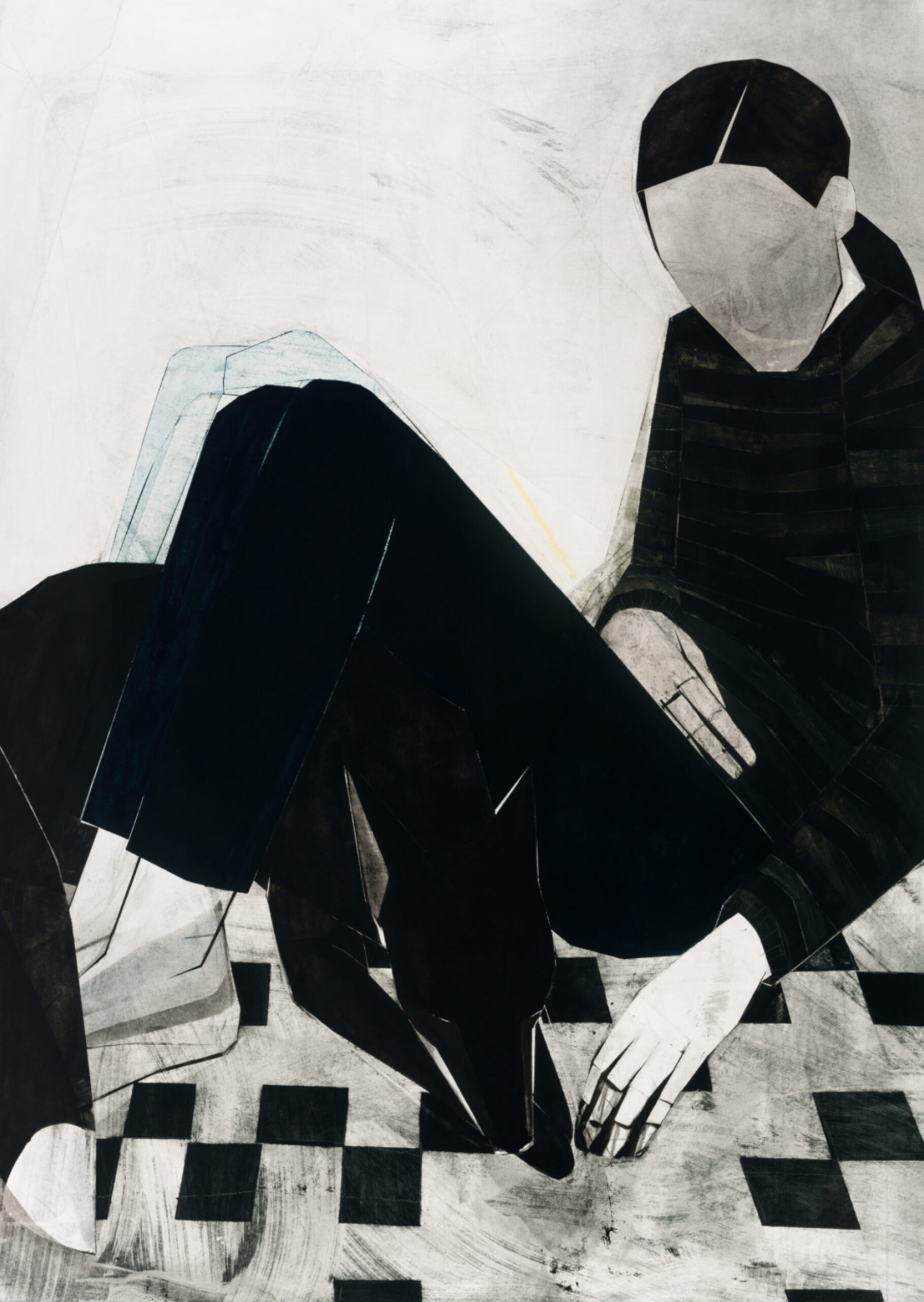
untitled (woman & fox), 2017
watercolour & paint on paper, 170 x 121 cm
while the others are dancing,
martin eugen raabenstein’s
sensor spotlight focuses on:
© iris schomaker
iris schomaker continually forces the human figure into a mannequin world, whose pictorial space she indeed explores in the classical manner of portraiture – yet the residual figurine within it, deprived of any individual identifying characteristic, she hands over to us in poses that are at times sensually dreamy, fully aware of its actual lostness, if it were to be … or wanted to be … or merely could be. the nonchalant scent of noble self-forgetfulness envelops the uncreased forehead, perhaps a trace of opium, a splash of heroin, or simple, deep-dripping, looming boredom. one can only speculate why face-to-face negotiation cannot necessarily take place here … for such a face does not exist. is it due to loss of face or intrusive interchangeability? scenes of robotic mechanics drift in, removable facial fronts with steel skulls beneath them, but no. that would correspond exactly to a counter-design to schomaker’s visualization of missing facial nuances.
portrait painting promises, as is already evident from the designation itself, a somehow artistically interpreted access to the depicted individual, whether as a sensual window to the soul, a demonstration of social power, or a psychically expressive explosion – yet the respectively chosen moment still requires a genuinely comprehensible line of development with a real psyche as its origin. although schomaker retains pose, gesture, and conventional portrait atmosphere, she nevertheless withdraws the finally clarifying face from the viewer, and precisely dismantles that very promise of representation; the frame remains, but the epistemic yield falls under the table. loss of face can thus be understood as a critique of the idea that truth is being negotiated here at all. a mannequin needs no face, is not conceived as a bearer of individuality, and thus offers the ideal surface for projection with accessories, clothing, or other luxury goods accordingly.
lostness in the schomakerian sense therefore corresponds not to deprivation but to actual unmasking — in the eternally back-and-forth interplay between self-perception and external perception, our social mask, which we desperately equate with depth, loses its urgency. schomaker’s pose appears sensual, dreamy, and opiate-tinted, with a protagonist who does not suffer her own erasure but consciously inhabits it or almost enjoys it. thus our interpretation slips away from loss toward refusal. the figure withdraws not despite but by means of this lack of identifiability, and indifference takes shape as a counter-design. andy warhol’s logic of repetition states that there is no beneath, that the face alone describes pure surface. schomaker’s pictorial system also tends toward a reinterpretation of cubic structures; this ism, too, favors non-individual findings, but we continue bravely to grope in the dark. what are we to do? do we leave the unknown standing, perform a respectful act before the autonomy of the artwork, and calmly wait to hear what others say, if they were to, wanted to, or merely could? woman with fox, perhaps the animal can help us further.
iir, june 2026
Iris Schomaker zwingt die menschliche Figur beständig in eine Modellpuppenwelt, deren Bildraum sie zwar in klassischer Porträtmanier erkundet – die jedweden individuellen Erkennungsmerkmales beraubte Restfigurine darin allerdings übereignet sie uns in mitunter sinnlich verträumter Pose, sich ihrer eigentlichen Verlustigkeit durchaus bewusst, so sie denn müsste … oder wollte … oder nur könnte. Der nonchalante Duft nobler Selbstvergessenheit umwölbt die nicht gekräuselte Stirn, ein Hauch Opium vielleicht, ein Spritzer Heroin, oder simple, in die Tiefe eintröpfelnde, dräuende Langeweile. Man kann nur vermuten, warum von Angesicht zu Angesicht hier nicht zwingend verhandelt werden kann … denn ein solches existiert nicht. Ist es Gesichtsverlust geschuldet oder aufdringlicher Austauschbarkeit? Szenen robotischer Mechanik schweben ein, abnehmbare Gesichtsfronten mit stählernen Schädeln darunter, aber nein. Das entspräche exakt einem Gegenentwurf Schomakers Visualisierung fehlender fazialer Nuancen.
Porträtmalerei verspricht, wie schon durch die Bezeichnung erkenntlich, einen wie auch immer künstlerisch interpretierten Zugang zum dargestellten Individuum, als sinnliches Seelenfenster, soziale Machtdemonstration oder seelisch expressive Explosion – der jeweils gewählte Moment allerdings benötigt noch immer eine tatsächlich nachvollziehbare Linienführung mit einer realen Psyche als Ursprung. Obwohl Schomaker Pose, Geste und gängige Porträtatmosphäre beibehält, entzieht sie dem Betrachter allerdings das final klärende Gesicht, und demontiert zielgenau eben jenes Abbildungsversprechen; die Rahmenform bleibt, der epistemische Ertrag allerdings fällt unter den Tisch. Gesichtsverlust kann solcherart als Kritik an der Idee verstanden werden, dass hier überhaupt Wahrheit verhandelt wird. Eine Modellpuppe benötigt kein Gesicht, ist nicht als Individualitätsträger gedacht und bietet so die ideale Oberfläche für Projektion mit Accessoires, Kleidung oder entsprechend anderen Luxusgütern.
Verlustigkeit im Schomakerschen Sinne entspräche dann nicht Beraubung, sondern eigentlicher Entlarvung — im ewig hin- und herspringenden Zusammenspiel zwischen Eigen- und Fremdwahrnehmung verliert unsere soziale Maske, die wir händeringend mit Tiefe gleichsetzen, ihre Dringlichkeit. Schomakers Pose erscheint sinnlich, träumerisch und opiatgetönt mit einer Hauptperson, die ihre eigene Auslöschung nicht erleidet, sondern bewusst bewohnt oder annähernd genießt. So entwischt unsere Deutung weg vom Verlust hin zur Verweigerung. Die Figur entzieht sich nicht trotz, sondern anhand dieser mangelnden Identifizierbarkeit und Indifferenz gestaltet sich zum Gegenentwurf. Andy Warhols Logik der Wiederholung besagt, es gebe kein Darunter, das Gesicht allein beschreibe reine Oberfläche. Schomakers bildnerisches System neigt zudem zur Uminterpretation kubischer Strukturen, auch dieser Ismus bevorzugt unindividuelle Findungen, aber wir tappen weiterhin tapfer im Dunklen. Was sollen wir tun? Lassen wir das Unbekannte stehen, vollziehen wir einen respektvollen Akt vor der Autonomie des Kunstwerks und warten ruhig ab, was die anderen sagen, wenn sie müssten, wollten oder nur könnten? Frau mit Fuchs, vielleicht kann uns ja das Tier weiterhelfen.
iir, june 2026