

j.r.r. tolkien
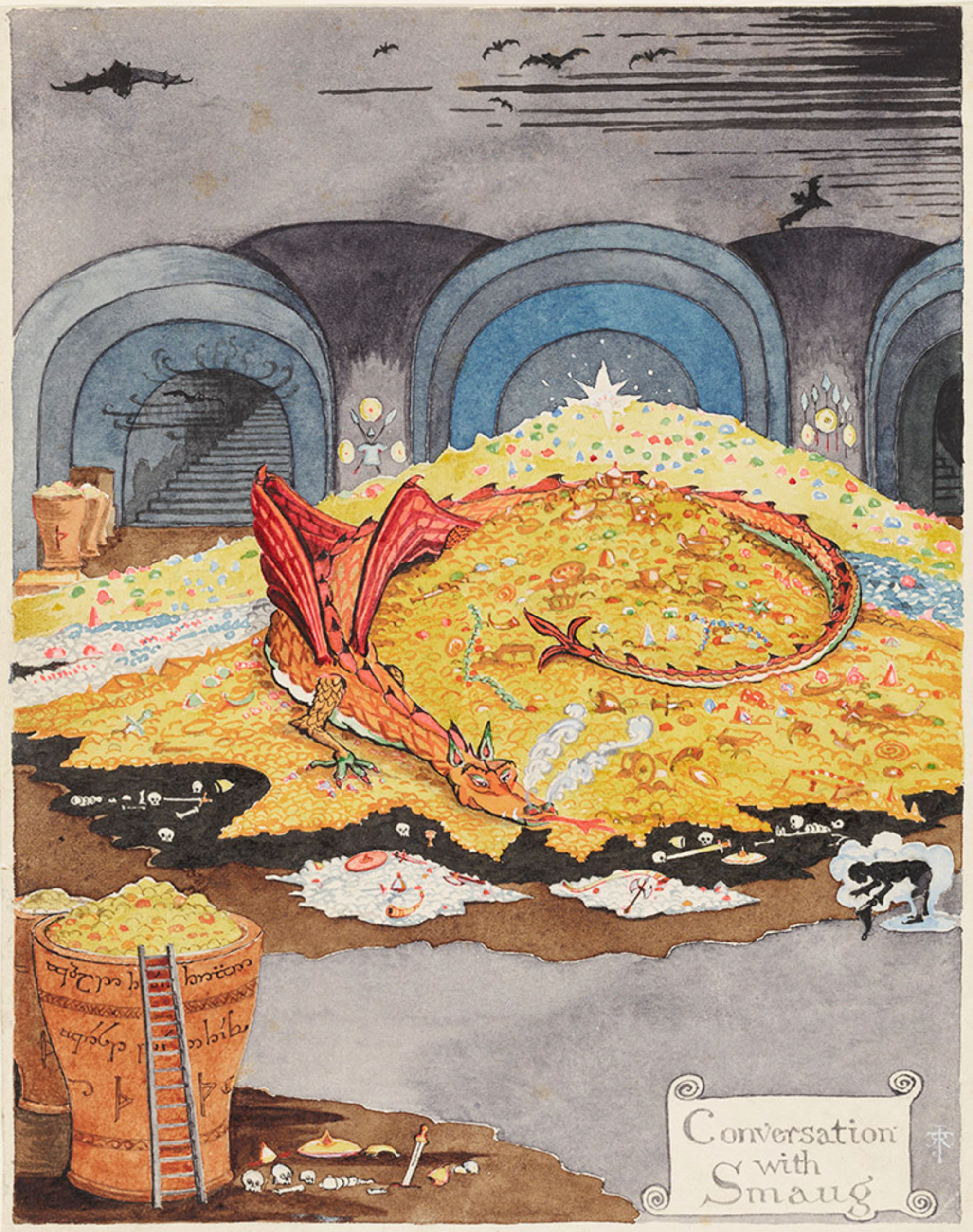
conversation with smaug, 1937
ink, indian ink and watercolour on paper, 13.3 x 18.1 cm
while the others are dancing,
martin eugen raabenstein’s
sensor spotlight focuses on:
© the tolkien estate
in 1951, j. r. r. tolkien writes to his publisher milton waldman. in the letter, he explains that he begins working on his middle-earth legendarium while still at school. as a professional philologist with a particular interest in linguistic aesthetics, his tastes naturally change over time, his theories improve, and his craft as a writer undoubtedly develops as well. behind his stories lies a network of nearly fully developed languages from which almost all of the names appearing in his legends are derived. this approach, tolkien continues, gives his nomenclature a distinctive character—cohesion, linguistic consistency, and the appearance of historical credibility—that is noticeably lacking in other comparable projects. his fundamental passion is myth rather than allegory. fairy tales, and especially heroic legends that exist on the boundary between fairy tale and history, are far too rare in his view. tolkien’s world is linguistically based; the professor of english philology draws his influences from a variety of sources: the old english beowulf narrative and anglo-saxon heroic poetry in general, the old norse edda and völsunga saga traditions, as well as the finnish kalevala and kullervo stories. the welsh language also serves as a model for him—primarily in a phonological and aesthetic sense—as an ideal of sound.
tolkien enjoys drawing. his technical skill in this area is of a commendable standard, yet he is a writer; his vision remains bound to the written word rather than the illustrative image. the lord of the rings, published in 1954–55, becomes one of the most successful books of the twentieth century and is regarded as a foundational work of modern fantasy literature. bo hansson releases a tribute album in 1970 that becomes a massive success throughout scandinavia. the ballantine paperbacks of the 1960s, featuring barbara remington’s psychedelic cover art, sell in the millions and shape an entire generation. fritz the cat director ralph bakshi produces an animated adaptation in 1978 in which certain scenes are first filmed with live actors and subsequently traced using the rotoscoping process. rankin/bass studios, known for christmas specials such as rudolph the red-nosed reindeer, are a fixture of american network television and produce the hobbit as an animated television special in 1977, broadcast on nbc, with orson bean as bilbo and john huston as gandalf. in 1980, the return of the king follows as a concluding special, since bakshi’s theatrical film tells the story only up to the battle of helm’s deep and, for legal reasons, receives no cinematic continuation. every child encounters this distribution model repeatedly: the specials are not aired only once but, like all rankin/bass productions, are broadcast for years as recurring programming blocks, often around holidays. much like a charlie brown christmas, this rotation creates a form of passive mass reception, entirely independent of whether one is actively interested in tolkien or not. middle-earth is delivered almost incidentally, as part of the television socialization process of an entire generation of american children.
interestingly, the animation for both specials is carried out by the japanese studio topcraft, whose core team later becomes the founding staff of studio ghibli. thus, a distant technical connection exists between early visual representations of tolkien and the later ghibli aesthetic. however, the storytelling traditions of hayao miyazaki and isao takahata emerge from a completely independent lineage that has nothing to do with tolkien or rankin/bass and concerns primarily the “how” rather than the “what” of storytelling. studio ghibli’s extended moments of quiet observation, its ecological awareness, and its pedagogical realism differ fundamentally from the structures of western high fantasy. the studio’s defining sensibility arises from the concept of ma, the deliberate interval or empty space, the act of lingering; other elements are lovingly borrowed from shintō mythology. the role-playing game scene adds another variation to the image of middle-earth. iron crown enterprises begins producing licensed tolkien material in 1982 through its middle-earth role playing (merp) line. here, the established military and historical illustrator angus mcbride spends years illustrating modules and sourcebooks featuring rohirrim riders, haradrim, and orcs. his style is heraldic, drawing on late antique and medieval armour typologies, and is scarcely distinguishable from what is now considered the jackson aesthetic. peter jackson, through his epic film adaptations, largely shapes our contemporary visual conception of tolkien’s world, supported by illustrators alan lee and john howe, who are likewise active in this field during the 1980s and 1990s and whom the director directly recruits for his trilogy.
four decades earlier, however, almost no one outside the role-playing game community takes notice of this development. the entire sourcebook genre of the 1980s—and with it merp—establishes a convention of “lore as illustration,” in which the tools of both applied and fine art are used to create and depict fictional worlds, to tell the backstories of characters, or to communicate mythologies. cultures, armour systems, and architectural traditions are systematically elaborated rather than merely illustrated. this very systematicity in the visual depiction of a secondary-world system serves as the visual counterpart to tolkien’s linguistic depth. from a production standpoint—at least within specialist circles—it establishes a practiced visual standard that jackson’s cinematic adaptation merely needs to adopt for a global audience. particularly fascinating in this regard are the differing visualizations of each decade. the remington covers are stylistically far removed from what we today perceive as “tolkienesque,” resembling flower-power surrealism far more than pseudo-medieval realism. accordingly, the canon embraced by jackson is itself a historically late development, one that bears little resemblance to the mass-cultural reception of the 1960s and engages only peripherally with tolkien’s original artwork. bilbo encounters the dragon: this depiction, created by the world-renowned author himself, resembles an innocent children’s book illustration and stands as a quintessential example of a world that continues to turn, endlessly forging and reforging its own images according to the tastes and desires of each new generation.
iir, june 2026
1951 schreibt J. R. R. Tolkien an seinen Verleger Milton Waldman. Darin erklärt er, dass er schon während seiner Schulzeit beginnt, an seinem Mittelerde-Universum zu arbeiten. Als professioneller Philologe mit besonderem Interesse für linguistische Ästhetik verändert sich später natürlich sein Geschmack, seine Theorie verbessert sich, und sicherlich entwickelt sich auch sein schriftstellerisches Handwerk weiter. Hinter seinen Geschichten verbirgt sich ein Geflecht nahezu vollständig ausgearbeiteter Sprachen, aus denen fast alle in seinen Legenden vorkommen Namen abgeleitet sind. Dieses Vorgehen, so Tolkien weiter, verleiht seiner Nomenklatur einen gewissen Charakter – Kohäsion, sprachliche Konsistenz und den Anschein historischer Glaubwürdigkeit –, der anderen vergleichbaren Projekten deutlich fehle. Seine grundlegende Leidenschaft gilt dem Mythos und nicht der Allegorie. Märchen, vor allem aber Heldenlegenden an der Grenze zwischen Märchen und Geschichte, gibt es aus seiner Sicht viel zu wenig. Tolkiens Welt ist linguistisch basiert, der Professor für englische Sprachwissenschaft zieht seine Einflüsse aus verschiedenen Quellen: der altenglischen Beowulf-Erzählung und angelsächsischer Heldendichtung im Allgemeinen, den altnordischen Edda– und Völsunga-Sagen sowie den finnischen Kalevala– und Kullervo-Geschichten. Die walisische Sprache ist für ihn zudem – allerdings primär nur phonologisch beziehungsweise ästhetisch – ein klangliches Vorbild.
Tolkien zeichnet gern. Sein handwerkliches Können ist hierin von anerkennenswertem Niveau, aber er ist Schriftsteller; die Vision ist dem geschriebenen Wort verhaftet und nicht dem illustrierenden Bild. The Lord of the Rings, 1954/55 veröffentlicht, ist eines der erfolgreichsten Bücher des 20. Jahrhunderts und gilt als Wegbereiter moderner Fantasy-Literatur. Bo Hansson bringt 1970 ein entsprechendes Hommage-Album heraus, das in Skandinavien zu einem Riesenerfolg wird. Die Ballantine-Taschenbücher der 1960er Jahre mit Barbara Remingtons psychedelischen Covern erscheinen in Millionenauflagen und prägen eine ganze Generation. Der Fritz the Cat-Filmregisseur Ralph Bakshi realisiert 1978 einen Animationsfilm, bei dem einige Szenen zunächst mit realen Schauspielern gedreht, um anschließend im Rotoskopie-Verfahren nachgezeichnet zu werden. Die Rankin/Bass Studios, bekannt für Weihnachtsspecials wie Rudolph the Red-Nosed Reindeer, sind eine feste Institution im US-Network-Fernsehen und produzieren 1977 The Hobbit als animiertes TV-Special, ausgestrahlt auf NBC, mit Orson Bean als Bilbo und John Huston als Gandalf. 1980 folgt The Return of the King als Abschluss-Special, da Bakshis Kinofilm die Geschichte nur bis zur Schlacht von Helms Klamm erzählt und aus rechtlichen Gründen keine filmische Fortsetzung erhält. Jedes Kind sieht dieses Distributionsmodell mehrfach: Die Specials laufen nicht nur einmal im Fernsehen, sondern werden wie alle anderen Rankin/Bass-Produktionen über Jahre hinweg als wiederkehrende Programmblöcke gesendet, oft um Feiertage herum. Ähnlich wie A Charlie Brown Christmas erzeugt diese Rotation eine passive Massenrezeption, gänzlich unabhängig davon, ob man sich tatsächlich und aktiv für Tolkien interessiert oder nicht. Mittelerde wird quasi nebenbei mitgeliefert, als Teil des amerikanischen TV-Sozialisationsprogramms einer ganzen Kindergeneration.
Interessanterweise wird die Animation für beide Specials vom japanischen Studio Topcraft ausgeführt, dessen Kernteam später die Gründungsmitarbeiter von Studio Ghibli stellt. So existiert eine entfernte technische Verbindung zwischen früher Tolkien-Bebilderung und späterer Ghibli-Ästhetik. Das Storytelling von Hayao Miyazaki und Isao Takahata hat allerdings eine völlig unabhängige und eigenständige Herkunftslinie, die mit Tolkien oder Rankin/Bass nichts zu tun hat und primär das „Wie“, nicht das „Was“ der Erzählung betrifft. Studio Ghiblis lange, in Ruhe geführte Alltagsbeobachtung, dessen ökologisches Bewusstsein und pädagogischer Realismus unterscheiden sich fundamental von den Strukturen westlicher High Fantasy. Die stilprägende Sensibilität des Studios entspringt dem Konzept des Ma, der bewussten Leerstelle, dem Verweilen; weitere Elemente sind liebevoll der Shintō-Mythologie entlehnt. Die Rollenspielszene fügt dem Mittelerde-Bild eine weitere Variation hinzu. Iron Crown Enterprises produziert mit der Middle-earth Role Playing-Linie (MERP) ab 1982 lizenziertes Tolkien-Material. Hier zeichnet der etablierte Militär- und Historienillustrator Angus McBride über Jahre hinweg Module und Sourcebooks mit Rohirrim-Reitern, Haradrim und Orks. Sein Stil ist heraldisch und mit Anleihen an spätantike und mittelalterliche Rüstungstypologien versehen und kaum vom heutigen Jackson-Look zu unterscheiden. Peter Jackson prägt durch seine epische Verfilmungen maßgeblich unsere heutige visuelle Vorstellung der Welt Tolkiens, unterstützt von den ebenfalls in den 80ern und 90ern in diesem Feld tätigen Illustratoren Alan Lee und John Howe, die der Regisseur für seine Trilogie direkt engagiert.
Vier Jahrzehnte zuvor nimmt dies außerhalb der Rollenspielszene allerdings kaum jemand zur Kenntnis. Das gesamte Sourcebook-Genre der 1980er Jahre – und damit auch MERP – etabliert eine Konvention von „Lore as Illustration“, bei der die Mittel angewandter und freier Kunst genutzt werden, um fiktive Welten zu erschaffen und darzustellen, Hintergrundgeschichten von Figuren zu erzählen oder Mythologien zu vermitteln. Kulturen, Rüstungen und Architekturen werden systematisch durchdekliniert und nicht nur einfach bebildert. Eben jene Systematik in der Illustration eines Sekundärweltsystems ist die visuelle Entsprechung zu Tolkiens linguistischer Tiefe. Sie errichtet produktionstechnisch – zumindest in Fachkreisen – einem eingeübten visuellen Standard, dessen sich Jacksons filmische Umsetzung für ein Weltpublikum nur noch zu bedienen braucht. Spannend sind hierbei auch die unterschiedlichen Visualisierungen der jeweiligen Jahrzehnte. Die Remington-Cover sind stilistisch weit entfernt von dem, was wir heute als tolkienesk empfinden, und eher Flower-Power-Surrealismus als pseudo-mittelalterlicher Realismus. Dieser von Jackson bediente Kanon ist dementsprechend selbst ein historisch spätes Produkt, das der ursprünglichen Massenkultur-Rezeption der 1960er Jahre wenig entspricht und mit den ursprünglichen Arbeiten Tolkiens nur peripher umgeht. Bilbo trifft auf den Drachen: Diese Darstellung aus der Hand des Weltautors selbst entspricht einer unschuldigen Kinderbuchillustration und ist ein mustergültiges Beispiel für eine sich immer weiter drehende Welt, die sich ihre Bilder frei nach Belieben eifrig passend zurechtschmiedet.
iir, june 2026