

jean-michel basquiat
self-portrait, 1984
acrylic, oil pastels & paper on canvas, 98,7 x 71,1 cm
while the others are dancing,
martin eugen raabenstein’s
sensor spotlight focuses on:
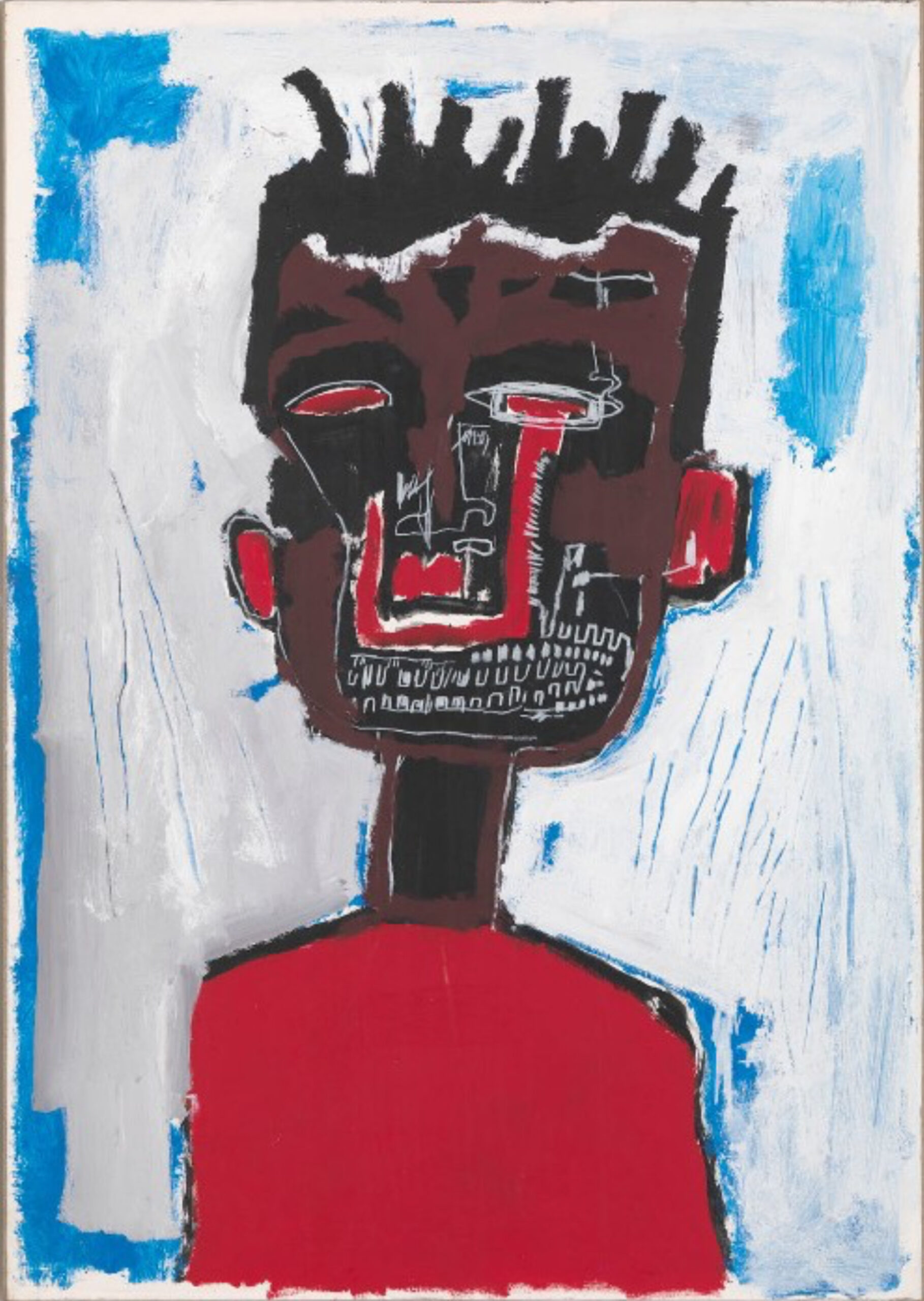
© the estate of jean-michel basquiat
a black artist from the graffiti scene thoroughly shakes up the white art world thanks to his mentor andy warhol and dies at the age of 27, which corresponds exactly to a mythology that the art market requires for solid value appreciation. his early death has a stabilizing effect on the body of work and thus prevents a possibly disappointing flattening-out late phase. jean-michel basquiat furthermore strikes a genuine nerve of art history with perfect precision by hurling a content-laden painting practice permeated with figuration, text and history against the enervated minimal and concept art of the late seventies. the visual and thematic engagement with slavery, jazz, boxing and ancient as well as african references now stands in opposition to a self-satisfied, self-referential epoch heavily burdened with mental prohibition signs, places itself cheerfully smiling alongside the neo-expressionists francesco clemente and julian schnabel, and likewise enables a later identity-political reading. a line from the 1976 political thriller all the president’s men gets to the heart of the matter: “follow the money” is a remarkable indicator not only of criminal machinations, and thus basquiat dominats the secondary market since the 2010s as one of its most liquid names. auction houses value trophy works, and the artist’s relatively short creative period, together with the fact that many works are in private hands, creates an artificial scarcity that drives prices upward amid simultaneously high demand – supported by fresh capital from newly developed markets such as asia, which seeks legitimacy through iconic names rather than through corresponding art-historical expertise.
added to this, and this is the truly cynical point, is the marketing of his difference, which itself in turn becomes a commodity; the “wild genius from the street” is a narrative that can be comfortably consumed by the establishment without having to genuinely engage with the structural critique contained in his work. the ongoing hype surrounding his work amounts, as unfortunately so often, to a monetary form of appropriation accompanied by the marginalization of its artistic potential for content. no other black artist achieves during his lifetime a comparable position within the white-dominated gallery and collector apparatus of figures such as mary boone, bischofberger or gagosian. with some delay, glenn ligon and david hammons conquer certain art-market segments, but they do not come close to entering this premier league of auction prices and celebrity status. basquiat dies at the age of 27 from an overdose of numerous drugs, mainly heroin, and there may be various reasons for this. the 1985 exhibition paintings, together with andy warhol at tony shafrazi, is heavily attacked by critics; eleanor heartney and especially vivien raynor in the new york times effectively describe basquiat as warhol’s mistress, as a talented mascot who allows himself to be used. accordingly, basquiat is devastated, and friends later report extreme self-doubt. the corresponding exhibition poster seems to portray perfectly and cynically what others perceive as an asymmetrical relationship – both are staged half-naked and boxing, as a white pop patriarch exchanging blows with his wild black protégé. warhol benefits from the connection, both economically and symbolically; basquiat lends street credibility to warhol’s crumbling relevance and provides renewed access to a significantly younger scene.
warhol’s death in february 1987, however, seemingly changes this superficially and maliciously constructed image, because afterwards basquiat’s decline accelerates dramatically and he dies barely a year and a half later. despite an obviously exploitative dynamic, this nevertheless suggests a stabilizing fatherly function, in that the older man even succeeds for a time in weaning basquiat off heroin and forces him to jog daily and work in the studio. a highly specific and unequal relationship of exploitation collapses, and as a consequence both partners are dead. jean-michel basquiat is the son of a haitian father and a puerto rican mother, leaves his family home in brooklyn at the age of fifteen and survives on the streets – two early experiences of strain are cited in relation to his drug addiction. after a serious traffic accident at the age of eight, his spleen is removed; during his months-long stay in hospital, his mother gives him the classic gray’s anatomy as a present, which inspires the anatomical motifs of his later work. his mother’s psychiatric illness and temporary institutionalization are likewise regarded as a possible cause of self-medication. a clean separation from the later market/warhol dynamic appears pointless, since both causal strands operate simultaneously and can even reinforce one another. basquiat’s self-portrait of 1984 does not possess the distinctive charge characteristic of other groups of works, but it can nevertheless provide insight into the artist’s visual world with only a few details.
iir, june 2026
Ein schwarzer Künstler aus der Graffitiszene mischt dank seines Mentors Andy Warhol die weiße Kunstszene kräftig auf und verstirbt im Alter von 27 Jahren, das entspricht exakt einer Mythologie, die der Kunstmarkt für solide Wertsteigerung benötigt. Sein früher Tod wirkt stabilisierend auf das Werk und verhindert so eine möglicherweise enttäuschend abflachende Spätphase. Jean-Michel Basquiat trifft zudem punktgenau einen genuinen Nerv der Kunstgeschichte, indem er der erschlafften Minimal- und Concept Art der späten Siebziger mit Figuration, Text und Geschichte durchwachsene, inhaltsbeladene Malerei entgegenschleudert. Die bildnerisch inhaltliche Auseinandersetzung mit Sklaverei, Jazz, Boxen und antiken sowie afrikanischen Referenzen steht nun einer selbstgefälligen selbstreferenziellen, massiv mit mentalen Verbotsschildern behafteten Epoche gegenüber, stellt sich freudig lächelnd an die Seite der Neo-Expressionisten Francesco Clemente nebst Julian Schnabel und ermöglicht gleichfalls eine spätere identitätspolitische Lesart. Ein Spruch aus dem Politthriller Die Unbestechlichen von 1976 bringt die Sache auf den Punkt, „Folge immer dem Geld“ ist ein bemerkenswerter Indikator nicht nur für kriminelle Machenschaften und so beherrscht Basquiat seit den 2010ern als einer der liquidesten Namen den Sekundärmarkt. Die Auktionshäuser schätzen Trophäenwerke, des Künstlers relativ kurze Schaffensperiode und künstliche Verknappung bei gleichzeitig hoher Nachfrage – begünstigt durch frisches Kapital aus neu erschlossenen Märkten wie Asien, das Legitimität durch ikonische Namen sucht anstatt entsprechendem kunsthistorischem Fachwissen.
Hinzu kommt, und das ist der eigentlich zynische Punkt, die Vermarktung seiner Differenz, die selbst wiederum zur Ware wird, der „wild genius from the street“ ist ein für das Establishment bequem konsumierbare Narration, ohne sich mit der inhaltlich strukturellen Kritik seiner Arbeit tatsächlich auseinandersetzen zu müssen. Der anhaltende Hype um seine Arbeit entspricht, wie leider so oft, einer monetären Form von Aneignung bei gleichzeitiger Marginalisierung des künstlerischen Inhaltspotentiales. Kein anderer schwarzer Künstler erreicht zu Lebzeiten eine vergleichbare Position im weiß geprägten Galerie- und Sammlerapparat von Größen wie Mary Boone, Bischofberger oder Gagosian. Mit einiger Verzögerung erobern Glenn Ligon und David Hammons gewisse Kunstarktsegmente, stoßen aber bei Weitem nicht in diese Oberliga aus Auktionspreisen und Celebrity-Status vor. Basquiat stirbt mit 27 Jahren an einer Überdosis unterschiedlicher Drogen, hauptsächlich Heroin und dafür mag es verschiedene Gründe geben. Die 1985er Ausstellung Paintings gemeinsam mit Andy Warhol bei Tony Shafrazi wird von der Kritik gewaltig beschossen, Eleanor Heartney und vor allem Vivien Raynor in der New York Times bezeichnen Basquiat sinngemäß als Warhols Mätresse, als talentiertes Maskottchen, das sich benutzen lässt. Basquiat ist dementsprechend am Boden zerstört und Freunde berichten später von massivsten Selbstzweifeln. Das entsprechende Ausstellungsplakat scheint perfekt und zynisch abzubilden, was andere als asymmetrisches Verhältnis wahrnehmen – beide sind halbnackt und boxend inszeniert als weißer Pop-Patriarch im Schlagabtausch mit seinem wilden, schwarzen Zögling. Warhol profitiert von der Verbindung, sowohl ökonomisch als auch symbolisch, Basquiat verleiht dessen bröckelnder Relevanz Street-Credibility und verschafft neuen Anschluss an eine deutlich jüngere Szene.
Warhols Tod im Februar 1987 allerdings ändert das vordergründig und boshaft aufgezogene Bild vermeindlich, denn danach beschleunigt sich Basquiats Verfall dramatisch und er stirbt knapp anderthalb Jahre später. Dies lässt, trotz einer offensichtlich ausbeuterischen Dynamik, auf eine gleichwohl stabilisierende Vaterfunktion rückschließen, indem der Ältere Basquiat zeitweise sogar erfolgreich von Heroin abbringt und ihn täglich zum Joggen und ins Studio zwingt. Eine sehr spezifische und ungleiche Verwertungsbeziehung kollabiert und in Folge sind beide Partner tot. Jean-Michel Basquiat ist Sohn eines haitianischen Vaters und einer puerto-ricanischen Mutter, verlässt mit fünfzehn Jahren sein Elternhaus in Brooklyn und schlägt sich auf der Straße durch – für seine Drogenabhängigkeit werden zwei frühe Belastungsmomente herangezogen. Nach einem schweren Verkehrsunfall im Alter von acht Jahren wird die Milz entfernt, anlässlich seines monatelangen Krankenhausaufenthaltes schenkt ihm seine Mutter den Klassiker Gray’s Anatomy, die Inspiration zu anatomischen Motiven seines späteren Werks. Die psychiatrische Erkrankung und zeitweise Einweisung der Mutter gilt ebenfalls als möglicher Grund von Self-Medication. Eine saubere Trennung von der späteren Markt-/Warhol-Dynamik erscheint sinnlos, da beide Kausalstränge gleichzeitig wirken und sich gegenseitig sogar verstärken können. Basquiats Selbstporträt von 1984 hat nicht die ihm sehr eigene Aufgeladenheit anderer Werkgruppen, kann aber dennoch mit nur wenigen Details Einblick in die visuelle Welt des Künstlers vermitteln.
iir, june 2026