

moebius
l’incal, 1981 –
comic book series
while the others are dancing,
martin eugen raabenstein’s
sensor spotlight focuses on:

© les humanoïdes associés
comfortably sharing his bathwater with a homeo-geisha, a quisky in his hand, that is all john difool, class r private detective, desperately dreams of. but – and this surprises absolutely no one – things turn out completely different. between 1981 and 1988, the first six-part incal cycle, penned by alejandro jodorowsky with drawings by moebius, is published by les humanoïdes associés. the coloring passes from hand to hand; yves chaland, isabelle beaumenay-joannet, and zoran janjetov make the panels bloom, and finally, the colorist janjetov also takes over the drawing for the prequel series before the incal. moebius tosses in a single follow-up volume, after the incal, but jodorowsky is grumpy and forbids its continuation. josé ladrönn is then allowed to draw the three-part final incal, and then it is over in the incal universe. however, jodorowsky cannot keep his hands off it, and so the series of the technopriests and the metabarons drift aimlessly around the core idea.
in this one, difool rather accidentally acquires the „light incal,“ a crystalline artifact of immeasurable power, and thus becomes the target of various forces. the corrupt government, the alien race of the bergs, mutants, and the fanatical science sect of the techno-technos are alternately hot on his heels. at the same time, the entity known as the „great darkness“ threatens the universe, and the plagued difool must reluctantly form a community of fate with his talking cement bird deepo, the incal keeper animah, her sister tanatah, the mercenary metabaron, the androgynous solune, and the mercenary kill doghead to banish this danger. in the process, they flee from the dystopian, vertical shaft-city to the center of the planet; intergalactic and metaphysical dimensions come into play, and the seven characters must unite to achieve the state of the „fifth essence“ through the incal and thus finally defeat the darkness. however, difool loses the cosmic enlightenment he gained on his fantastic odyssey as well as his memory and finds himself falling down the exact same shaft where the whole story begins.
jodorowsky’s perfectly staged, narrative full circle reveals a vision of the future as a satirically cynical dystopia. uncontrolled, freely proliferating capitalism, mass consumption, and an increasing technocracy – the chilean of ukrainian descent bundles socio-political currents of the 1980s into a juicily marbled sweeping blow, whose targeted critique also aims far into the esoteric circles of the time. he presents a vertical class society, classic marx, so nothing new in the west and not only here. people live in planet-deep shafts: the elites and rulers in the upper, bright, and clean levels, the rest down below in the shadowy garbage. his social fiction is also oriented towards the pre-modern era; social advancement is virtually impossible. consumer terror and media manipulation serve in jodorowsky’s work as a distraction for the ruling class. the population is sedated by 24/7 holo-television and similar news propaganda with the help of synthetic drugs. in this way, the citizen degenerates, is reduced to purely hedonistic consumption, in which political will or rebellion finds no place at all due to this constant entertainment.
the author cleverly plays technocracy against spirituality by having the overpowering sect of the techno-technos, with their blindly dogmatic, mechanical belief in science, efficiently fight all natural striving – machines and scientific progress serve total surveillance, manipulation, and destruction here. the planet in this scenario is dead, nature comprehensively destroyed and built over. amidst toxic gases, gigantic acid lakes, and endless garbage dumps, the physical poisoning of the world reflects the spiritual emptiness of its apathetic inhabitants. this radically materialistic and corrupt civilization cannot be saved by political reforms, technology, or social revolutions. the only way out in this esoterically shaped universe is radical metaphysical transcendence. only through the overcoming of the lower ego and the expansion of consciousness can this spirituality heal the world again, in order to escape the eternal cycle of consumption and destruction.
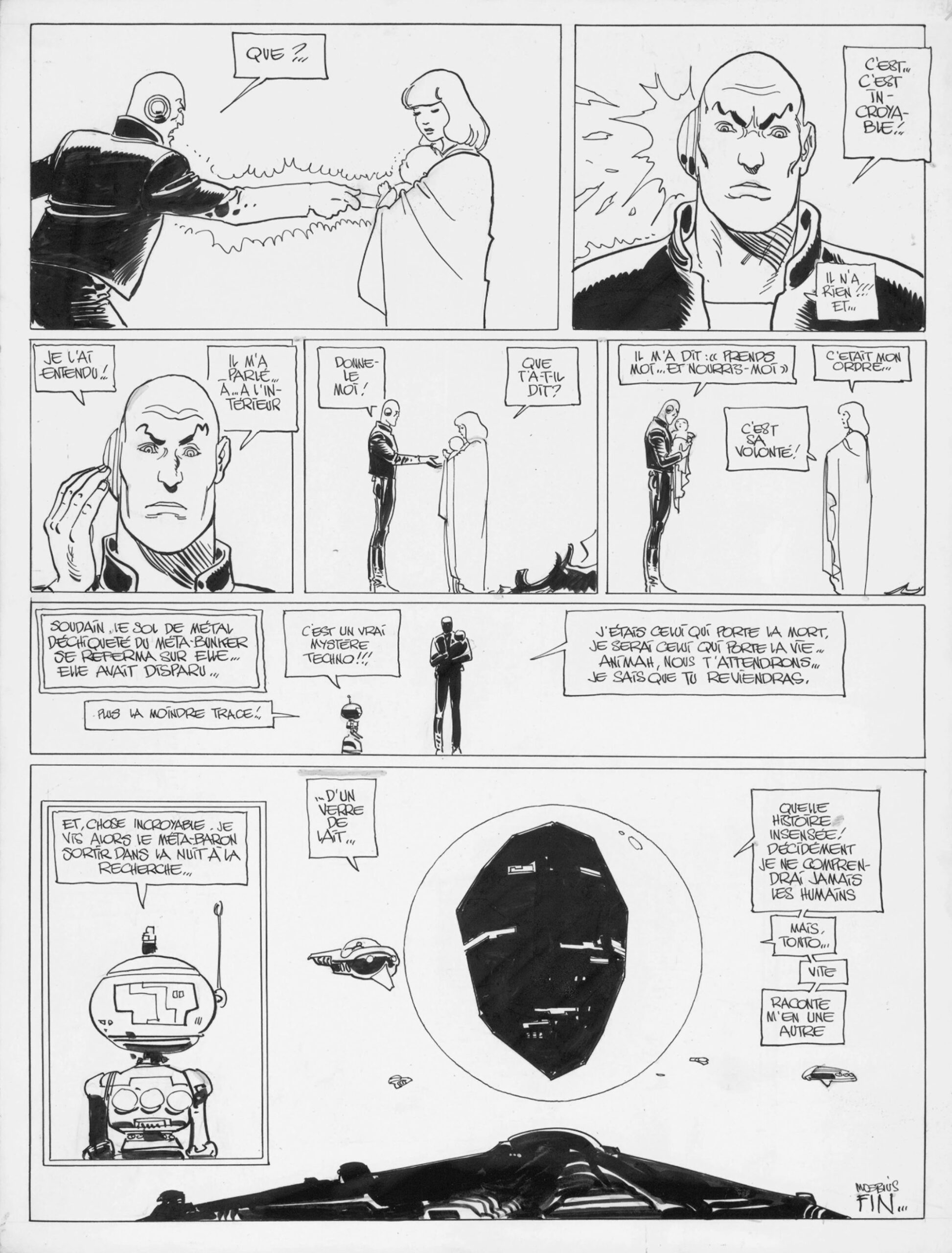
moebius is more than just the executing craftsman of jodorowsky’s vision. he is an indispensable counterweight that saves this work from narrative and philosophical collapse, which would presumably crumble, wheezing, under the esoteric, cynical, and violent fantasies of the author without the artist’s influence. jodorowsky’s approach to spirituality is loud, theatrical, often bloody, and deeply rooted in strictly occult systems like tarot, kabbalah, or psychomagic; his mind produces a constantly proliferating, chaotic universe. moebius translates this chaotic proliferation into deeply meditative, zen-oriented clarity in the panels – he visualizes metaphysical transcendence not as a loud, esoteric bang, but as a weightless, silent gliding. moebius himself is strongly influenced by shamanism, especially by the writings of carlos castaneda; meditation and a very fluid, nature-connected esotericism shape him. he designs crystals, light in general, and his eternal theme of the desert with its organic forms with an aura of genuine holiness. he grants the radical transcendence that jodorowsky invokes thematically the necessary visual poetry and emotional credibility.
furthermore, jodorowsky just throws around abstract social concepts. in moebius’s translation, this intellectual superstructure achieves a tangible, physically plausible reality. his legendary sense of space, perspective, and gigantic architecture, as well as his brilliant, pure stroke, allow the master of the evolved ligne claire to prevent the overloaded dystopian world from sinking into visual garbage. while jodorowsky conceptually designs john difool as the „fool“ of the tarot who blindly stumbles into adventure, moebius draws him jowl-faced and cowardly in a flabby, imperfect body. with this deeply felt, visualized humanity in the face of cosmic gods, apocalyptic dangers, and miraculous healing processes, our empathy is awakened with simple means. moebius’s spiritual search is shaped by intense self-doubt, and difool breathes out exactly this vulnerable fallibility in every panel. jodorowsky analyzes and identifies the symptoms of civilizational tumors and formulates purely theoretical concepts for help. but only moebius develops and administers the healing medication. with his very own, inward-looking spirituality, moebius transforms a cynically designed, agitated science-fiction pamphlet into a glowing, metaphysical masterpiece. for clarifying proof, one only has to look closer at jodorowsky’s cinematic work – or moebius’s all-encompassing remaining body of work …
iir, may 2026
Sich das Badewasser gemütlich mit einer Homöogeisha teilen, einen Quisky in der Hand, das ist alles, was sich John Difool, Privatdetektiv der Klasse R, sehnlichst erträumt. Aber – niemanden wundert das wirklich – es kommt alles ganz anders. Zwischen 1981 und 1988 erscheint bei Les Humanoïdes Associés der erste sechsteilige Inkal-Zyklus aus der Feder von Alejandro Jodorowsky mit Zeichnungen von Moebius. Die Kolorierung wandert von Hand zu Hand, Yves Chaland, Isabelle Beaumenay-Joannet und Zoran Janjetov lassen die Panels erblühen, und schließlich übernimmt der Kolorist Janjetov auch die Zeichnerei für die Nachfolgereihe Vor dem Inkal. Moebius wirft noch einen einzelnen Band John Difool nach der Katharsis hinterher, aber Jodorowsky ist maulig und untersagt dessen Fortsetzung. José Ladrönn darf dann noch den Dreiteiler Final Inkal zeichnen, dann ist Schluss im Inkal-Universum. Jodorowsky kann aber die Finger nicht davon lassen, und so treiben zusätzlich die Serien der Techno-Väter und der Meta-Barone ziellos um die Kernidee herum.
In dieser erlangt Difool eher zufällig den „Licht-Inkal“, ein kristallines Artefakt unermesslicher Macht, und wird so zur Zielscheibe verschiedener Mächte. Die korrupte Regierung, die Alien-Rasse der Bergs, Mutanten und die fanatische Wissenschaftssekte der Techno-Technos sind ihm wechselnd auf den Fersen. Zugleich bedroht die „Große Finsternis“ genannte Entität das Universum, und der geplagte Difool muss widerwillig eine Schicksalsgemeinschaft mit seinem sprechenden Zementvogel Deepo, der Inkal-Hüterin Animah, ihrer Schwester Tanatah, dem Söldner Metabaron, dem androgynen Solune und dem Söldner Kill Hundekopf bilden, um diese Gefahr zu bannen. Dabei fliehen sie aus der dystopischen, vertikalen Schacht-Stadt zum Mittelpunkt des Planeten, intergalaktische und metaphysische Dimensionen kommen ins Spiel, und die sieben Charaktere müssen sich vereinen, um durch den Inkal den Zustand der „Fünften Essenz“ zu erreichen und die Finsternis so final zu besiegen. Difool büßt allerdings die auf seiner fantastischen Irrfahrt erlangte kosmische Erleuchtung sowie sein Gedächtnis ein und findet sich im Sturz in exakt denselben Schacht wieder, wie die ganze Geschichte beginnt.
Jodorowskys perfekt inszenierter, narrativer Zirkelschluss zeigt eine Zukunftsvision als satirisch-zynische Dystopie. Unkontrollierter, frei wuchernder Kapitalismus, Massenkonsum und eine zunehmende Technokratie – der aus der Ukraine stammende Chilene bündelt gesellschaftspolitische Strömungen der 1980er Jahre zu einem saftig durchwachsenen Rundumschlag, dessen zielgerichtete Kritik auch weit in die esoterischen Kreise der Zeit zielt. Er präsentiert eine vertikale Klassengesellschaft, classic Marx, im Westen und nicht nur hier also nichts Neues. Man lebt in planetentiefen Schächten: die Eliten und Herrschenden in den oberen, hellen und sauberen Ebenen, der Rest drunten im schattigen Müll. Auch seine soziale Fiktion orientiert sich an der Vormoderne; gesellschaftlicher Aufstieg ist quasi unmöglich. Konsumterror und mediale Manipulation dienen bei Jodorowsky als Ablenkung der herrschenden Klasse. Die Bevölkerung wird durch 24/7-Holo-Fernsehen und ebensolche Nachrichtenpropaganda unter Zuhilfenahme synthetischer Drogen sediert. Solcherart degeneriert der Bürger, wird auf rein hedonistischen Konsum reduziert, in dem politischer Wille oder Aufbegehren durch diese Dauerbespaßung gar keinen Platz findet.
Der Autor spielt clever Technokratie gegen Spiritualität aus, indem er die übermächtige Sekte der Techno-Technos mit ihrem blind dogmatischen, maschinellen Wissenschaftsglauben alles natürliche Streben effizient bekämpfen lässt – Maschinen und wissenschaftlicher Fortschritt dienen hier totaler Überwachung, Manipulation und Zerstörung. Der Planet in diesem Szenario ist tot, die Natur flächendeckend vernichtet und verbaut. Inmitten toxischer Gase, gigantischer Säureseen und unendlicher Mülldeponien spiegelt die physische Vergiftung der Welt die spirituelle Leere ihrer teilnahmslosen Bewohner wider. Diese radikal materialistische und korrupte Zivilisation kann nicht durch politische Reformen, Technologie oder soziale Revolutionen gerettet werden. Der einzige Ausweg in diesem esoterisch geprägten Universum ist die radikale metaphysische Transzendenz. Erst durch die Überwindung des niederen Egos und die Erweiterung des Bewusstseins kann diese Spiritualität die Welt wieder heilen, um so dem ewigen Kreislauf aus Konsum und Zerstörung zu entkommen.
Moebius ist mehr als nur der ausführende Handwerker von Jodorowskys Vision. Er ist ein unverzichtbares Gegengewicht, das dieses Werk vor dem erzählerischen und philosophischen Kollaps bewahrt, welches vermutlich ohne den Einfluss des Zeichners unter den esoterischen, zynischen und gewalttätigen Fantasien des Autors röchelnd zusammenbräche. Jodorowskys Spiritualitätsansatz ist laut, theatralisch, oft blutig und tief in streng okkulten Systemen wie Tarot, Kabbala oder Psychomagie verwurzelt; sein Geist produziert ein beständig weiter anwachsendes, chaotisches Universum. Moebius setzt diese chaotische Wucherung in zutiefst meditativer, Zen-orientierter Klarheit in den Panels um – er visualisiert metaphysische Transzendenz nicht als lauten, esoterischen Knall, sondern als schwereloses, stilles Gleiten. Moebius ist selbst stark vom Schamanismus beeinflusst, insbesondere von den Schriften von Carlos Castaneda; Meditation und eine sehr fließende, naturverbundene Esoterik prägen ihn. Kristalle, Licht im Allgemeinen und sein ewiges Thema der Wüste mit ihren organischen Formen gestaltet er mit einer Aura echter Heiligkeit. Er verleiht der radikalen Transzendenz, die Jodorowsky thematisch anruft, die notwendige visuelle Poesie und emotionale Glaubhaftigkeit.
Zudem wirft Jodorowsky mit abstrakten Gesellschaftskonzepten nur so um sich. In der Moebius’schen Übersetzung erlangt dieser intellektuelle Überbau eine greifbare, physisch plausible Realität. Sein legendäres Gespür für Raum, Perspektive und gigantische Architektur sowie sein brillanter, reiner Strich lassen den Meister der weiterentwickelten Ligne Claire verhindern, dass die überladen dystopische Welt im visuellen Müll versinkt. Während Jodorowsky John Difool konzeptionell als den „Narren“ des Tarots anlegt, der blindlings ins Abenteuer stolpert, zeichnet Moebius ihn hängebackig und feige in einem schlaffen, unperfekten Körper. Mit dieser tief empfundenen, visualisierten Menschlichkeit im Angesicht kosmischer Götter, apokalyptischer Gefahren und wundersamer Heilungsprozesse wird mit einfachen Mitteln unsere Empathie geweckt. Moebius’ spirituelle Suche ist von intensiven Selbstzweifeln geprägt, und genau diese verletzliche Fehlbarkeit atmet Difool in jedem Panel aus. Jodorowsky analysiert und bezeichnet die Symptome zivilisatorischer Geschwulste und formuliert rein theoretisch Hilfskonzepte. Aber erst Moebius entwickelt und verabreicht das heilende Medikament. Mit seiner ureigenen, nach innen gerichteten Spiritualität transformiert Moebius ein zynisch angelegtes, aufgeregtes Science-Fiction-Pamphlet in ein leuchtendes, metaphysisches Meisterwerk. Zum klärenden Beweis schaue man sich Jodorowskys filmisches Werk genauer an – oder Moebius’ allumfassendes restliche Arbeiten …
iir, may 2026
© les humanoïdes associés