

n.n.
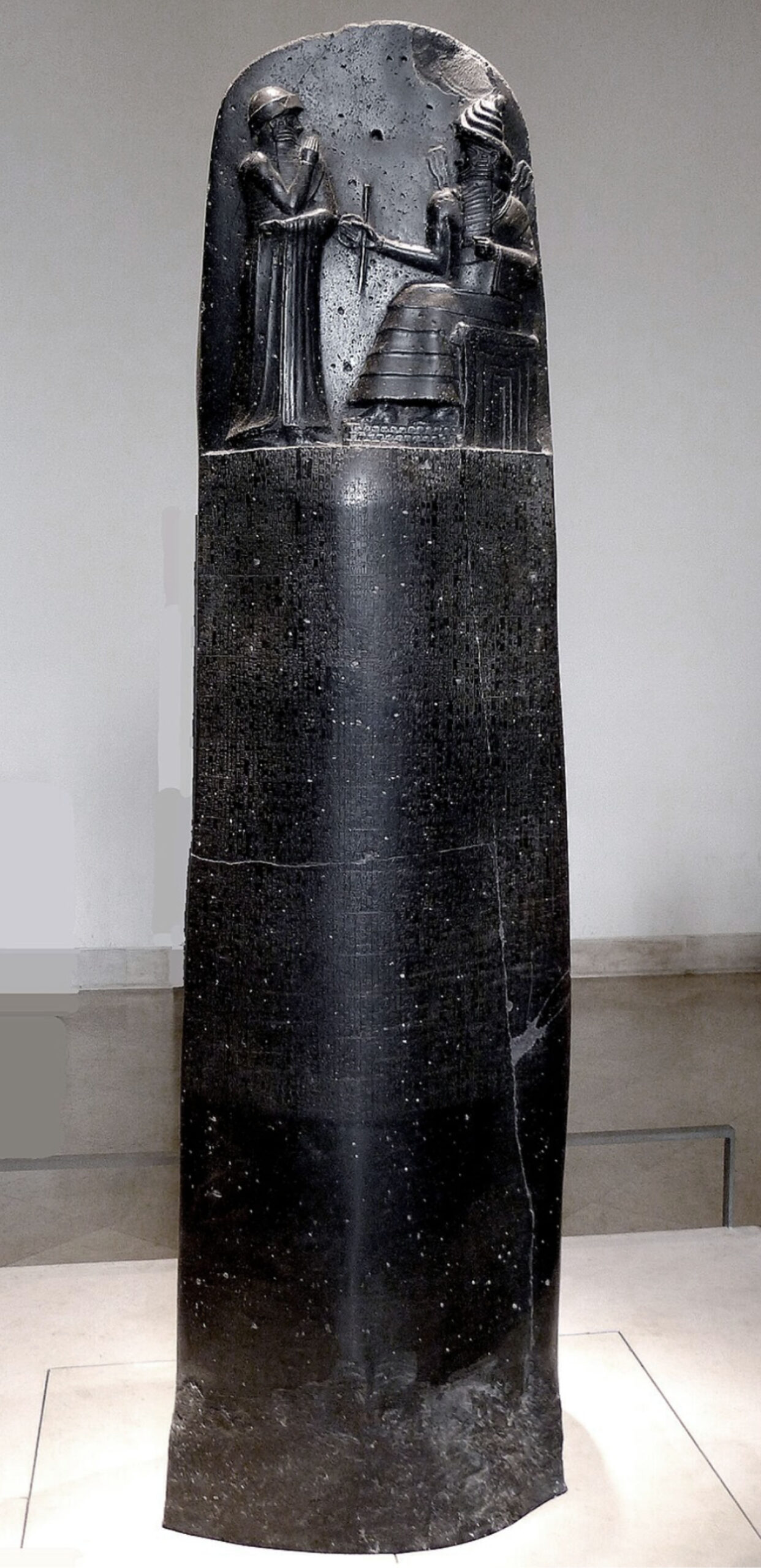
codex hammurapi, 1800 bc
stone heritage, 225 x 79 x 47 cm
while the others are dancing,
martin eugen raabenstein’s
sensor spotlight focuses on:
© louvre paris
the code of hammurabi is a collection of babylonian legal rulings from the 18th century bce and is considered one of the most important literary works of ancient mesopotamia. the texts, attributed to hammurabi, the sixth king of the first dynasty of babylon, are preserved on a 2.25-metre-high diorite stele, several fragments of additional basalt steles, and in more than 30 copies on clay tablets from the second and first millennia bce. babylon’s core territory lies within what is today southern iraq. the approximately 8,000 words inscribed in cuneiform on the main stele are divided into 49 columns of around 80 lines each and consist of three sections: a prologue establishing the king’s divine legitimacy, followed by a main body of 282 legal provisions, and an epilogue praising the king’s righteousness and urging future rulers to uphold the norms covering public law, property law, debt law, family law, inheritance law, criminal law, tenancy law, and the regulation of livestock and slaves. in the winter of 1901/1902, gustave jéquier and jean-vincent scheil, during a french expedition to persia led by jacques de morgan, discover three fragments in the acropolis of susa, which are promptly reassembled into a single stele and handed over to the parisian museum. the editing and translation into french is carried out in the same year by jean-vincent scheil.
the codex is not the oldest law code in the world, but by far the most extensive and best-preserved work of its kind from that era. it is known, among other things, for the principle of talion – the notion of an eye for an eye, a tooth for a tooth – which at the time of hammurabi represents an enormous civilisational advance, as it upholds the idea of proportionality. the previously common and unlimited practice of blood vengeance is prohibited, and punishment is established as no more severe than the offence committed. the codex also requires witnesses, contracts, and tangible evidence before a court, and prescribes harsh penalties for false accusations or for judges who seek to manipulate a verdict once it has been delivered. regarded as an early root of due legal process, the text governs not only murder and manslaughter but every aspect of daily life – from shoddy construction work and minimum wages for agricultural labourers to liability for damage caused by the negligent flooding of a neighbour’s fields. historians thus gain an invaluable insight into sources for economic and social history.
the name hammurabi has been heard increasingly often in recent times, as archaeology and linguistics deploy ai models to translate fragmentary and barely legible cuneiform tablets and to virtually reassemble broken pieces. tens of thousands of clay tablets – including many copies and everyday records referring to hammurabi’s laws – are stored in museum archives. the ai systems decode valuable details of this ancient world with accuracy rates of between 80 and 90 percent. since the pergamon museum in berlin is closed for years due to renovation, many exhibits have to be relocated; a historical cast of the codex has recently been integrated into the permanent collection of the bode museum – as one of the earliest documents to fix prices, values, and financial penalties by state authority, set down centuries before the invention of coinage. international archaeological projects are also refocusing increasingly on old babylonian settlements from the time of hammurabi, such as the current excavations at tell muhammad near baghdad. the main focus is on investigating the lived reality of the ordinary population in relation to these laws. the codex is more than ever an intensely active object of research and a starting point for current debates about how societies negotiate rules.
above all, assyriology – the study of the ancient near east – and legal history have in recent years undermined several long-held certainties about the code of hammurabi and produced radical reinterpretations of what this text actually is. in line with this paradigm shift, the code of hammurabi is not a binding law code in the sense of our modern understanding. scholars such as martha roth and pamela barmash emphasise that the text probably played no role in actual court proceedings. as evidence they cite tens of thousands of everyday court records and contracts from the time of hammurabi in which not a single document quotes the relevant clause from the stele. it is therefore assumed that the codex is more likely a literary collection of model judgements, serving as an academic text for trainee scribes and above all as royal propaganda – hammurabi stages himself before the gods and posterity as a perfect, just, order-bringing king (šar mīšarim).
the principle of talion, long read as a milestone of proportionality, is being examined more closely by current research, particularly with regard to the extreme social hierarchies it reflects. the principle of exact retribution applies only within the upper class and is today understood less as a universal ideal of justice than as a legal instrument securing a strict three-tier class society. kathryn slanski investigates the materiality of the codex by asking: how does this object act upon people? over 90 percent of the population at the time are illiterate and cannot read the laws inscribed on the stele. the monumental, 2.25-metre-high black stone stele, displayed publicly, is now interpreted primarily as a visual instrument of intimidation and power, one that shows the sun god shamash handing the king the insignia of rulership and signals to ordinary people that the rules of this king are divinely ordained. the code of hammurabi thus loses its leading role as a legal handbook for judges and endures as a cautionary masterwork and testament to how ancient elites think about justice, power, and society.
iir, june 2026
Der Codex Hammurapi ist eine Sammlung babylonischer Rechtssprüche des 18. Jahrhunderts v. Chr. und gilt zugleich als eines der wichtigsten literarischen Werke des antiken Mesopotamiens. Auf einer 2,25 m hohen Dioritstele und mehreren Basaltstelenbruchstücken weiterer Stelen sowie in über 30 Abschriften auf Tontafeln des zweiten und ersten Jahrtausends v. Chr. versammeln sich Texte, die auf den sechsten König der Ersten Dynastie in Babylon, Hammurapi, zurückgeführt werden. Babylons Kerngebiet liegt auf dem heutigen Gebiet des südlichen Irak. Die etwa 8000 in Keilschrift ausgeführten Wörter auf der Hauptstele unterteilen sich in 49 Kolumnen zu je rund 80 Zeilen und bestehen aus drei Abschnitten: einem Prolog zur göttlichen Legitimation des Königs, gefolgt von einem Hauptteil mit 282 Rechtssätzen, und einem Epilog, der die Rechtschaffenheit des Königs lobt und nachfolgende Herrscher zur Befolgung der Staatsrecht, Liegenschaftsrecht, Schuldrecht, Eherecht, Erbrecht, Strafrecht, Mietrecht und Viehzucht- sowie Sklavenrecht umfassenden Normen auffordert. Im Winter 1901/1902 finden Gustave Jéquier und Jean-Vincent Scheil während einer französischen Expedition in Persien unter der Leitung von Jacques de Morgan in der Akropolis von Susa drei Bruchstücke, die man umgehend wieder zu einer Stele zusammensetzt und dem Pariser Museum übergibt. Die Editierung und Übersetzung ins Französische von Jean-Vincent Scheil erfolgt ebenfalls im selben Jahr.
Der Codex ist nicht das älteste Gesetzbuch der Welt, aber das bei weitem umfangreichste und am besten erhaltene Werk seiner Zeit. Bekannt ist er unter anderem für das Talionsprinzip, das Auge um Auge, Zahn um Zahn meint und zu Hammurapis Zeit einen enormen zivilisatorischen Fortschritt darstellt, da es die Idee der Verhältnismäßigkeit vertritt. Die bis dato gängige und grenzenlose Blutrache wird untersagt und die Strafe als nicht schlimmer als das begangene Verbrechen festgelegt. Zudem verlangt der Codex Zeugen, Verträge und handfeste Beweise vor Gericht und verordnet drakonische Strafen für falsche Anschuldigungen oder Richter, die ein einmal ergangenes Urteil nachträglich zu manipulieren suchen. Der als frühe Wurzel eines rechtsstaatlichen Verfahrens angesehene Text regelt nicht nur Mord und Totschlag, sondern das gesamte alltägliche Leben – ob bautechnischer Pfusch, Mindestlohn für Landarbeiter oder die Regelung entstehender Schäden fahrlässiger Überschwemmung nachbarschaftlicher Felder. Historiker haben so einen unschätzbaren Einblick in wirtschafts- und sozialgeschichtliche Quellen.
Der Name Hammurapi ist in letzter Zeit wieder öfter in aller Munde, da Archäologie und Linguistik KI-Modelle darauf ansetzen, fragmentarische und schwer lesbare Keilschrifttafeln zu übersetzen und Bruchstücke virtuell zusammenzusetzen. Zehntausende von Tontafeln, darunter auch viele Kopien und Alltagsakten, die sich auf Hammurapis Gesetze beziehen, lagern in den Archiven der Museen. Die KIs entschlüsseln wertvolle Details dieser antiken Welt mit Trefferquoten zwischen 80 und 90 Prozent. Da das Pergamonmuseum in Berlin für Jahre wegen Sanierung geschlossen ist, müssen viele Exponate umgezogen werden; ein historischer Abguss des Codex ist seit Kurzem in die Dauerausstellung des Bode-Museums integriert – als eines der frühesten Dokumente, das Preise, Werte und Geldstrafen staatlich festsetzt, niedergelegt Jahrhunderte vor der Erfindung des Münzgeldes. Zudem konzentrieren sich internationale archäologische Projekte wieder verstärkt auf altbabylonische Siedlungen aus der Zeit Hammurapis, wie aktuell in Tell Muhammad bei Bagdad. Das Hauptaugenmerk gilt der Untersuchung der Lebensrealität der normalen Bevölkerung in Bezug auf diese Gesetze. Der Codex ist mehr denn je hochaktives Forschungsobjekt und Ausgangspunkt aktueller Debatten darüber, wie Gesellschaften Regeln aushandeln.
Vor allem die Assyriologie, die Altertumskunde des Nahen Ostens, sowie die Rechtsgeschichte entkräften in den letzten Jahren einige alte Gewissheiten zum Codex Hammurapi und liefern radikale Neuinterpretationen dessen, was dieser Text überhaupt sei. Entsprechend dieses Paradigmenwechsels ist der Codex Hammurapi kein bindendes Gesetzbuch entsprechend unserem modernen Verständnis. Forscherinnen wie Martha Roth oder Pamela Barmash betonen, der Text habe vor Gericht wahrscheinlich keine Rolle gespielt. Als Beweis führen sie Zehntausende alltäglicher Gerichtsprotokolle und Verträge aus der Zeit Hammurapis an, in denen kein einziges dieser Dokumente den jeweiligen Paragrafen auf der Stele zitiert. So geht man davon aus, der Codex sei eher eine literarische Sammlung von Musterurteilen und diene als akademischer Text für angehende Schreiber und vor allem als königliche Propaganda – Hammurapi inszeniert sich gegenüber den Göttern und der Nachwelt als vollkommener, gerechter, das Land ordnender König (šar mīšarim).
Das Talionsprinzip, lange als Meilenstein der Verhältnismäßigkeit gelesen, wird von der aktuellen Forschung genauer, gerade im Hinblick auf die extremen sozialen Hierarchien, analysiert. Das Prinzip der exakten Vergeltung gilt nur innerhalb der Oberschicht und wird heute eher als ein die strikte Drei-Klassen-Gesellschaft rechtlich absicherndes Instrument denn als universelles Gerechtigkeitsideal verstanden. Kathryn Slanski erforscht die Materialität des Codex mit der Frage: Wie wirkt dieses Objekt auf die Menschen? Über 90 Prozent der damaligen Bevölkerung sind Analphabeten, die die vorgestellten Gesetze nicht lesen können. Die monumentale, 2,25 Meter hohe, öffentlich zur Schau gestellte schwarze Steinstele wird nun hauptsächlich als visuelles Einschüchterungs- und Machtinstrument interpretiert, das anzeigt, wie der Sonnengott Schamasch dem König die Herrschaftsinsignien überreicht, und dem einfachen Volk signalisiert: Die Regeln dieses Königs sind gottgegeben. Der Codex Hammurapi verliert so seine leitende Rolle als juristisches Handbuch für Richter und verbleibt als mahnendes Meisterwerk und Anzeige dafür, wie antike Eliten über Gerechtigkeit, Macht und Gesellschaft denken.
iir, june 2026