

sabine hornig
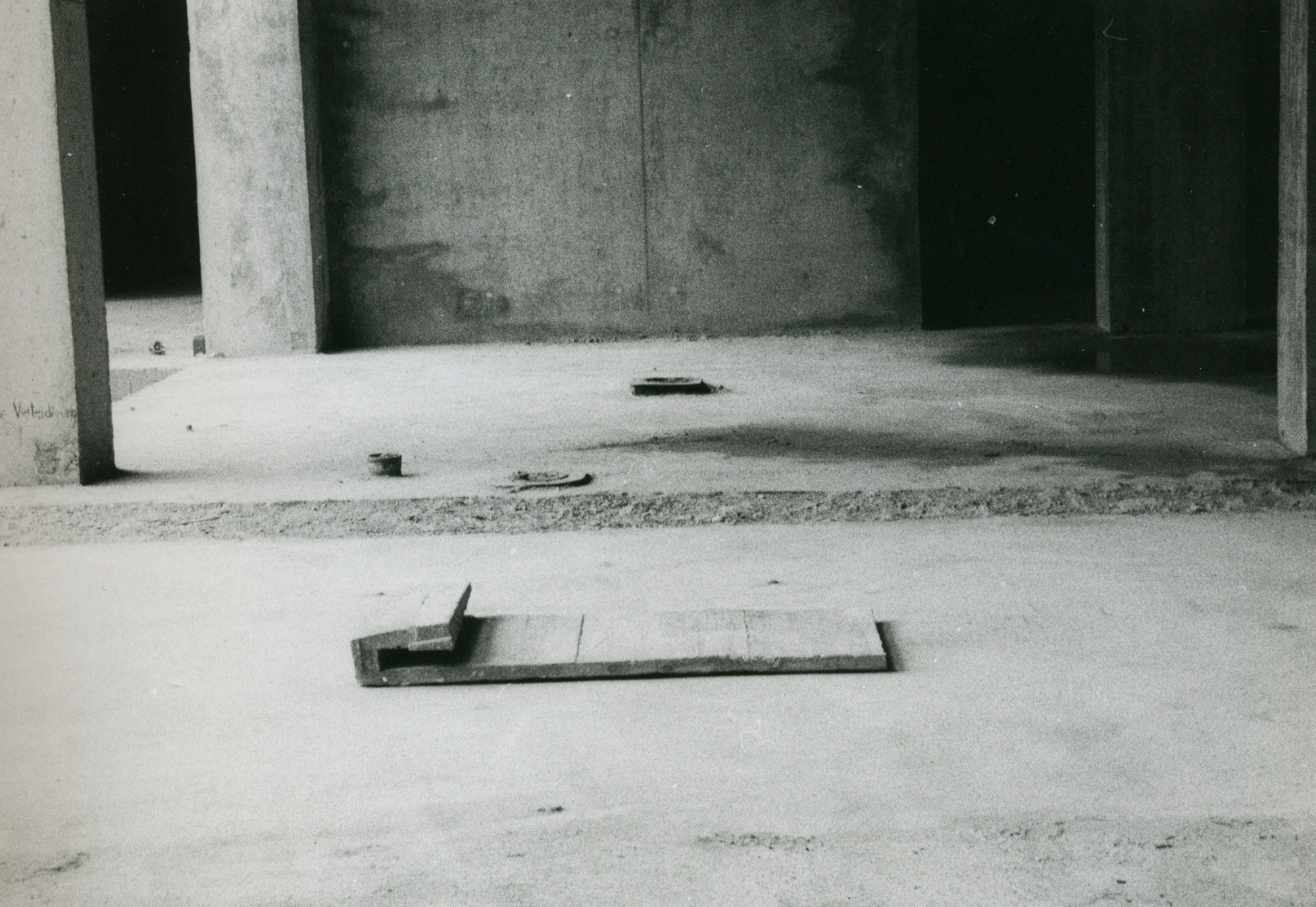
untitled (bed), 1990
concrete, 12 x 140 x 80 cm
while the others are dancing,
martin eugen raabenstein’s
sensor spotlight focuses on:
© sabine hornig
sabine hornig addresses in her work durchreiche from 2025 precisely that opening in the wall that makes this function possible. by placing a fictitious volume into this recess and giving this metal body, as a sculptural finding, the form of mortar in masonry, she engages the theme of volume in exactly the opposite way from a miniaturized and untitled bed form made of concrete 35 years earlier. both sculptural concepts suggest mass without actually meaning it in the literal sense. the categories of mass, void, and volume are engaged, yet negotiated through negation; presence, in hornig’s sense, emerges through withholding or reinterpretation. both works refuse the classically sculptural assertion of the 1980s that celebrates substance as an incontrovertibly monolithic truth. hubert kiecol, isa genzken, or thomas schütte use concrete as a material to investigate the utopian promises of modernist architecture or the weight of sculptural volumes. hornig, by contrast, rarely uses concrete as a solitary, heavy material for its own sake; rather, she is interested in the architectural fragment and structural framing. her work mostly reconstructs the banal everyday urban spatial situation of shopfronts or bus shelters. here concrete stands for the raw, physical reality of the city, which hornig confronts with the fleeting character of reflection and transparency through photography and glass. where elsewhere the uncompromising opacity and density of the material is celebrated, hornig takes concrete as a point of departure and tectonic anchor in order to stage her own idea of permeability. the artists‘ discourse, stretched across decades, is framed here by two reduced works as cornerstones. whether as the steel fixation of a wall opening or the formal reduction of a piece of furniture, she explores the architectural vocabulary in order to question volume as a mental space in a tangible way.
for her, mass corresponds to a relational structure that exists in the consciousness of the viewer, who can fill the emptiness of the serving hatch or the bodily absence in the bed with their own bodily experiences. in his essay das wirken in den dingen, the sinologist jean-françois billeter frees the work of zhuangzi from religious chinoiserie as well as esoteric embellishment and at the same time deploys it as a sharp tool and critique against western epistemology. in it, he accuses the phenomenologists of confusing consciousness with the entire human subject while at the same time excluding the unconscious activities of the body. according to billeter, they analyze human action and experience primarily from the perspective of intentional, reflective consciousness and equate the self with the thinking mind. phenomenology remains stuck in the analysis of phenomena that are already conceptually formed, and the actual mystery of fluid, masterful action, as completely unconscious bodily coordination, cannot be grasped in this way—constructed systems thus replace precise observation. the fine threads between theories of perception, philosophy, and sculptural practice are brilliantly drawn together here. in his text, billeter also refers to ludwig wittgenstein and laozi, connecting them with his thoughts on language and perception.
moreover, he thereby provides the perfect theoretical foundation for hornig’s spatial practice. in the finely woven network of zhuangzi – laozi – wittgenstein constructed by billeter, eastern and western thought condense at the boundary of language. language is analytical, divides the world into subject, object, and predicate, and freezes the flow of things in order to make them nameable. whoever actively speaks is cut off from immediate contact with the environment. true, profound perception, however, requires the silencing of the inner monologue, which billeter describes as emptiness. here he draws the line from the daodejing to wittgenstein’s tractatus logico-philosophicus, which, with the sentence „what can be shown cannot be said,“ conveys that there are things that elude verbalization. if we now apply this philosophical block to sabine hornig’s works bett and durchreiche, an immense urgency articulates itself in their formal and textual silence. hornig explicitly places the linguistic label of the volume readable as a bed in parentheses; according to zhuangzi and laozi, this is a profoundly necessary act. through the parenthesizing of the title and the shift in proportion, she torpedoes linguistic access. with durchreiche and the inserted fictitious metal volume, she operates precisely at the boundary between what can be said and what can only be shown. the presence of a gap, the weight of missing masonry—where language becomes entangled in simple paradoxes, the sculpture simply shows. the metal framework conceived as mortar makes the void and the tectonics of space physically perceptible without having to lose any words, as the material manifestation of that knowledge that our body possesses about architecture, weight, and permeability—a knowledge that exists before language.
iir, june 2026
Sabine Hornig thematisiert in ihrer Arbeit Durchreiche von 2025 eben jene Öffnung in der Wand, die diese Funktion erst ermöglicht. Indem sie ein fiktives Volumen in diese Aussparung setzt und diesem metallenen Korpus als skulpturale Findung die der Form von Mörtel in einem Mauerwerk entspricht, bespielt sie das Thema Volumen auf genau gegensätzliche Art wie 35 Jahre zuvor eine miniaturisierte und unbetitelte Bettform aus Beton. Beide bildhauerischen Konzepte deuten Masse an, ohne aber diese im eigentlichen Sinne zu meinen. Die Kategorien Masse, Hohlraum und Volumen werden bespielt, aber verneinend verhandelt, Präsenz im Hornigschen Sinne entsteht durch Vorenthaltung oder Umdeutung. Beide Arbeiten verweigern sich klassisch skulpturaler Setzung der 1980er Jahre, die Substanz als unumstößlich monolithische Wahrheit feiert. Hubert Kiecol, Isa Genzken oder Thomas Schütte nutzen den Werkstoff Beton, um utopische Versprechungen modernistischer Architektur oder die Schwere skulpturaler Volumina zu untersuchen. Hornig hingegen setzt Beton selten als solitäres, schweres Material um seiner selbst willen ein, vielmehr interessiert sie das architektonische Fragment und strukturelle Rahmung, ihre Arbeit rekonstruiert zumeist die banal alltägliche, urbane Raumsituation von Schaufensterfronten oder Wartehäuschen. Beton steht hier für rohe, physische Stadtrealität, der sie den flüchtigen Charakter von Spiegelung und Transparenz mit Fotografie und Glas begegnet. Wird andernorts die kompromisslose Opazität und Dichte des Materials gefeiert, nimmt Hornig Beton als Ausgangspunkt und tektonischen Anker, um ihre eigene Idee von Durchlässigkeit zu inszenieren. Der Künstlerin über Jahrzehnte gespannter Diskurs wird hier von zwei reduzierten Arbeiten als Eckpunkte gefasst. Ob nun als stählerne Fixierung einer Wandöffnung oder formale Reduktion eines Möbels, erkundet sie das architektonische Vokabular, um Volumen als geistigen Raum spürbar zu hinterfragen.
Die Masse entspricht bei ihr einem relationalen Gefüge, das im Bewusstsein des Betrachters existiert, der die Leere der Durchreiche oder die körperliche Abwesenheit im Bett mit seinen eigenen Körpererfahrungen anfüllen kann. In seinem Essay Das Wirken in den Dingen befreit der Sinologe Jean-François Billeter das Werk des Zhuangzi von religiöser Chinoiserie sowie esoterischem Beiwerk und setzt es zugleich als scharfes Werkzeug und Kritik gegen die westliche Erkenntnistheorie ein. Darin wirft er den Phänomenologen vor, Bewusstsein mit dem gesamten menschlichen Subjekt zu verwechseln, bei gleichzeitiger Ausklammerung der unbewussten Aktivitäten des Körpers. Diese, so Billeter, analysieren menschliches Handeln und Erleben primär aus der Perspektive des intentionalen, reflektierenden Bewusstseins und setzen das Ich mit dem denkenden Geist gleich. Phänomenologie bleibe in der Analyse von Phänomenen stecken, die bereits begrifflich geformt sind, und das eigentliche Geheimnis des flüssigen, meisterhaften Handelns, als vollkommen unbewusste, körperliche Koordination, könne solcherart nicht erfasst werden – konstruierte Systeme ersetzten so exakte Beobachtungen. Die feinen Fäden zwischen Wahrnehmungstheorie, Philosophie und skulpturaler Praxis werden hier brillant zusammengezogen. Billeter verweist in seinem Text zugleich auf Ludwig Wittgenstein und Laozi, verbindet diese mit seinen Gedanken über Sprache und Wahrnehmung.
Zudem liefert er so den perfekten theoretischen Unterbau zu Hornigs räumlichem Schaffen. In dem von Billeter fein aufgezogenen Netz Zhuangzi – Laozi – Wittgenstein verdichtet sich östliches und westliches Denken an der Grenze der Sprache. Diese ist analytisch, teilt die Welt in Subjekt, Objekt und Prädikat und friert den Fluss der Dinge ein, um sie benennbar zu machen. Wer aktiv spricht, ist vom unmittelbaren Kontakt mit der Umwelt abgeschnitten. Wahre, tiefe Wahrnehmung allerdings erfordert das Verstummen des inneren Monologs, das Billeter als Leere beschreibt. Hier zieht er die Linie vom Daodejing zu Wittgensteins Tractatus logico-philosophicus, der mit dem Satz „Was gezeigt werden kann, kann nicht gesagt werden” vermittelt, dass es Dinge gebe, die sich der Versprachlichung entziehen. Wenden wir diesen philosophischen Block nun auf Sabine Hornigs Arbeiten Bett und Durchreiche an, formuliert sich in deren formaler und textueller Stummheit eine immense Dringlichkeit. Hornig setzt das sprachliche Etikett bei dem als Bett zu lesenden Volumen explizit in Klammern, nach Zhuangzi und Laozi ein zutiefst notwendiger Akt, durch Titeleinklammerung und Proportionsverschiebung torpediert sie sprachlichen Zugriff. Mit der Durchreiche und dem eingefügten fiktiven Metall-Volumen operiert sie genau auf der Grenze dessen, was sagbar, und dem, was nur zeigbar ist. Die Präsenz einer Lücke, das Gewicht fehlenden Mauerwerks – wo sich Sprache in schlichten Paradoxien verfängt, zeigt die Skulptur einfach. Das als Mörtel angedachte metallene Gerüst macht den Hohlraum und die Tektonik des Raumes körperlich erfahrbar, ohne Worte verlieren zu müssen, als materielle Manifestation jenes Wissens, das unser Körper über Architektur, Schwere und Durchlässigkeit besitzt – ein Wissen, das vor der Sprache existiert.
iir, june 2026
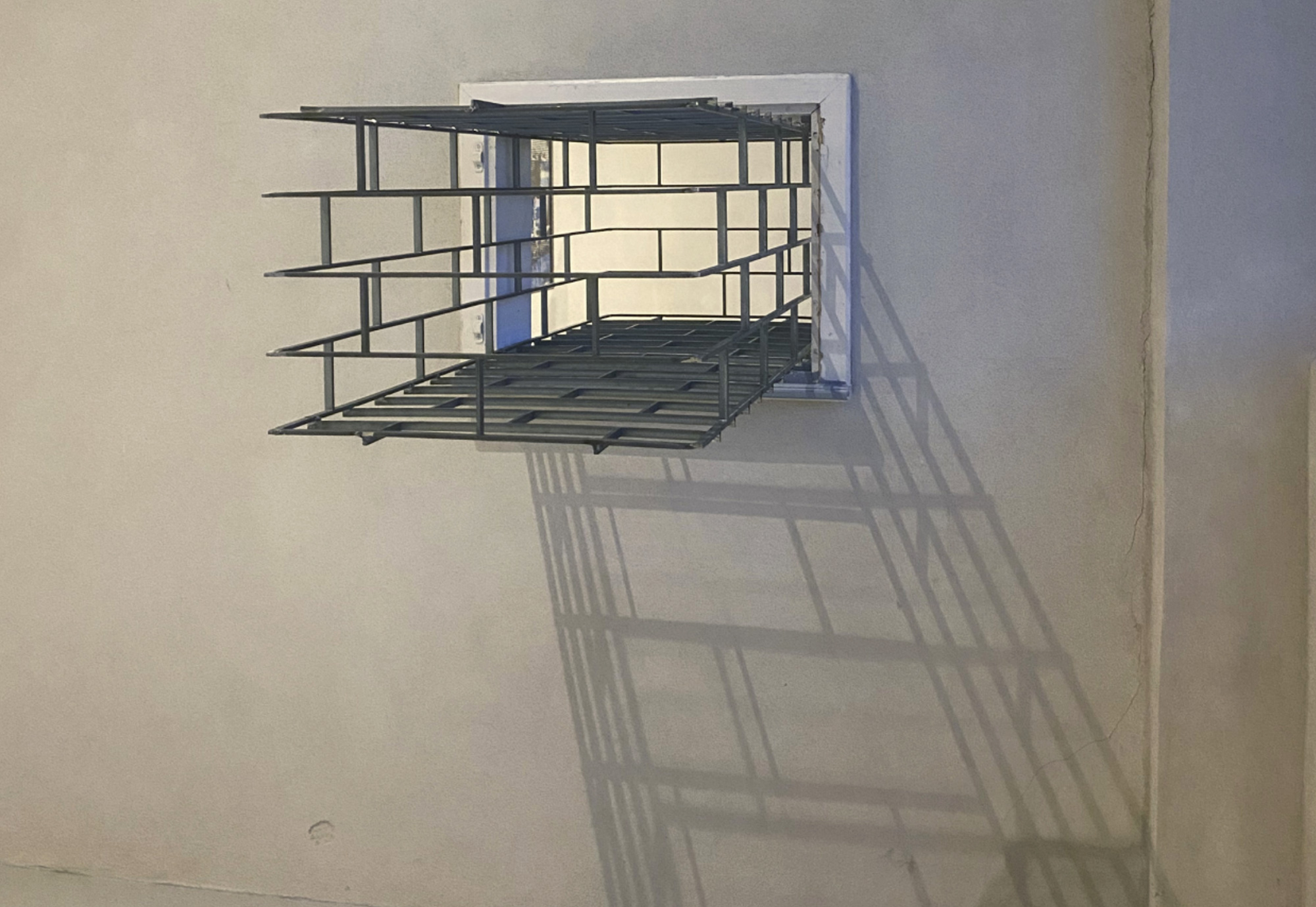
© sabine hornig, durchreiche, metal, 45 x 38 x 130 cm, edition – unique, 2025