

simone zaugg
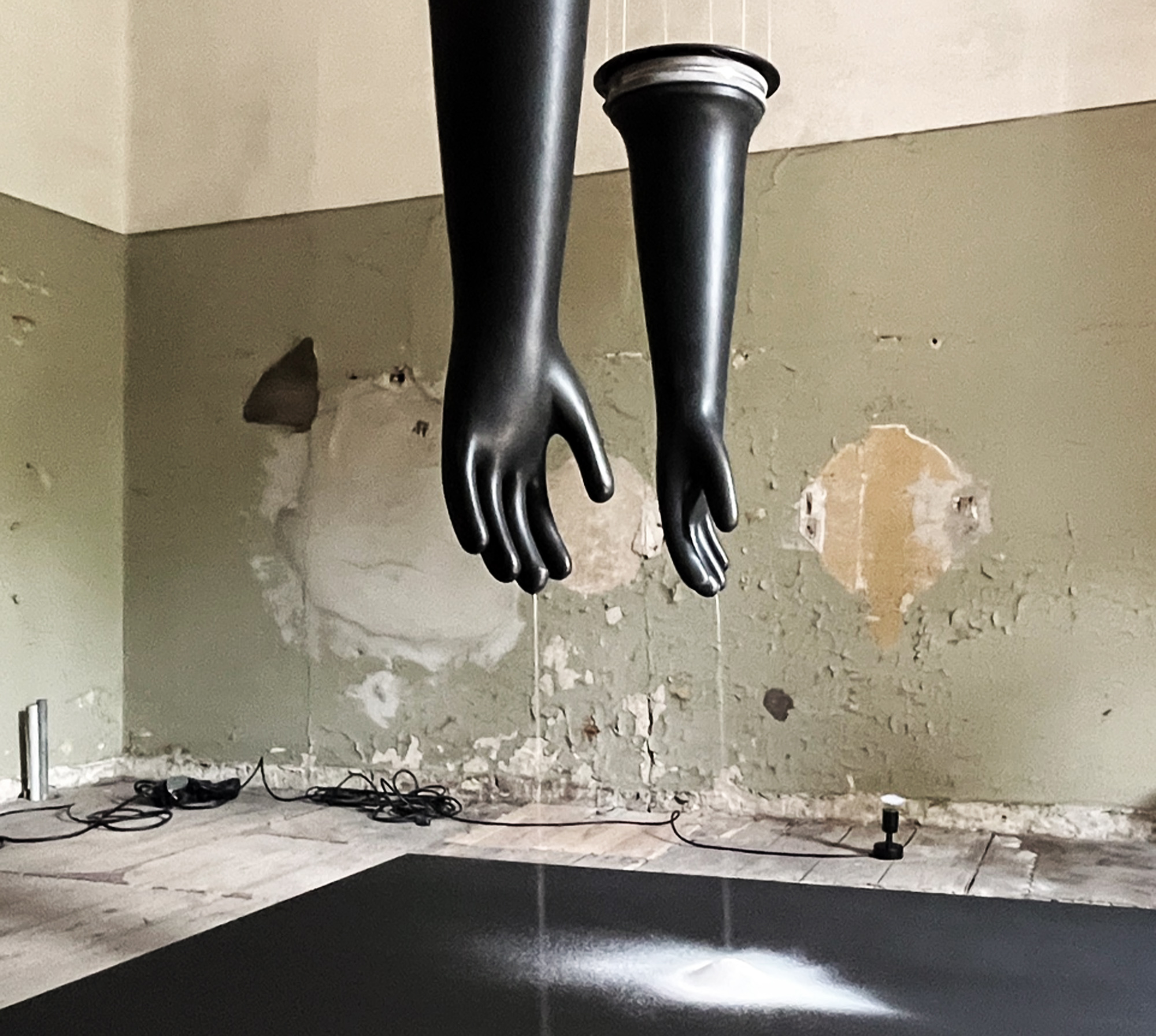
fingerspitzengefühl, 2023
installation, rubber gloves, sand, platform, light, buckets, hand brush, shovel & sieve
while the others are dancing,
martin eugen raabenstein’s
sensor spotlight focuses on:
© simone zaugg
people who tend to comment on certain situations with sayings such as “time slips through my fingers like sand” or “when you point a finger at others, three point back at you,” dispensing obvious truths along the way, are rarely welcome guests. then again, they are not exactly uninvited because of their nuggets of wisdom either. one is supposed to overlook the mistakes of others with composure – yet another maxim for the thoughtful daily calendar – but with some people it is unbearably difficult to follow such a commendable instruction, especially when it comes to know-it-alls. when it is already clear beforehand what is about to follow, this is not only tiresome in interpersonal relations; in the art world as well, evidences sometimes produce breathtaking moments of embarrassment and discomfort. marcel prefers the everyday, yves rather the naked, nikki too. then we spin the whole thing through a few decades of the lottery of subsequent generations, or photograph a female genital, model it in clay, crochet it at will, and hang it on the wall to general amazement. art has a tendency to age badly at times, and film is no exception. it is regrettable to watch examples such as la grande bouffe or le mépris decline over the decades from fascinating shockers to acceptable evening entertainment and eventually into the ultimate yawn-inducing experience. time is a bitch. evidently, one can get quite a lot wrong here, and so it is more than gratifying to encounter in simone zaugg’s installation fingerspitzengefühl precisely that highly intelligent process of thinking and making that is aware of all the pitfalls mentioned above and navigates around them with elegance.
the passing of time is materialized through the finger of sand inside the glove itself. “time over” here means that all material is exhausted and transformed. although every element of the work ultimately corresponds to the obviousness discussed above – the title, the procedure, everything appears so unspeakably predictable and straightforward – the process unfolding before our eyes is so fascinating that it must arise from a different level than the ingredients employed seem, at first glance, to reveal. this “something more” is not located within the materials themselves, but in the difference between the modes of speech act and process. the expression “time slips through your fingers like sand” is, as an utterance, free of charge and endlessly repeatable; nothing is consumed in its saying. it is precisely this lack of consequence that turns it into a platitude, a know-it-all phrase that can be repeated with impunity as often as one likes. the installation translates this sentence, to speak in the words of charles sanders peirce, from the symbolic into the indexical: sand running through the finger of a glove no longer represents passing time, but corresponds to its actual trace, just as a sundial does not speak about time but indicates it by making use of it. unlike the speech act, this process is finite, irreversible, and indeed costs something. “time over” in this sense means: finished, no longer repeatable in this particular constellation. thus, this “something more” corresponds to a procedure of estrangement in the sense of viktor shklovsky’s defamiliarization, which describes the central aim of art: to disrupt our everyday and largely dulled perception of the world around us. this does not mean inventing a new image, but resensitizing an existing one by taking it literally.
this effect functions only because of the extreme wear and tear of the cliché; no one reflects any longer on its literal meaning. zaugg’s artistic realization performs precisely this trick and provokes a “well, yes, exactly …” effect. a second reading, however, focuses very much on the material employed and leads us directly to the inventory of tools: gloves, bucket, brush, shovel, and sieve. these are instruments of cleaning and maintenance, highly unusual for artistic production. this places the work close to the maintenance-oriented conceptual artist mierle laderman ukeles and her concept of “maintenance art.” another interpretative layer is offered by jean tinguely and his occasionally self-destructive machines: a closed system whose sole purpose is its own consumption. the “something more” does not necessarily have to be hidden within the objects themselves, but may instead reside in the temporal structure they generate – in duration itself. the philosopher of life henri bergson might remark that the expression spatializes time and conceives of sand as a countable substance, whereas the installation plays with a process of durée and with the moment between “the sand is still running” and “the sand is no longer running.” the metaphor names an experience; zaugg’s installation, by contrast, stages an event. and it is precisely here, in this subtle difference between assertion and enactment, that a “something more” peeks out, exceeding the seemingly banal components from which the work is assembled. purely speculatively, however, plain dada may also have a finger in the pie: that tingling sensation in the fingertips, you know about that one … the artist is swiss – and in this case, many things remain possible.
iir, june 2026
Menschen, die dazu neigen, gewisse Situationen mit Sprüchen wie „Die Zeit rinnt mir durch die Finger wie Sand“ oder „Wenn du mit dem Finger auf andere zeigst, weisen drei auf dich“ zu kommentieren und dabei Offensichtlichkeiten zu verteilen, sind selten gern gesehene Gäste, ausgeladen werden sie aufgrund ihrer Lebensweisheiten allerdings auch wieder nicht. Man soll über die Fehler anderer gelassen hinwegsehen – eine weitere Sentenz für den klugen Tageskalender, doch bei manchen fällt es unsäglich schwer, dieser löblichen Weisung Folge zu leisten, vor allem bei Klugscheißern. Wenn im Vorfeld schon klar ist, was folgen mag, ist dies nicht nur im zwischenmenschlichen Bereich beschwerlich; auch in der Kunstwelt bilden Evidenzen mitunter atemberaubende Momente der Scham und Pein. Marcel bevorzugt Alltägliches, Yves eher Nacktes, die Nikki auch. Dann drehen wir das Ganze ein paar Jahrzehnte durch die Glückslotterie nachfolgender Generationen oder fotografieren ein weibliches Genital, formen es in Ton nach, häkeln es ganz nach Belieben und hängen es unter Staunen an die Wand. Kunst hat die Neigung, mitunter schlecht zu altern, so auch der Film. Es ist bedauerlich, Beispiele wie Das große Fressen oder Die Verachtung über Jahrzehnte vom faszinierenden Schocker zur akzeptablen Abendunterhaltung bis hin zum ultimativen Gähnreiz niedergehen zu sehen. Time is a bitch, offensichtlich kann man da einiges recht falsch machen, und so ist es mehr als erfreulich, mit Simone Zauggs Installation Fingerspitzengefühl eben jenem höchst intelligenten Denk- und Gestaltungsprozess beiwohnen zu dürfen, der um all jene genannten Untiefen weiß und sie elegant umschifft.
Die verrinnende Zeit ist durch den Finger aus Sand im Inneren des Handschuhs selbst materialisiert. „Time over“ bedeutet hier: Alles Material ist aufgebraucht und transformiert. Obschon letztendlich alle Elemente der Arbeit der oben angesprochenen Offensichtlichkeit entsprechen – der Titel, der Vorgang, alles kommt so unsagbar vorhersehbar und einfach daher –, ist der zu beobachtende Prozess so faszinierend, dass er einer anderen Ebene entspringen muss, als dies die verwendeten Ingredienzen vordergründig offenbaren. Dieses „Mehr“ ist nicht in den Materialien selbst zu finden, sondern in der Differenz zwischen den Modi Sprechakt und Vorgang. Die Redewendung „Die Zeit rinnt durch die Finger wie Sand“ ist als Äußerung kostenlos und beliebig wiederholbar; nichts wird hier verbraucht. Eben jene Folgenlosigkeit lässt sie zur Plattitüde werden, zur Klugscheißerphrase, die man ungestraft und beliebig oft von sich geben kann. Die Installation übersetzt diesen Satz, mit den Worten Charles Sanders Peirces gesprochen, aus dem Symbolischen ins Indexikalische: Sand, der durch einen Handschuhfinger läuft, repräsentiert verstreichende Zeit nicht mehr, sondern entspricht ihrer tatsächlichen Spur, ganz wie eine Sonnenuhr nicht über Zeit spricht, sondern sie anzeigt, indem sie sie nutzt. Dieser Vorgang ist, anders als die Sprechhandlung, endlich, irreversibel und kostet sehr wohl etwas. „Time over“ meint in diesem Sinne: vorbei, in dieser Konstellation nicht wiederholbar. Somit entspricht dieses „Mehr“ einem Verfahren der Entfremdung im Sinne Viktor Schklowskijs, der Ostranenie, die das zentrale Ziel der Kunst beschreibt, die alltägliche und zumeist abgestumpfte Wahrnehmung unserer Umwelt aufzubrechen. Dies meint nicht die Erfindung eines neuen Bildes, sondern dessen Resensibilisierung, indem man es buchstäblich ernst nimmt.
Dieser Effekt funktioniert nur aufgrund der massiven Abnutzung der Floskel; niemand reflektiert mehr deren wörtlichen Sinn. Zauggs künstlerische Umsetzung vollzieht den Trick und provoziert einen „Hum ja, genau …“-Effekt. Eine zweite Lesart wiederum fokussiert sehr wohl das verwendete Material und führt uns direkt zum Werkzeuginventar: Handschuhe, Eimer, Bürste, Schaufel und Sieb. Das sind Reinigungs- und Wartungsgeräte, sehr untypisch für die Kunstproduktion. Das rückt die Arbeit in die Nähe der an Wartungsthemen orientierten Konzeptkünstlerin Mierle Laderman Ukeles und ihrer „Maintenance Art“. Eine weitere Interpretationsebene bietet Jean Tinguely und dessen mitunter selbstzerstörerische Maschinen: ein geschlossenes System, dessen einziger Nutzen sein eigener Verbrauch ist. Das „Mehr“ muss nicht notwendigerweise in den Dingen verborgen sein, sondern möglicherweise in der Zeitstruktur, die sie erzeugen – in der Dauer selbst. Der Lebensphilosoph Henri Bergson würde hierzu anmerken: Die Redewendung spatialisiert Zeit und meint Sand als zählbare Substanz; die Installation hingegen spielt mit einem Ablauf der durée und dem Moment zwischen „Der Sand rinnt noch“ und „Der Sand rinnt nicht mehr“. Die Metapher benennt eine Erfahrung, Zauggs Installation hingegen ein Geschehnis. Und genau hier, in diesem feinen Unterschied zwischen Behauptung und Vollzug, äugt ein „Mehr“ hervor, das die einzelnen, für sich genommen banal erscheinenden Versatzstücke übersteigt. Rein spekulativ allerdings – kann ebenfalls reiner Dada die Finger mit im Spiel haben, dieses prickelnde Gefühl in den Spitzen, Sie wissen schon … Die Künstlerin ist Schweizerin – da ist vieles möglich.
iir, june 2026